
Ultimate Guide to High-Demand Skills in South Africa
 12 min read

If I were hiring in South Africa today, I’d start with tech, customer support, and back-office roles. The reason is simple: these jobs are in short supply locally, fit remote work well, and often lower hiring costs compared to U.S. hires.
Here’s the short version:
- Best first roles to hire: software, cloud, cybersecurity, data, customer success, executive assistance, marketing, UX/UI, and finance
- Best fit for remote teams: jobs with clear tasks and measurable output
- What the data shows: 92% of South African employers reported trouble hiring critical skills in 2025, up from 79% in 2024
- Tech stands out most: South Africa has about 118,000 unfilled digital jobs, with a 37% vacancy rate
- Cybersecurity is even tighter: about 63% of roles are unfilled
- Cost range when offshoring to popular countries: many support roles land around $1,200 to $3,500 per month, while some digital and design roles land higher
If you want the clearest starting point, I’d rank the hiring groups like this:
- Software and cloud
- Cybersecurity
- Data and analytics
- Customer success and business support
- Digital marketing and UI/UX
- Finance
- Engineering
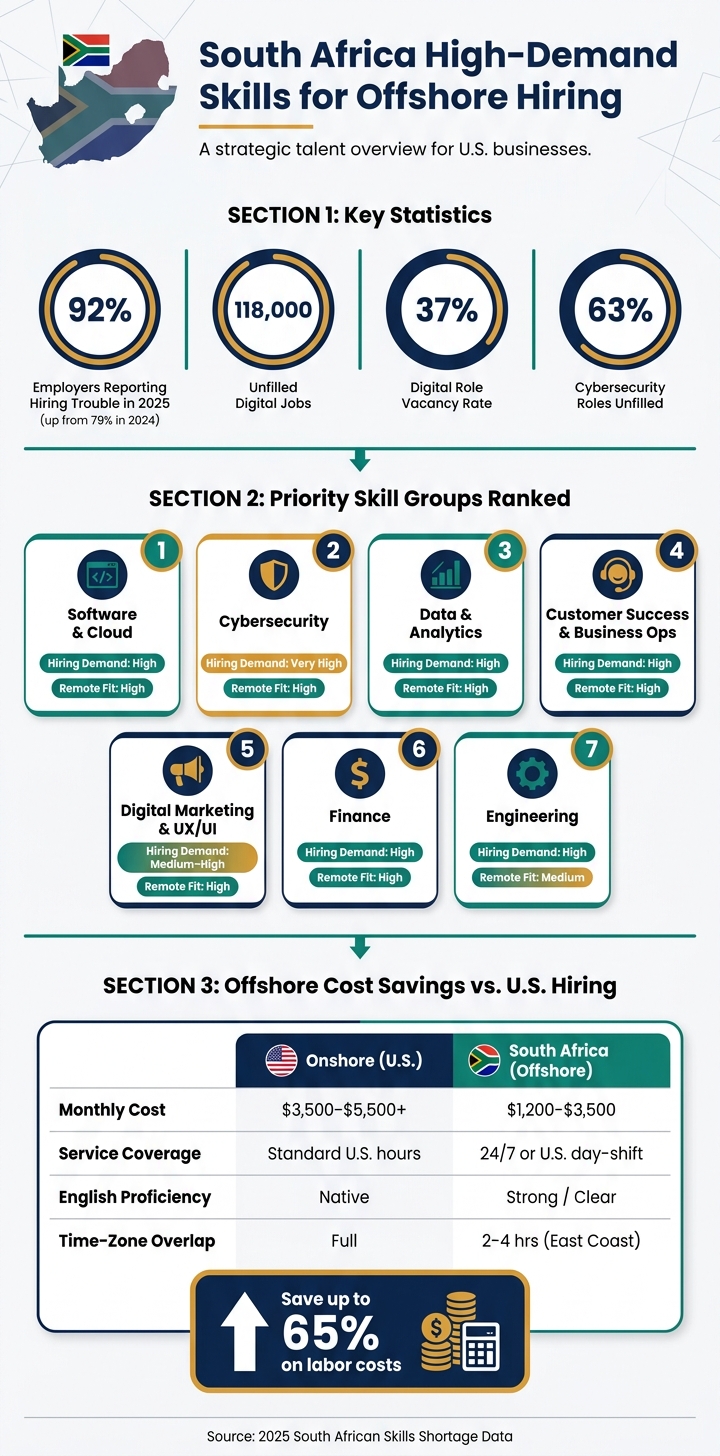
South Africa High-Demand Skills for Offshore Hiring: At a Glance
The Top 10 In-Demand Roles: Inside South Africa’s Critical Skills Shortage
sbb-itb-7512dae
Quick Comparison
| Skill Group | Hiring Demand | Remote Fit | Common Use |
|---|---|---|---|
| Software & IT | High | High | Product, apps, cloud, security |
| Data & Analytics | High | High | Reporting, pipelines, BI |
| Customer Support & Success | High | High | Support, retention, account help |
| Business Support | High | High | Admin, scheduling, coordination |
| Marketing & UI/UX | Medium to High | High | SEO, design, campaigns |
| Finance | High | High | Bookkeeping, reporting, tax support |
| Engineering | High | Medium | Design, drafting, planning |
Bottom line: if you need to scale with South African talent that are easier to plug into a remote U.S. team, I’d focus first on roles that can be done fully online, tracked with simple KPIs, and handed off through clear systems. For more details, see our guide on hiring remote staff in South Africa.
How South Africa’s Skills Shortages Shape Offshore Hiring
South Africa’s skills shortage doesn’t look the same across every field. In some jobs, lots of people apply, but only a small share meet the bar. In others, there just aren’t enough local people available in the first place. For offshore staffing, the strongest openings tend to sit in High Demand/Low Competition roles, where employer need is higher than the local supply of qualified talent. And for U.S. companies, one filter matters more than anything else: can the work be done well in a remote setup?
In 2025, 92% of South African organizations said they had trouble hiring critically skilled employees, up from 79% in 2024. Across 9 of the top 10 critical skill areas, shortages climbed by 2 to 15 percentage points in just one year.
What South Africa’s Critical Skills List Shows Employers
South Africa’s National Critical Skills List (CSL) is a government-run list of occupations where local supply falls short of employer demand. It points to fields like ICT, engineering, and finance, where hiring from abroad is actively encouraged.
That said, not every CSL role makes sense for remote work. A site engineer or registered nurse needs to be there in person. But the list also includes roles like actuaries, multimedia designers, software developers, and BPO customer service managers. Those jobs often fit remote teams well. For U.S. employers, the smart move is to focus on CSL roles that line up with remote delivery from day one.
Demand, Remote Fit, and Hiring Use Cases by Skill Category
The table below shows where South African talent tends to line up best with U.S. remote team needs.
| Skill Category | Example Roles | Demand Indicator | Remote Suitability | Common U.S. Use Case |
|---|---|---|---|---|
| ICT & Software | Software Developer, Cloud Engineer, Data Scientist | High Demand / Low Competition | High | Product development, SaaS scaling, data analytics |
| Finance & Risk | Actuary, External Auditor, Tax Professional | High Demand / Medium Competition | High | Compliance, risk modeling, back-office accounting |
| Business Ops | BPO Customer Service Manager, Executive Assistant | High Demand / High Competition | High | Customer success, 24/7 support, operations coordination |
| Marketing & Creative | Multimedia Designer, Digital Marketer | Low Availability / High Competition | High | Creative content, digital campaigns, UI/UX design |
| Engineering | Civil, Electrical, Industrial Engineer | High Demand / Low Competition | Medium | CAD modeling, infrastructure design, project planning |
| Healthcare | Specialist Nurse, Pharmacist | High Demand / Low Competition | Low–Medium | Telehealth support, medical coding, clinical data management |
Among these groups, ICT and software are still moving the fastest in offshore hiring. ICT shortages hit 22% in 2025, up from 14% in 2024 and 10% in 2023, which means South African tech talent is getting harder to secure as demand keeps climbing.
High-Demand Skill Groups for U.S. Offshore Teams
The best offshore roles for U.S. teams usually have two things in common: strong hiring demand at home and work that can be delivered cleanly from anywhere.
Software, Data, and IT Operations
Tech roles sit at the top of the list for a simple reason: they’re hard to fill locally and well suited to remote work. South African tech professionals support full-stack development in JavaScript, Python, and React, along with cloud infrastructure management on AWS and Azure and cybersecurity threat detection. Data engineering is also in demand, pushed by digital transformation, cloud migration, and cybersecurity demand. For many U.S. companies, software and IT roles are the clearest place to start when building an offshore team.
The numbers make that pretty plain. South Africa has an estimated 118,000 unfilled digital roles, which equals a 37% vacancy rate. Cybersecurity is even tighter, with 63% of roles currently unfilled. That gap helps explain why many experienced South African tech professionals are now working remotely for international employers.
When you screen candidates, focus more on proof of work than polished resumes. Portfolios, GitHub repositories, and certifications from AWS, Azure, or Google Cloud often tell you more than a CV does. For technical hiring, a live app or a case study usually says more than a degree on its own.
If your first offshore hire isn’t in tech, there are key functions to outsource like customer-facing operations that are often the next best fit.
Customer Support, Customer Success, and Business Operations
Customer-facing roles tend to scale well offshore because the work runs on process, systems, and response quality more than physical location. South African professionals in this group support customer support, customer success management, and executive assistance. Many also bring hands-on experience with tools like Salesforce and Zendesk, plus SaaS customer lifecycle management.
The cost gap versus U.S.-based hiring can be hard to ignore. Here’s the side-by-side view:
| Feature | Onshore (U.S.) | South Africa (Offshore) |
|---|---|---|
| Cost (USD/mo) | $3,500–$5,500+ | $1,200–$3,500 |
| Service Coverage | Standard U.S. hours | 24/7 or U.S. day-shift coverage |
| Communication Quality | Native English | Strong English and clear communication |
| Time-Zone Overlap | Full | 2–4 hours (East Coast) |
For East Coast teams in the U.S., that overlap usually lands in the South African afternoon. In practice, that’s enough time for daily standups, escalations, and handoffs. Some companies stretch coverage into early morning or evening U.S. hours by setting South African shifts to match.
After support and operations, the next set of roles that travel well are marketing, design, and back-office finance.
Marketing, Creative, and Finance Roles
These roles tend to work offshore when the output is digital and easy to track. That includes digital marketing and SEO specialists, graphic designers, UI/UX designers, bookkeepers, and financial analysts. The work moves well across borders because it can be handled through set workflows, whether that’s an SEO optimization project, a Figma design file, or a QuickBooks or Xero reconciliation.
This group fits offshore teams because the deliverables are clear and the process can be repeated without much friction. Digital marketing and SEO roles usually run $2,200–$6,000 per month for remote international hires, while UI/UX designers often fall between $2,500–$6,500 per month. Back-office finance work like bookkeeping follows the same remote-friendly model. These roles tend to perform best when output is standardized and easy to measure.
How to Find, Vet, and Hire South African Talent
Once you know which skill groups work well offshore vs onshore, the next step is simple: figure out role fit, availability, and whether someone can do the job well in a remote setup.
Match Your Role to the Right Talent Pool
Before you post a job or contact candidates, get clear on what the role actually needs. Define the responsibilities, KPIs, working hours, and reporting line. Then split skills into two buckets: skills the person must already have, and skills they can learn on the job.
For example, a data analyst might need strong Python skills from day one, while your internal reporting templates can be taught. That one distinction helps narrow the pool to candidates who can start contributing right away.
For senior roles, check local professional credentials. For senior finance roles, verify CA status. For engineering roles, verify Pr Eng registration. These credentials show that the candidate has met a set professional standard.
Once the role is clear, hiring speed usually comes down to cost and availability.
Assess Cost, Availability, and Remote Readiness
Availability changes by skill group, and salary pressure changes with it. High-demand specializations like senior software engineers and cybersecurity professionals are harder to hire, so strong offers matter more than they may for other roles. Standard notice periods in South Africa can run two to three months, so build that into your onboarding timeline.
It also helps to benchmark offers against current USD market rates instead of older salary assumptions. And when you find a strong fit, move fast.
During interviews, confirm the basics for remote work:
- Backup power
- Reliable internet connectivity
- A dedicated workspace
Those checks may sound simple, but they can save you from major headaches later.
Use Structured Vetting for High-Demand Roles
Once cost and availability make sense, test for actual job performance instead of leaning too hard on resumes.
Use skills tests, job simulations, and portfolios to cut bad hires and open the door to more qualified candidates. That might mean live code tests for software roles, real datasets for analytics, portfolios for marketing and creative work, communication interviews for support roles, and inbox or calendar simulations for operations.
Use STAR questions to test problem-solving. For senior hires, save reference checks for the final stage.
Talently can handle sourcing, vetting, interviews, and fixed-rate payroll for teams that want a simpler process.
Conclusion: Which High-Demand South African Skills to Hire for First
For U.S. teams, the best first hires are the roles that check three boxes: high demand, easy remote execution, and clear output you can track. Based on demand, remote fit, and time to hire, the South African skill groups to put at the top of the list are software, cloud, cybersecurity, and data roles.
After tech, the most practical offshore hires are customer success, executive assistance, and business operations. Then come digital marketing, UX/UI design, and finance roles. These jobs also fit remote work well and tend to produce output that’s easy to measure.
Here’s the priority order:
- Software and cloud
- Cybersecurity
- Data and analytics
- Customer success and business ops
- Digital marketing and UX/UI
- Finance
- Engineering
The same rule applies across every category: hire for roles with clear remote workflows and measurable output.
For teams that want to move faster, Talently handles sourcing, vetting, interviews, and payroll for South African hires.
FAQs
Which South African roles are easiest to hire remotely first?
The easiest remote roles to hire first in South Africa tend to be the ones built around communication, organization, and digital operations. In many cases, these professionals are strong English speakers with solid problem-solving skills, which makes them a good fit for international teams.
Common starting roles include customer success and support, executive assistance, marketing and content management, sales development, and digital creative work like graphic design and video editing.
How do I vet South African candidates for remote work?
Start by defining the role, KPIs, and reporting line before you hire. That gives you a clear target and helps you avoid bringing in someone who looks good on paper but doesn’t match the job.
During interviews, look beyond technical skill. You also want to assess communication, problem-solving, and professionalism. A candidate might be strong technically, but if they can’t explain their thinking or work well with your team, problems tend to show up later.
To check practical ability, use hands-on methods like:
- Live collaboration exercises
- Technical assessments
- Portfolios
- Micro-projects
These give you a much better sense of how someone works day to day. It also helps to prioritize team fit, so the candidate’s work style and communication match the way your team operates.
Talently can help by taking care of sourcing, vetting, and interviews.
What should I budget for hiring in South Africa?
Use South Africa’s 2026 market salary bands as your starting point, then adjust for experience and location. For mid-level roles in high-demand fields, a common range is about ZAR 25,000–65,000 per month. The minimum wage is ZAR 27.58 per hour.
When you build a budget, focus on monthly CTC instead of base salary alone. That matters a lot in heavy industry, where CTC can land 15–35% above base once allowances and benefits are added in.
It also helps to tweak salary bands for the sector you’re hiring in. A simple rule of thumb is ±10–15%, depending on demand, working conditions, and the pay norms in that part of the market.
Related Blog Posts
Ready to build your dream team?
Book a free consultation and get your first candidate shortlist within 48 hours.
No upfront fee • Only pay if you hire