
Offshore vs Onshore Staffing: Which Wins?
 19 min read
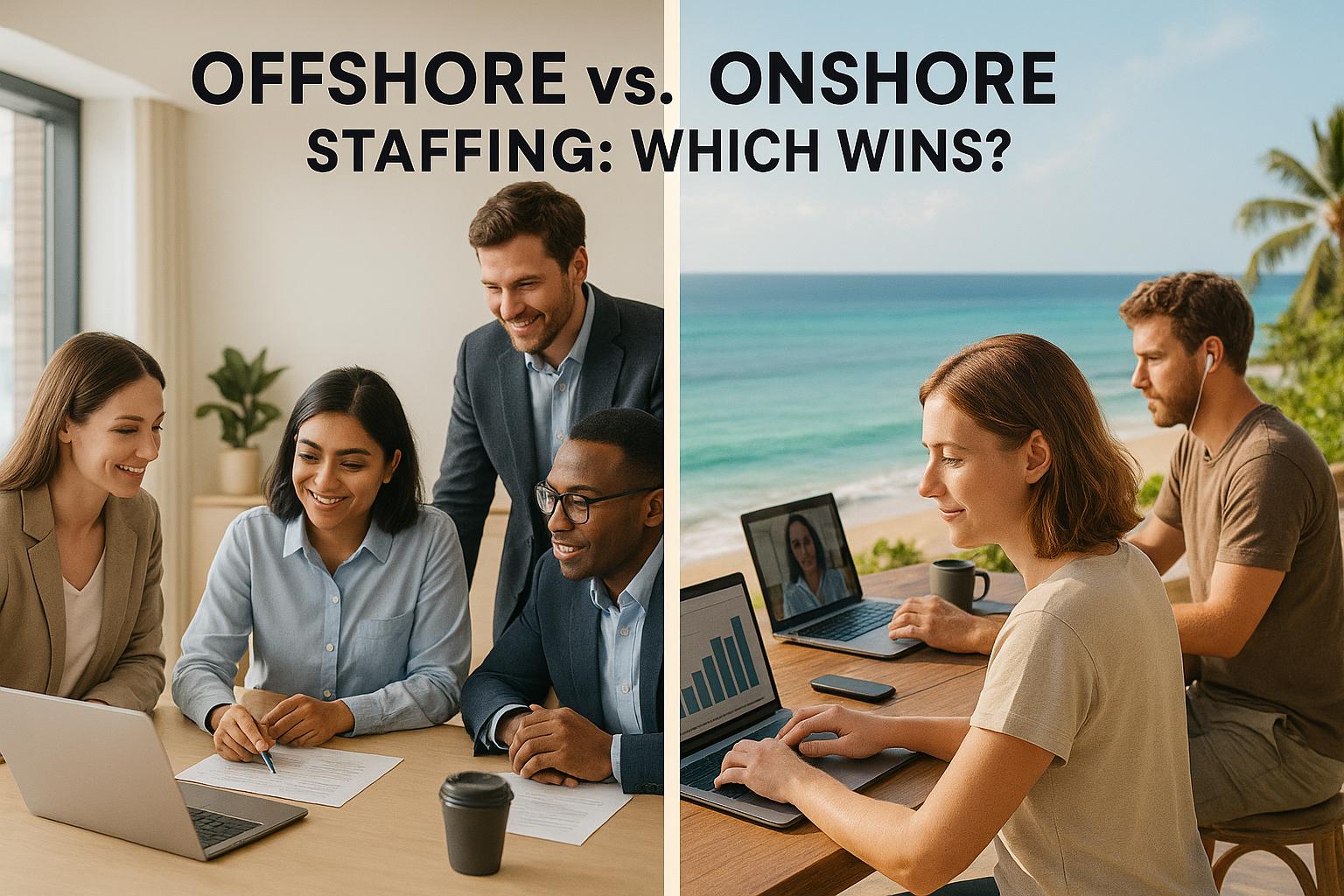
When deciding between offshore and onshore staffing, the choice comes down to cost, talent availability, and collaboration needs. Offshore staffing offers lower costs and access to global talent, while onshore staffing provides easier communication, local expertise, and compliance with U.S. laws. Many companies combine both approaches to balance savings and operational efficiency.
Key Points:
- Onshore Staffing: Best for real-time collaboration, roles needing U.S. market knowledge, and industries with strict regulations. However, it’s expensive and faces a limited talent pool.
- Offshore Staffing: Ideal for cost savings, specialized skills, and scalability. Challenges include time zone differences, compliance complexities, and potential public perception issues.
- South Africa as an Offshore Hub: Offers skilled, English-speaking professionals with overlapping U.S. time zones and lower costs.
Quick Comparison:
| Factor | Offshore Staffing | Onshore Staffing |
|---|---|---|
| Cost | Lower salaries, 40–70% less | Higher salaries and overhead |
| Talent Pool | Global, specialized skills | Limited, competitive |
| Collaboration | Time zone hurdles | Real-time communication |
| Compliance | Complex international laws | Familiar U.S. regulations |
| Scalability | Easier, larger talent pool | Slower, smaller pool |
For companies seeking a middle ground, a hybrid model combines the strengths of both, ensuring efficiency and cost control.
Understanding Onshore vs Offshore Outsourcing in 2025
What Is Onshore Staffing
Onshore staffing involves hiring talent or service providers based within the United States. Interestingly, over 40% of new outsourcing contracts in North America are now awarded to onshore providers, signaling a growing preference for domestic partnerships. This approach comes with its own set of benefits and challenges, which we’ll explore below.
Benefits of Onshore Staffing
Same Time Zones Mean Real-Time Collaboration
Operating within U.S. time zones eliminates scheduling headaches. Teams can hold impromptu meetings, address urgent issues promptly, and maintain smooth communication throughout the workday. This alignment speeds up decision-making and keeps projects moving efficiently.
Cultural Alignment Eases Collaboration
Shared cultural norms and business practices reduce friction. U.S.-based professionals are well-versed in local market expectations, consumer behavior, and workplace etiquette. This is especially valuable for customer-facing roles, where native fluency and cultural understanding can directly impact customer satisfaction.
Simplified Legal Compliance
Onshore teams operate under the same legal and regulatory framework, ensuring compliance with U.S. labor laws, data protection rules, and industry standards. This simplifies the legal process and minimizes risks, particularly in highly regulated industries like healthcare and finance.
"Onshore outsourcing can only excel in areas where communication, compliance, and quality oversight are critical." – Innovation M Services
Greater Oversight and Control
Close proximity allows for more direct supervision. Companies can conduct in-person meetings, provide hands-on training, and maintain tighter oversight of external teams. This is especially crucial for complex projects that require frequent collaboration and adjustments.
Quicker Onboarding and Integration
Onshore hiring often comes with faster onboarding. With clear legal agreements, straightforward tax structures, and simplified training logistics, new team members can hit the ground running, reducing the time it takes for them to become fully productive.
Boosts Local Economy and Corporate Image
Keeping operations domestic supports local job creation and strengthens communities. It also enhances a company’s reputation, aligning with corporate social responsibility efforts and appealing to customers who value brands that invest in the U.S.
While onshore staffing has clear advantages, it’s not without its challenges.
Drawbacks of Onshore Staffing
Higher Costs
"Onshore hiring is by far the most expensive option." – Jobsity
U.S. labor costs are steep, with tech salaries averaging $152,000 per year. This is often two to three times higher than offshore rates. Beyond salaries, companies face additional expenses like training, facility upgrades, management overhead, and comprehensive benefits. Costs can also vary widely depending on the region, with major cities typically demanding higher wages.
Smaller Talent Pool Increases Competition
The limited domestic talent pool can drive up salaries and intensify competition. For example, U.S. accounting employment has decreased by 17%, making it harder for companies to find qualified accountants and auditors.
"ManekTech points out that onshore staffing can lead to an ‘overfished pool of talent,’ making it hard to find specialized skills locally." – SourceBae
Retention Issues in Competitive Markets
"The U.S. has the most competitive tech market in the world, leading to low retention rates and the increasing demand for higher salaries and benefits, where you’re constantly expected to pay even more." – Jobsity
High-demand professionals often juggle multiple offers, pushing companies to increase salaries and offer enhanced benefits to retain their talent. This can create ongoing financial strain, as employers must continually invest in retention strategies.
Challenges with Scalability
Relying solely on domestic talent can make rapid scaling difficult. Tight labor markets and a limited pool of qualified candidates can slow down hiring, potentially delaying growth plans and critical projects.
Dependency Risks
Overreliance on a small network of domestic vendors can leave companies vulnerable. If a key onshore provider faces operational disruptions, finding a replacement within the same geographic and regulatory framework can be both challenging and costly.
What Is Offshore Staffing
Offshore staffing refers to hiring professionals from countries outside the United States to handle various business operations. Unlike onshore staffing, which focuses on domestic talent, this approach taps into a global workforce, often through dedicated overseas teams or partnerships with third-party providers.
The offshore software development market is set to grow significantly, from $122 billion in 2024 to $283 billion by 2031. This surge underscores how U.S. companies increasingly view offshore staffing not just as a way to cut costs, but as a strategic tool for growth and efficiency.
"Do what you do best, outsource the rest." – Peter Drucker
While cost savings remain a key motivator – 59% of companies outsource to reduce expenses, and 65% plan to expand their outsourcing efforts – other drivers like access to specialized talent and improved efficiency are equally important. Offshore staffing is about more than just saving money; it also addresses scalability and the need for expertise, setting the stage for a deeper dive into its benefits and challenges.
Benefits of Offshore Staffing
Offshore staffing brings several advantages that can help businesses remain competitive and efficient:
Dramatic Cost Savings
One of the biggest draws of offshore staffing is the potential for significant cost reductions. For instance, offshore software development can lower labor costs by up to 70%. Hiring developers from regions like Latin America and Eastern Europe can save U.S. companies 40–50% compared to domestic salaries. To put it in perspective, a senior Java developer in the U.S. earns around $114,000 annually, while the same role costs about $72,000 in Ukraine, $81,600 in Romania, or $66,000 in Mexico. Factoring in recruitment fees and benefits, hiring tech specialists in Latin America can cut costs by nearly 55% compared to U.S. rates.
Access to Global Talent
Offshore staffing provides access to a vast pool of specialized talent that may be scarce or expensive domestically. For example, Eastern Europe has approximately 1.8 million tech developers, while Latin America boasts around 2 million experts. This expansive talent pool allows companies to find the exact skills they need without the intense competition often seen in the U.S. market.
Business Continuity and Risk Diversification
By spreading operations across different regions, businesses can enhance continuity and flexibility. This geographic diversification helps reduce risks that might arise from relying solely on domestic operations.
Opportunities for Innovation
Many offshore hubs invest heavily in creating favorable conditions for tech companies and research and development. These regions often offer access to advanced equipment and refined processes that can drive innovation.
Improved Efficiency
Operating across multiple time zones can lead to round-the-clock productivity. Offshore staffing has also been linked to increased efficiency in U.S. operations, with companies reinvesting the savings into productivity improvements and capital investments.
Drawbacks of Offshore Staffing
While offshore staffing offers numerous benefits, it also comes with challenges that businesses need to address:
Time Zone and Communication Barriers
Coordinating teams across different time zones can be tricky, especially when urgent issues arise. While many offshore professionals have strong English skills, occasional language barriers and cultural differences may still complicate communication.
Regulatory and Compliance Hurdles
International operations require navigating complex legal, tax, and employment systems. Companies must also adhere to varying data protection laws, which can make managing offshore teams more demanding.
Public Perception and Employee Morale
Offshoring often faces criticism in the U.S., with surveys showing that 76–95% of Americans associate it with job losses and economic challenges. This perception can harm a company’s reputation, and domestic employees may feel insecure, potentially impacting morale and engagement.
Knowledge Transfer and Oversight Challenges
Relying on offshore teams can sometimes lead to critical company knowledge becoming siloed. Additionally, managing overseas operations may result in less direct control compared to domestic teams.
Security and Data Risks
Offshore operations bring added security concerns. The global average cost of a data breach in 2024 was estimated at $4.88 million, emphasizing the need for robust international data protection measures.
Offshore vs Onshore Staffing Comparison
For U.S. businesses, deciding between offshore and onshore staffing often comes down to balancing cost efficiency with operational control. Each approach brings its own set of benefits and challenges, influencing everything from expenses to scalability. Here’s a side-by-side look at how the two models compare:
Comparison Table
| Factor | Offshore Staffing | Onshore Staffing |
|---|---|---|
| Cost | More affordable, with lower salary and operational expenses | Higher costs due to local salary standards and overhead |
| Talent Pool | Access to a broad, global talent network | Limited to domestic candidates |
| Speed to Hire | Faster hiring thanks to a larger pool of candidates | Slower hiring in a competitive local market |
| Communication | Potential hurdles with time zones, requiring careful coordination | Seamless, real-time collaboration |
| Regulatory Compliance | Complex international laws and varying regulations to navigate | Familiar and straightforward U.S. legal framework |
| Local Market Knowledge | Limited understanding of U.S. market specifics | Strong insights into local market dynamics |
| Cultural Alignment | Extra effort needed to bridge cultural differences | Naturally aligned with local practices and norms |
| Quality Control | Relies on structured oversight to maintain standards | Easier to monitor and manage directly |
| Scalability | Quick scaling through global talent access | Scaling limited by the size of the domestic workforce |
| Risk Management | Risks spread across multiple regions | Risks concentrated within one region |
Offshore staffing often stands out for its cost savings, even when factoring in additional management needs. It can also extend operational hours across time zones if coordinated effectively. On the other hand, onshore staffing shines in areas like immediate collaboration, local expertise, and simplified compliance within U.S. regulations.
When specialized skills are required, the global talent pool of offshore staffing can fill gaps where domestic options fall short. Meanwhile, onshore staffing benefits from a deeper understanding of the local market and cultural alignment, which can be critical for certain roles.
This comparison helps businesses weigh their options and choose the staffing model that best fits their unique needs.
sbb-itb-7512dae
When to Choose Each Model
Selecting between offshore and onshore staffing isn’t a one-size-fits-all decision. It depends on your business needs, industry demands, and where your company is in its growth journey. Making the right choice can save you time, cut costs, and enhance efficiency. Below, we break down the scenarios where each model shines.
Best Use Cases for Onshore Staffing
Onshore staffing works best when your business requires immediate collaboration, strict regulatory compliance, or deep understanding of the local market. While this option may come with higher costs, it can prevent missed opportunities and compliance pitfalls.
Client-facing roles thrive with onshore staffing. Positions like sales representatives, account managers, and customer success professionals benefit from being in the same time zone and cultural context as clients. They can attend events, hold face-to-face meetings, and build relationships that directly impact revenue.
Highly regulated industries such as finance, healthcare, and law often demand onshore teams. Sensitive tasks involving HIPAA compliance, SEC regulations, or other legal requirements are better handled within U.S. jurisdiction to minimize risks.
Senior leadership positions are another area where onshore staffing excels. C-suite executives and department heads need to be fully immersed in the company’s culture and have easy access to other leaders. Their roles often require a nuanced understanding of American business practices and market trends.
Crisis management and emergency response roles also benefit from onshore staffing. When a critical issue arises – like a website crash at 2 AM EST – you need someone who can act immediately, coordinate with vendors, and communicate with stakeholders without delay.
Best Use Cases for Offshore Staffing
Offshore staffing is a great choice when you need specialized skills, cost-effective solutions, or scalable teams. The global talent pool offers opportunities that domestic hiring can’t always match.
Technical and creative roles are particularly well-suited for offshore staffing. Software developers, graphic designers, digital marketers, and data analysts can often deliver high-quality work remotely with the right tools and communication systems. These roles focus on results rather than location.
Back-office operations like data entry, bookkeeping, administrative tasks, and customer support are ideal for offshore teams. These jobs usually follow established processes and don’t require constant in-person interaction.
Project-based work with defined deliverables is another area where offshore staffing excels. Whether it’s building a mobile app, launching a marketing campaign, or conducting market research, clear objectives make remote collaboration seamless.
Rapid growth phases often call for offshore solutions. When scaling quickly is a priority, offshore staffing provides access to qualified candidates in a short timeframe – perfect for startups or businesses entering new markets.
Cost-sensitive operations naturally lean toward offshore models. For early-stage startups or businesses looking to manage expenses, offshore staffing delivers quality results at a fraction of the cost.
Combined Staffing Models
Hybrid models combine the best of both onshore and offshore staffing. By leveraging their respective strengths, businesses can minimize the drawbacks of each approach while maximizing overall efficiency.
Core-satellite structures are a popular hybrid strategy. Keep critical roles like leadership, client-facing positions, and compliance-sensitive tasks onshore, while delegating support functions, technical development, and specialized projects to offshore teams. This setup balances control with cost savings.
Follow-the-sun operations extend your business hours by strategically using teams across different time zones. For example, a customer support team in South Africa can handle inquiries during U.S. nighttime hours, offering 24/7 service without requiring domestic staff to work overnight.
Skills-based allocation ensures the right talent is used for the right tasks. Onshore staff can handle roles that require local expertise or frequent in-person interactions, while offshore teams take on technical, creative, or specialized tasks that may be harder or more expensive to source domestically.
Gradual transition models allow businesses to ease into offshore staffing. Start small by outsourcing non-critical tasks or support roles, keeping core operations onshore. As systems and confidence build, you can expand offshore responsibilities based on proven outcomes.
For hybrid models to succeed, clear communication, well-defined roles, and strong project management are essential. When onshore and offshore teams collaborate effectively, the combined approach often outperforms either model on its own.
Ultimately, your staffing strategy should reflect your company’s current needs, growth plans, and risk tolerance. What works for a startup might not suit an established corporation, and your approach may need to evolve as your business grows.
Offshore Staffing with South African Talent
South Africa has become a top choice for U.S. businesses looking to expand their teams through offshore staffing. With a skilled workforce, shared cultural values, and overlapping time zones, South Africa offers a practical solution for companies seeking global talent.
Why South African Talent
South Africa provides a combination of benefits that make it a standout option for American businesses. Over 50% of young professionals in the country hold tertiary qualifications, with many excelling in fields like finance, operations management, and supply chain logistics. This strong educational background equips them to handle complex and specialized tasks with confidence.
English fluency is another key advantage. South African professionals are not only proficient in the language but are also well-versed in Western business practices. This ensures clear communication and a smooth transition into American workplace environments. Their familiarity with U.S. business norms minimizes misunderstandings and helps them integrate quickly into existing teams.
Additionally, South Africa’s time zone aligns closely with U.S. business hours, enabling real-time collaboration. This overlap is particularly beneficial for roles that require immediate interaction and coordination.
These factors make South African talent an excellent fit for offshore staffing, and Talently simplifies the process of accessing this talent pool.
How Talently Supports Offshore Staffing
Talently takes the strengths of South African professionals and makes offshore hiring effortless for businesses. By managing every step of the process, they remove the common hurdles of international staffing.
Thorough Screening Process
Talently ensures that only qualified candidates are presented to you. Their rigorous vetting process evaluates technical expertise, communication skills, and cultural compatibility, saving you the time and effort of screening unsuitable applicants.
Transparent Pricing
With a fixed-rate pricing model starting at $2,500 per month, Talently offers cost predictability. Payments are in U.S. dollars, so you won’t encounter unexpected fees or fluctuating costs.
Comprehensive Employment Management
Talently handles the administrative side of international hiring, including employment contracts, benefits, payroll, and even equipment logistics. This means you can onboard skilled South African professionals without worrying about navigating local labor laws or tax regulations.
Specialized Role Placement
Talently specializes in filling roles that are ideal for remote work, such as customer success managers, graphic designers, marketing specialists, executive assistants, and business development representatives. These positions align well with South Africa’s talent pool, ensuring you get access to highly skilled professionals.
Personalized Matching and Onboarding
The process begins with a detailed consultation to understand your business needs. Talently identifies candidates with the right skills, experience, and personality to complement your team’s culture. Once a hire is made, Talently supports onboarding by setting up tools, workflows, and communication channels to ensure the new team member is productive from day one.
For businesses exploring offshore staffing, South African talent through Talently offers a practical and efficient way to build a skilled, reliable team with minimal risk and maximum potential.
Choosing the Right Staffing Strategy
Selecting the right staffing model depends on what your business truly needs. Each approach has its own strengths, and when used wisely, it can contribute significantly to your success.
If your work demands close collaboration or a deep understanding of local markets, onshore staffing is often the best choice. On the other hand, offshore staffing shines when you need cost savings and the ability to operate across different time zones – perfect for tasks that don’t require a physical presence. These differences often guide decisions based on both operational needs and budget constraints.
Speaking of budgets, they play a major role in this decision. Onshore talent generally comes with higher costs, but that investment might make sense for roles requiring local expertise or in-person collaboration. Meanwhile, offshore staffing provides access to skilled professionals at a lower cost, which can help maintain healthier profit margins without sacrificing quality.
For U.S. businesses, South African talent through Talently is an attractive offshore option. With fixed monthly rates starting at $2,500, you can hire English-speaking professionals who align with North American time zones, making communication seamless.
Many companies find success by combining the two models. A hybrid approach allows businesses to leverage the strengths of onshore staff for key strategic roles while utilizing offshore professionals for specialized or support tasks. This balance helps manage costs while ensuring operational efficiency, creating a team that’s both effective and budget-friendly.
Ultimately, your staffing strategy should align with your business’s current stage, operational needs, and long-term goals. For startups, offshore staffing can be a smart way to stretch resources and extend runway. Larger, established companies might use offshore talent to scale quickly in specific areas, blending affordability with growth potential.
FAQs
How can a business decide the right mix of offshore and onshore staffing to meet its goals?
To strike the right balance between offshore and onshore staffing, businesses need to weigh factors like project complexity, budget, team collaboration requirements, and time zone differences. For instance, offshore staffing often works well for roles that don’t demand immediate in-person interaction, offering a more budget-friendly option. On the other hand, onshore staffing is typically better suited for tasks that require close collaboration or a deep understanding of local markets.
Think about your priorities: Is your goal to cut costs, tap into specialized expertise, or maintain smooth communication? By aligning your staffing choices with your business objectives, you can develop a strategy that boosts both efficiency and outcomes.
What risks should businesses consider with offshore staffing, and how can they address them?
Offshore staffing often presents hurdles like data security risks, communication barriers, hidden expenses, and differences in work culture. If not handled carefully, these challenges can disrupt operations.
To address these issues, companies should implement strong cybersecurity measures, set up clear and dependable communication channels, and conduct thorough evaluations of offshore partners to ensure they meet the company’s requirements. Regular audits and cultural awareness training can also play a key role in bridging gaps and fostering better teamwork. With these strategies in place, businesses can reap the rewards of offshore staffing while keeping potential risks in check.
What is a hybrid staffing model, and why is it beneficial to combine onshore and offshore teams?
A hybrid staffing model brings together onshore employees and offshore team members, leveraging their combined strengths to deliver better results. This strategy offers businesses a mix of cost savings, access to a broader talent pool, and the flexibility to adapt to changing market demands.
By pairing local expertise with offshore capabilities, companies can cut operational expenses without sacrificing effective communication or control. Additionally, this approach encourages collaboration across varied viewpoints, enabling businesses to remain competitive in today’s fast-evolving global landscape.
Related Blog Posts
Ready to build your dream team?
Book a free consultation and get your first candidate shortlist within 48 hours.
No upfront fee • Only pay if you hire