
Why South African Talent Lowers Hiring Costs
 11 min read

Hiring South African professionals can save businesses 30% to 80% on salaries compared to U.S. hires. This cost reduction stems from lower living expenses in South Africa, favorable exchange rates, and minimal employer contributions (around 2%). For example, a junior software developer in the U.S. costs $80,350 annually, while the same role in South Africa is about $13,500.
Key advantages include:
- Lower salaries: Professionals in South Africa earn significantly less while maintaining high standards.
- Exchange rate benefits: As of February 2026, 1 USD ≈ 15.92 ZAR, amplifying savings.
- Skilled workforce: South Africa offers an English-speaking, well-educated talent pool with time zone overlap (GMT+2) for seamless collaboration with North American teams.
- Reduced overhead: Employer contributions are minimal, and professionals often have remote work setups, cutting operational costs.
Companies like Talently streamline the process by handling sourcing, payroll, and compliance, offering fixed monthly fees starting at $2,500. This approach makes hiring South African talent an efficient way to lower costs without sacrificing quality.
The $60,000 Offshore Advantage
sbb-itb-7512dae
The High Cost of Local Hiring in North America
Hiring locally in North America comes with a hefty price tag – two to three times the global average – when you factor in payroll taxes, benefits, recruitment costs, and operational overhead.
Rising Salaries and Payroll Expenses
Base salaries in the U.S. for skilled professionals are a growing burden for many companies. For example, hiring a software engineer costs employers about $11,800 per month, including employer contributions, while a product manager averages $12,800 per month.
On top of salaries, employers must account for 8% to 10% in statutory payroll taxes, which include FICA contributions (6.2% for Social Security and 1.45% for Medicare), along with federal and state unemployment insurance. Add to that another 15% to 25% for benefits like healthcare, 401(k) matching, and insurance. For instance, a marketing specialist earning $5,800 per month could cost the employer approximately $6,320 monthly when benefits and taxes are included.
Recruitment and Vetting Expenses
Finding the right candidate doesn’t come cheap. On average, U.S. companies spend about $4,700 to hire a new employee, but the cost can skyrocket to $28,329 for executive-level positions. This includes expenses like:
- Job postings: A 30-day LinkedIn campaign costs around $300.
- HR labor: Screening and interviewing take about 20 hours, costing $800.
- Background checks: Typically $25.
- Training materials: Around $300.
If you work with recruitment agencies, fees can add up fast – 20% to 30% of a candidate’s first-year salary. For a $100,000 position, that’s an additional $20,000 to $30,000. On top of that, productivity loss during the standard two-week training period for mid-level roles can tack on another $3,250.
Operational Overhead Costs
Local hires also bring significant operational expenses. Employers need to provide workspaces and equipment like laptops and phones, which typically cost about $500 per employee. Add to that office-related expenses like rent, utilities, and maintenance.
Managing U.S. labor laws and compliance requirements adds another layer of complexity. Tasks like quarterly payroll tax filings, W-2 reporting, and adhering to healthcare mandates for companies with over 50 employees often require dedicated HR and legal teams. These costs can be substantial and are a key reason many businesses are turning to offshore staffing, which can slash costs by 50% to 70% per role.
With so many layers of expenses, it’s clear why local hiring in North America is a major financial challenge for businesses. Offshore vs onshore staffing models are increasingly seen as a viable alternative for reducing these burdens.
Why South Africa Offers Cost-Effective Talent
South Africa has become a key offshore staffing option for North American businesses, offering significant cost savings without sacrificing quality. This is due to a combination of lower salary expectations, favorable exchange rates, and a highly skilled, English-speaking workforce. Let’s break down these cost-saving advantages.
Lower Salaries and Cost of Living
South Africa’s lower cost of living translates directly into reduced salary expectations for skilled professionals. For instance, roles in technical and creative fields often cost up to 80% less than their U.S. counterparts. Junior software developers and social media managers, for example, can deliver savings ranging from 77% to 84% compared to U.S. salary levels.
In addition, employer costs in South Africa remain modest. For a professional earning a nominal $100,000 salary, the total expense for a South African hire would be around $102,500, including mandatory contributions. This is significantly lower than the $123,000–$135,000 typically required for a similar U.S.-based employee. And when you factor in the exchange rate, these savings grow even further.
USD-ZAR Exchange Rate Advantages
The exchange rate between the U.S. Dollar (USD) and the South African Rand (ZAR) adds another layer of cost-effectiveness. As of July 2025, 1 ZAR was equivalent to approximately 0.0563 USD. This favorable rate allows businesses to offer competitive local salaries while still achieving 60% to 80% savings compared to U.S. hiring costs . It’s a financial win that aligns perfectly with the country’s strong talent pool, making South Africa an attractive choice compared to other popular offshoring countries.
Skilled, English-Speaking Workforce
South Africa’s workforce stands out for its high level of English proficiency. English serves as the primary language for business, education, and law, and professionals often have neutral, easily understandable accents – an asset for client-facing roles. Each year, the country produces thousands of graduates in fields like STEM, finance, and accounting, many of whom hold globally recognized certifications .
With an unemployment rate hovering around 30%, the labor market is highly competitive, allowing employers to select top-tier talent. Additionally, while South Africa operates on GMT+2, many professionals are willing to align their schedules with North American working hours. This flexibility ensures seamless collaboration without requiring overnight shifts . Together, these factors make South Africa a cost-effective destination for hiring skilled professionals while maintaining high-quality standards.
How Talently Reduces Hiring Costs
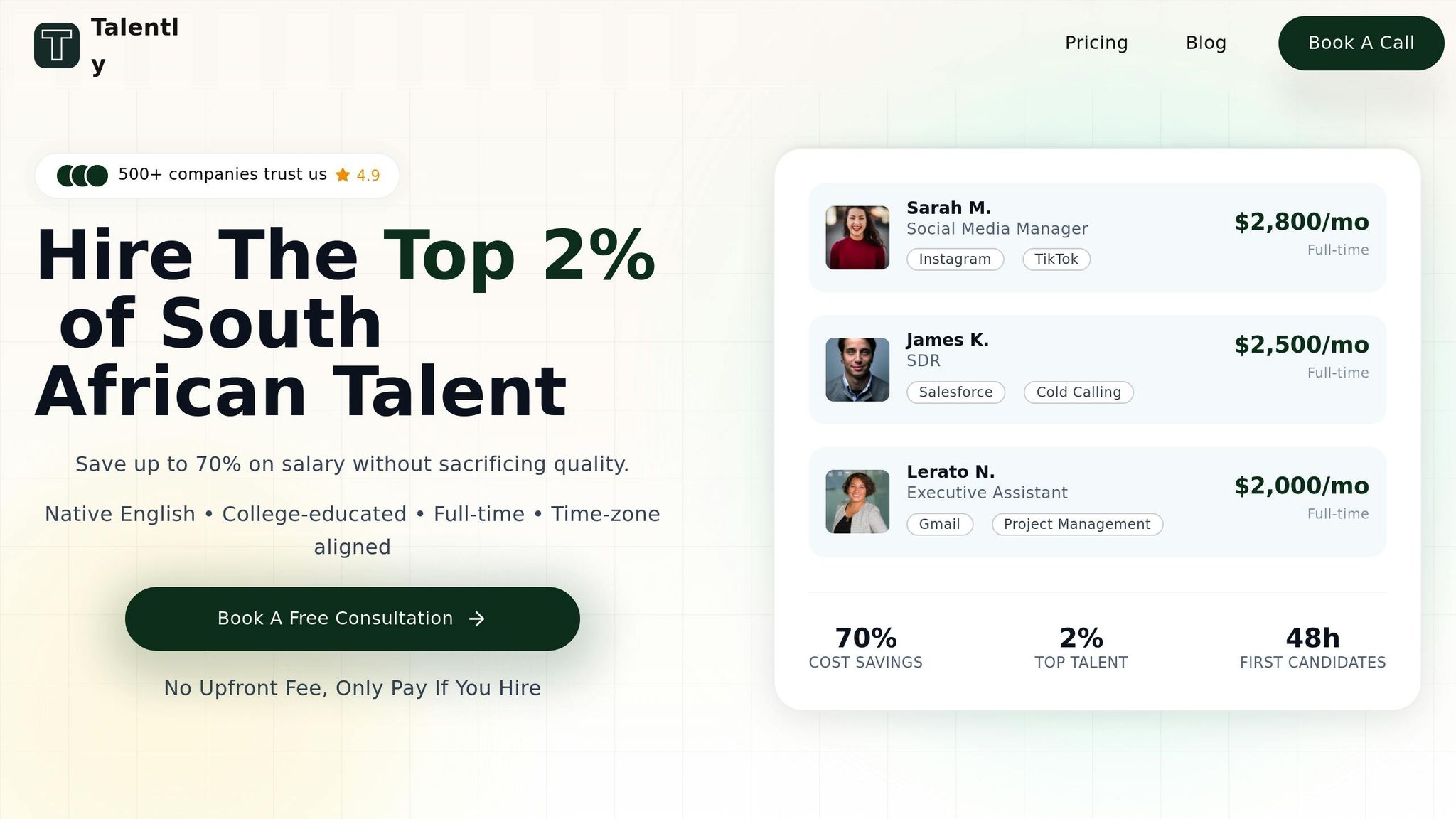
Talently leverages South Africa’s cost advantages to simplify hiring for North American businesses. By handling talent sourcing, vetting, payroll, and ongoing HR support, Talently removes the usual administrative hurdles and financial risks of international hiring. This approach gives companies access to skilled professionals without breaking the bank.
Complete Talent Sourcing and Vetting
Talently focuses on sourcing the top 2% of candidates – professionals who are college-educated, fluent in English, and business-oriented. Businesses get a pre-qualified shortlist of candidates within 48 hours, and the entire hiring process typically wraps up in just two weeks. Payment is only required after a successful hire.
Jessica Adams, CEO of GrowthLab, shared her positive experience: “The process, from consultation to onboarding, was efficient and met all our needs. They really understood our needs and found us the perfect executive assistant. Worth every penny.”
This streamlined process has led to over 500 successful placements and a 98% client satisfaction rate. Once the right talent is identified, Talently takes the stress out of payroll management.
Managed Payroll and Fixed Monthly Costs
Talently simplifies payroll by acting as the Employer of Record, managing contracts, payroll, benefits, and compliance with South African labor laws. Companies pay a fixed monthly fee – starting at $2,500 – that covers both the professional’s salary and management costs. This eliminates the need for local entities and ensures compliance with international tax laws. For example:
- Executive Assistant: ~$2,000/month
- Sales Development Representative: ~$2,500/month
- Social Media Manager: ~$2,800/month
Sarah Mitchell, VP of Customer Success at ScaleUp SaaS, highlighted the benefits: “Hiring two Customer Success Managers at half the cost of local hires led to a 35% reduction in churn within six months.”
With this predictable cost model, companies can save over $50,000 annually per hire.
Onboarding and Ongoing Support
Talently doesn’t stop at placement – it ensures smooth onboarding and provides continuous HR support to keep productivity high. Every candidate is thoroughly vetted for remote work readiness, including having reliable internet and backup power systems like inverters or UPS to handle potential power outages. This approach minimizes training delays and avoids productivity disruptions. Talently also handles performance tracking and ensures compliance with data protection regulations like GDPR and POPIA.
Michael Chen, Head of Sales at TechFlow Inc., shared: “The quality of talent is exceptional. Our South African BDRs are outperforming our US-based reps, booking 40% more meetings. The time zone overlap is perfect.”
With 6–8 hours of overlapping work time with EST/PST, South African professionals can collaborate seamlessly with North American teams.
Cost Comparison: U.S. vs. South African Hiring
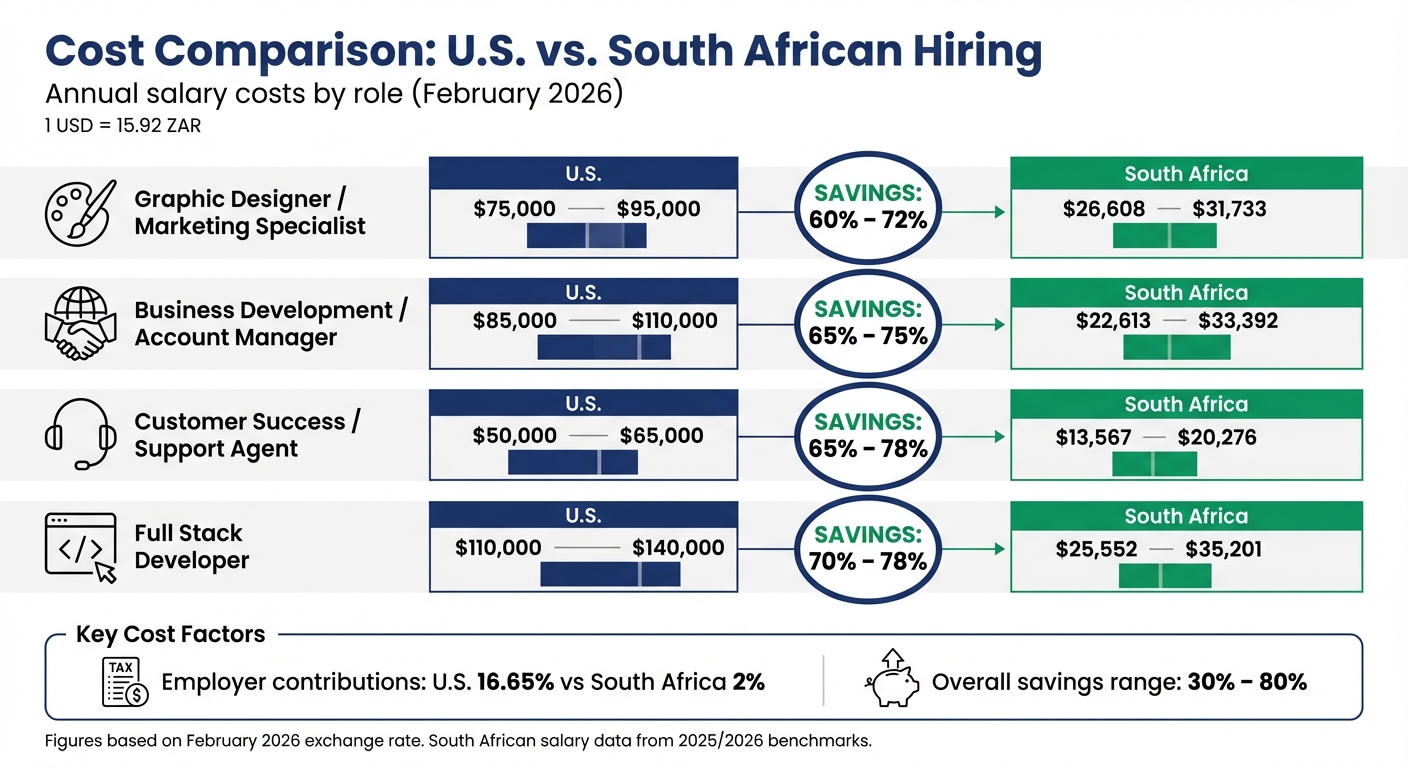
Cost Comparison: U.S. vs South African Hiring Across Key Roles
The numbers speak for themselves – hiring talent in South Africa offers significant cost advantages compared to the U.S., with potential savings ranging from 30% to 80%, depending on the role and expertise level.
This cost reduction largely comes from two factors: lower base salaries in South Africa and reduced employer contributions. In the U.S., employers typically pay around 16.65% in mandatory contributions (covering FICA and unemployment taxes). In contrast, South African employers only incur about 2% in contributions, which cover the Unemployment Insurance Fund and Skills Development Levy. This difference translates to thousands of dollars in annual savings per employee.
The exchange rate further amplifies these savings. As of February 10, 2026, 1 USD ≈ 15.92 ZAR. This favorable rate allows U.S. companies to offer competitive salaries in South Africa while spending just a fraction of what they would on domestic hires. Even when offering salaries 30%–100% above local benchmarks to attract top-tier talent, the overall hiring cost remains significantly lower than hiring within the U.S..
Cost Comparison Table
| Role | South Africa (Annual) | U.S. (Annual) | Savings % |
|---|---|---|---|
| Graphic Designer / Marketing Specialist | $26,608 – $31,733 | $75,000 – $95,000 | 60% – 72% |
| Business Development / Account Manager | $22,613 – $33,392 | $85,000 – $110,000 | 65% – 75% |
| Customer Success / Support Agent | $13,567 – $20,276 | $50,000 – $65,000 | 65% – 78% |
| Full Stack Developer | $25,552 – $35,201 | $110,000 – $140,000 | 70% – 78% |
Figures based on the February 2026 exchange rate of 1 USD = 15.92 ZAR. South African salary data derived from 2025/2026 benchmarks.
The savings extend across various departments. For example, Marketing & Advertising roles see a cost reduction of about 84%, Customer Service roles save 78%, and Information Technology roles cut costs by approximately 77%. These savings aren’t just numbers – they represent real opportunities for businesses to reinvest in growth, product innovation, or expanding their teams. Understanding the difference between offshoring and outsourcing is crucial when evaluating these models. The financial advantages make a compelling case for considering offshore staffing benefits for your business.
Conclusion
South Africa offers access to highly skilled professionals at salary costs that are 30%–80% lower than in many other markets. The country boasts seven of Africa’s top universities, ensuring a steady supply of well-educated talent ready to contribute effectively to global teams.
With 6–8 hours of overlap with U.S. time zones, South African professionals can easily align with your team’s schedule, making collaboration effortless. These logistical advantages simplify the process of integrating offshore talent into your operations.
Talently makes hiring in South Africa straightforward by handling sourcing, vetting, payroll, and compliance. You’ll receive a candidate shortlist within 48 hours, and the average time-to-hire is just two weeks. Plus, you only pay after making a successful hire.
South Africa’s low employer contributions – around 2% of an employee’s salary – further reduce hiring expenses. This allows businesses to allocate resources toward growth initiatives, whether that’s expanding teams, enhancing products, or scaling operations.
For companies looking to grow efficiently without compromising talent quality, Talently delivers a solution that works. With a 98% client satisfaction rate and over 500 successful placements, it has helped North American businesses build teams that achieve measurable success.
FAQs
What hidden costs should I budget for when hiring in South Africa?
When hiring in South Africa, businesses need to account for more than just salaries. Hidden costs can significantly impact the overall budget. For instance, employers are required to contribute to programs like the Unemployment Insurance Fund (UIF), the Skills Development Levy (SDL), and workers’ compensation. These mandatory contributions alone can add approximately 2.5% to the total employment costs.
Beyond these, there are other expenses to consider, such as onboarding, ensuring legal compliance, managing payroll, and providing employee benefits like health insurance and retirement plans. Administrative overheads also play a role in increasing costs. By planning carefully, businesses can ensure compliance with regulations and create a more accurate hiring budget.
How do I protect company data when working with South African remote hires?
To protect company data when collaborating with remote hires in South Africa, it’s essential to put robust cybersecurity practices in place and establish clear data management policies. Start by using secure tools such as encrypted email services and VPNs to safeguard communication and data exchanges. Make sure your company complies with South Africa’s data privacy regulations, such as the Protection of Personal Information Act (POPIA), and include confidentiality agreements in your contracts.
Platforms like Talently can simplify payroll and compliance while maintaining high security standards, ensuring both efficiency and data safety. Additionally, providing regular training for employees on cybersecurity best practices is a key step in reducing potential vulnerabilities and keeping sensitive information secure.
How fast can Talently help me hire and onboard someone in South Africa?
Talently makes hiring and onboarding talent from South Africa incredibly quick – sometimes in as little as 48 hours. They simplify the process by thoroughly vetting candidates and matching them to your exact requirements, ensuring you get the right fit without delays.
Related Blog Posts
Ready to build your dream team?
Book a free consultation and get your first candidate shortlist within 48 hours.
No upfront fee • Only pay if you hire