
Q&A: Cost Savings with South African Remote Teams
 13 min read

Want to save up to 75% on payroll costs without sacrificing quality? Hiring remote teams in South Africa offers U.S. businesses a cost-effective solution for accessing skilled professionals. With salaries significantly lower than U.S. averages, strong English proficiency, and overlapping time zones with the U.S. East Coast, South African professionals deliver excellent results at a fraction of the cost.
Key Takeaways:
- Salary Savings: South African professionals earn 60%–75% less than U.S. counterparts. For example, web developers earn $1,200–$2,500/month vs. $5,167/month in the U.S.
- Overhead Reduction: No office space, equipment, or local entity setup required. Employer of Record (EOR) services streamline payroll and compliance for $699/month per employee.
- Currency Advantage: Favorable USD-to-ZAR exchange rates (currently $1 = 16.49 ZAR) amplify savings.
- Time Zone Compatibility: 4–5 hours overlap with U.S. East Coast ensures real-time collaboration, reducing delays and hidden costs.
South African remote teams are an efficient way to scale operations, cut costs, and maintain high-quality work across roles like customer success, design, marketing, and business development.
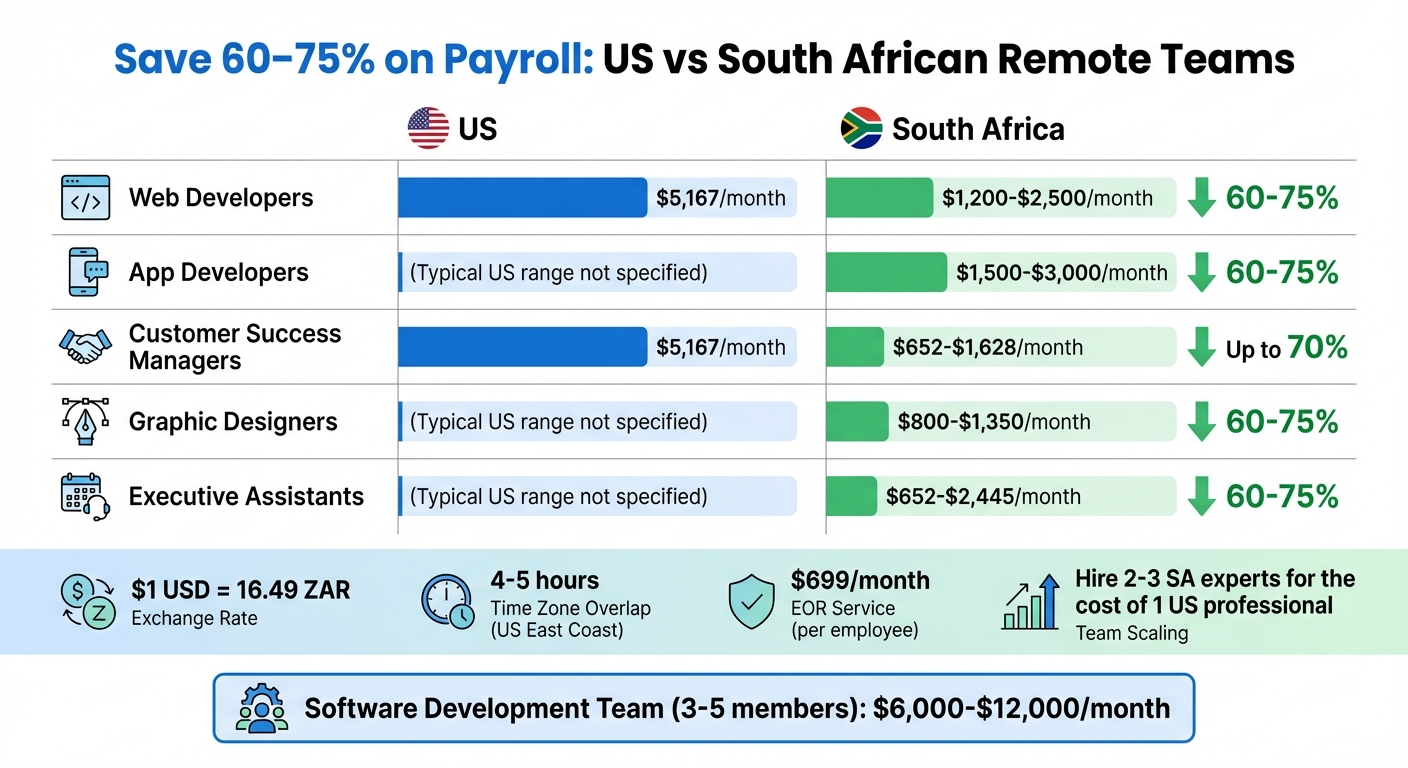
Cost Comparison: US vs South African Remote Teams by Role
Main Cost Benefits of South African Remote Teams
Lower Salaries with High-Quality Work
South African professionals deliver excellent work at significantly lower salaries compared to their U.S. counterparts. For instance, South African web developers typically earn between $1,200 and $2,500 per month, while app developers earn $1,500 to $3,000 per month. This translates to payroll savings of around 60%–75% for U.S. companies.
The quality of work remains impressive, thanks to South Africa’s strong educational system. Graduates from renowned institutions like the University of Cape Town and Wits University bring specialized skills in fields such as IT, engineering, and finance. Additionally, professionals in South Africa adapt to challenges like power outages by using backup systems and reliable fiber connectivity, ensuring 99% uptime.
“Our South African team is incredible. They bring energy, creativity, and consistency that make a real difference for our clients every day.” – Harlan Rappaport, Co-founder of Hire Overseas
This combination of affordability and quality makes South African remote teams a cost-effective solution for businesses.
Reduced Overhead and Operating Expenses
Hiring remote teams in South Africa eliminates the need for physical office spaces, cutting costs on rent, utilities, and workplace amenities. Companies also save on legal and administrative expenses since there’s no requirement to establish a local entity. This means avoiding costs for local attorneys, regional bank accounts, and HR setups.
IT and equipment expenses are also minimized. Cloud-based tools and employees using their own devices help reduce technology costs. Additionally, an Employer of Record (EOR) service, priced at $699 per employee per month, handles payroll, compliance, and statutory deductions, simplifying operations even further.
Currency Exchange Rate Advantages
The favorable USD-to-ZAR exchange rate adds another layer of cost efficiency. As of January 3, 2026, $1 USD equals approximately 16.49 ZAR. This exchange rate significantly increases purchasing power for U.S. companies, allowing them to pay competitive local salaries in rand while keeping dollar expenses low.
For the cost of hiring one Western professional, businesses can often build a team of two or three South African experts with comparable skills. Even mandatory contributions like UIF (calculated as a percentage of the ZAR salary) remain minimal when converted to dollars. A software development team of three to five members costs just $6,000 to $12,000 per month.
These currency advantages, combined with savings on salaries and overhead, make South African remote teams an attractive option for businesses looking to optimize costs.
Asking South Africans What They Do for Work (and Their Starting Salaries!!) PART 2
If these salary figures have you considering your options, you can hire remote staff in South Africa to tap into this cost-effective talent pool.
Time Zone Compatibility Reduces Hidden Costs
Thanks to South Africa’s UTC+2 time zone, there’s a 4–5-hour overlap with U.S. East Coast working hours, making real-time collaboration much easier. Instead of waiting an entire day for email replies or scheduling calls at odd hours, teams can jump on Zoom during regular business hours for quick decisions and same-day updates. This alignment allows for smooth, real-time communication.
The time difference also brings another advantage: overnight productivity. While North American teams are off the clock, South African teams can handle tasks like bookkeeping, CRM updates, or expense reconciliation. By the time the U.S. team starts their day, deliverables are ready to go, eliminating delays that could otherwise stretch project timelines by days.
Compared to outsourcing hubs like India or the Philippines, South Africa’s time zone minimizes the challenges of asynchronous communication. This reduces the risk of rework and misunderstandings, especially when paired with South Africa’s strong English proficiency. The result? A collaborative experience that feels much closer to working with an in-house team.
“Unlike outsourcing models where communication delays are the norm, working with South African professionals feels more like working with your in-house team.” – Tia Nundhall, Recruit SA
These time zone benefits also translate into cost savings. Businesses avoid paying extra for shift premiums during off-peak hours. Since South African work hours naturally align with European schedules and partially overlap with U.S. hours, companies can extend their operational coverage without the expense of 150% overtime rates or 200% Sunday wages that are common in other regions.
sbb-itb-7512dae
How Talently Simplifies Offshore Hiring
Hiring an offshore team can feel like a maze – navigating international job boards, screening candidates, and managing South African labor laws and payroll. Talently takes the complexity out of the process by offering an comprehensive offshore staffing guide, handling everything from recruitment to monthly payroll.
The journey starts with a free consultation to understand your business, product, and specific role needs. Within one to two weeks, Talently provides a shortlist of candidates representing the top 2% of South African talent. These individuals have undergone a rigorous five-step screening process. This vetting goes beyond technical skills, also evaluating personality and professional experience to ensure a strong alignment with your company’s work environment.
“I created Talently to focus on sourcing talent from the only market that provided consistent talent on the same level as North American and UK talent…… SOUTH AFRICA.”
– Dan Seligman, Founder & CEO, Talently
Once you select your candidate, Talently takes care of the rest – contracts, background checks, onboarding, and even providing necessary equipment. For a fixed monthly rate starting at $2,500, you get a package that includes salary, recruitment, payroll, benefits administration, and equipment. This streamlined model eliminates the unexpected costs often associated with traditional hiring. Let’s break down how Talently makes offshore hiring seamless.
Managed Recruitment and Candidate Screening
Talently’s five-step screening process ensures you only interview candidates who are a perfect fit for your needs. Instead of spending weeks sifting through resumes and job applications, you’re presented with pre-vetted professionals ready to hit the ground running. The platform specializes in high-impact, non-technical roles like Customer Success Managers, Business Development Representatives, Marketing Managers, Executive Assistants, and Graphic Designers. Each candidate is assessed for both their technical skills and how well they align with your team’s dynamics.
“Talently’s rigorous candidate selection process involves comprehensive screening, thorough testing, and in-depth interviews to ensure that only the best and most qualified individuals are chosen.”
– Outsource Accelerator
This pre-vetting process not only saves you time but also gives you access to exceptional talent at up to 70% less than the cost of hiring locally in North America.
Fixed Monthly Pricing Model
Offshore hiring often comes with unpredictable expenses – recruitment fees, payroll software, benefits administration, IT equipment, and compliance management. Talently eliminates these headaches by consolidating everything into one fixed monthly fee starting at $2,500.
“You pay a fixed monthly rate for offshore staffing, we take care of the rest.”
– Talently
This transparent pricing structure simplifies budgeting and financial planning. You won’t face surprise invoices for equipment or administrative costs. While specialized roles requiring additional experience may come with a higher rate, the fee is always clear and consistent, removing the need for additional HR or payroll software investments.
Full Payroll and Benefits Administration
Talently also handles the nitty-gritty of payroll and compliance. Acting as the employer of record, the company manages legal contracts, payroll in South African Rand (ZAR), and compliance with local labor laws, including statutory deductions like Unemployment Insurance Fund (UIF) contributions.
“We take care of the recruiting process, employment documents, and payroll (all the dirty work around offshore staffing).”
– Talently
Each month, Talently processes payments, manages currency exchange rates, and ensures all local legal requirements are met. You receive a single, consolidated invoice covering salaries, taxes, and management fees. This means you don’t need to set up a legal entity in South Africa or hire local HR experts. Talently takes care of the entire employment lifecycle, from drafting compliant contracts under the Basic Conditions of Employment Act to managing terminations if necessary.
Cost Savings by Job Function
When you break it down by specific roles, the cost advantages of hiring South African talent become even clearer. Depending on the job, businesses can save anywhere from 40% to 75% compared to typical North American salaries.
Customer Success and Administrative Support
Customer success managers and virtual assistants in South Africa earn between $652 and $1,628 per month, depending on their experience level. Compare that to the average U.S. salary of $5,167 per month, and you’re looking at savings of up to 70%. For instance, hiring a mid-level South African virtual assistant at $900 per month translates to about $5.20 per hour saved if they free up 10 hours of your time each week.
Their strong English skills ensure clear and effective communication with customers. Plus, with four to five hours of overlap with the U.S. East Coast workday, they can handle real-time customer inquiries without the extra costs of overnight shifts. These savings contribute significantly to reducing overall operational expenses.
Design and Marketing Specialists
South Africa produces over 70,000 marketing and media graduates each year, creating a robust pipeline of skilled talent for creative roles. Graphic designers typically earn between $800 and $1,350 per month, while social media managers and SEO specialists earn between $960 and $1,860. For the cost of one U.S.-based designer, you could hire two or even three South African specialists.
What’s more, they adapt quickly to Western marketing practices, often requiring minimal onboarding.
“Our South African team is incredible. They bring energy, creativity, and consistency that make a real difference for our clients every day.”
– Harlan Rappaport, Co-founder, Hire Overseas
This talent pool not only delivers quality work but also helps stretch your budget further.
Business Development and Executive Assistants
When it comes to business development representatives and executive assistants, payroll costs can be slashed by 60% to 75% without sacrificing quality. Entry-level executive assistants start at $652 per month, while seasoned professionals with over 10 years of experience can earn up to $2,445.
South African SDRs (Sales Development Representatives) are particularly skilled in cold-calling and managing sales pipelines, thanks to their clear communication and persuasive techniques. Many also bring experience from call centers and professional services, equipping them with strong CRM expertise, conflict resolution abilities, and polished communication skills.
These roles offer a winning combination of cost savings and professional excellence, making them a smart choice for businesses looking to optimize their workforce.
Conclusion
South African remote teams can help businesses slash payroll and overhead costs by an impressive 60% to 75% compared to hiring within the United States. These savings aren’t just limited to salaries – they’re amplified by cutting out overhead expenses, leveraging favorable exchange rates, and benefiting from time zone compatibility, which minimizes hidden costs. The result? A financial edge that serves as a smart strategy for business growth.
These cost benefits touch every corner of your business. Whether you’re scaling customer success teams, expanding marketing efforts, or bolstering business development, South African professionals deliver the same level of skill and expertise at a fraction of the cost. For example, companies report 50% to 65% savings on salaries for customer support and sales teams alone.
Talently takes the headache out of international hiring by managing recruitment, vetting, payroll, and compliance – all through a simple, fixed-fee model. This streamlined process ensures you have skilled professionals ready to hit the ground running from day one, making South African remote teams not just cost-effective but also incredibly easy to integrate into your operations.
FAQs
How does South Africa’s time zone alignment benefit U.S. businesses working with remote teams?
South Africa’s time zone, being just 6 to 9 hours ahead of U.S. time zones (ranging from Pacific to Eastern), offers a convenient overlap during standard business hours. This overlap makes it easy for U.S.-based teams to collaborate with South African remote workers in real time. Whether it’s video calls, screen sharing, or tackling issues on the spot, everything can be handled without anyone needing to work late into the night.
On top of that, South African teams can take on time-sensitive tasks – like addressing customer support queries or wrapping up urgent updates – toward the close of the U.S. workday. This setup essentially stretches your company’s productive hours, allowing for quicker turnarounds and more seamless project management.
What types of roles are ideal for South African remote teams?
South African remote teams excel across a wide range of roles, making them an excellent choice for businesses seeking to outsource talent. These roles span customer support, virtual assistants (covering areas like executive assistance, sales, legal, bookkeeping, and e-commerce support), digital marketing, social media management, IT and software development, finance and accounting (including bookkeeping and tax preparation), graphic design, business development, and more.
With a strong work ethic, impressive English proficiency, and access to quality education, professionals from South Africa deliver outstanding results. They offer businesses a way to reduce costs while maintaining high standards of performance.
How does an Employer of Record (EOR) make payroll and compliance easier for U.S. companies hiring in South Africa?
An Employer of Record (EOR) makes hiring international talent easier by serving as the official employer for your South African remote team. They take care of essential responsibilities like payroll management, tax withholdings, statutory contributions, and ensuring compliance with local labor laws.
For U.S. companies, this means you can recruit and compensate skilled professionals in South Africa without the hassle of establishing a local entity. It streamlines the process, cuts down on administrative work, and ensures everything aligns with South African legal requirements.
Related Blog Posts
Ready to build your dream team?
Book a free consultation and get your first candidate shortlist within 48 hours.
No upfront fee • Only pay if you hire