
Why South African Talent Fits North American Businesses
 7 min read

- Cost Savings: Hiring South African professionals can save businesses 40–60% compared to domestic hires. For example, an accountant in South Africa costs around R34,000/month (~$1,800), while the same role in the U.S. averages $5,512/month.
- Skilled Workforce: South African professionals excel in areas like sales, executive support, marketing, and IT. They’ve contributed to major U.S. business successes, such as NexGrill‘s growth and Vizio‘s acquisition by Walmart.
- Time Zone Compatibility: South Africa’s GMT+2 time zone allows for partial workday overlap with North American teams, making collaboration feasible. This is especially true when managing remote teams across time zones with established workflows.
- English Proficiency: English is the primary business language, often spoken with a neutral accent, ensuring clear communication.
- Work Ethic: Known for resilience and accountability, South African professionals often exceed a 45-hour workweek, reflecting dedication and productivity.
Quick Comparison
| Factor | South African Talent | North American Talent |
|---|---|---|
| Monthly Salary (Accountant) | R34,000 (~$1,800) | $5,512 |
| Employer Costs | 2% | 16.65% |
| Work Hours | 45+ hours/week | 40 hours/week |
| Time Zone Alignment | Half-day overlap | Full-day overlap |
| Language | Neutral English accent | Native English |
South African talent offers a practical way to scale teams while balancing quality and affordability. Platforms like Talently simplify the hiring process by handling sourcing, payroll, and compliance, with full-time professionals starting at $2,500/month.
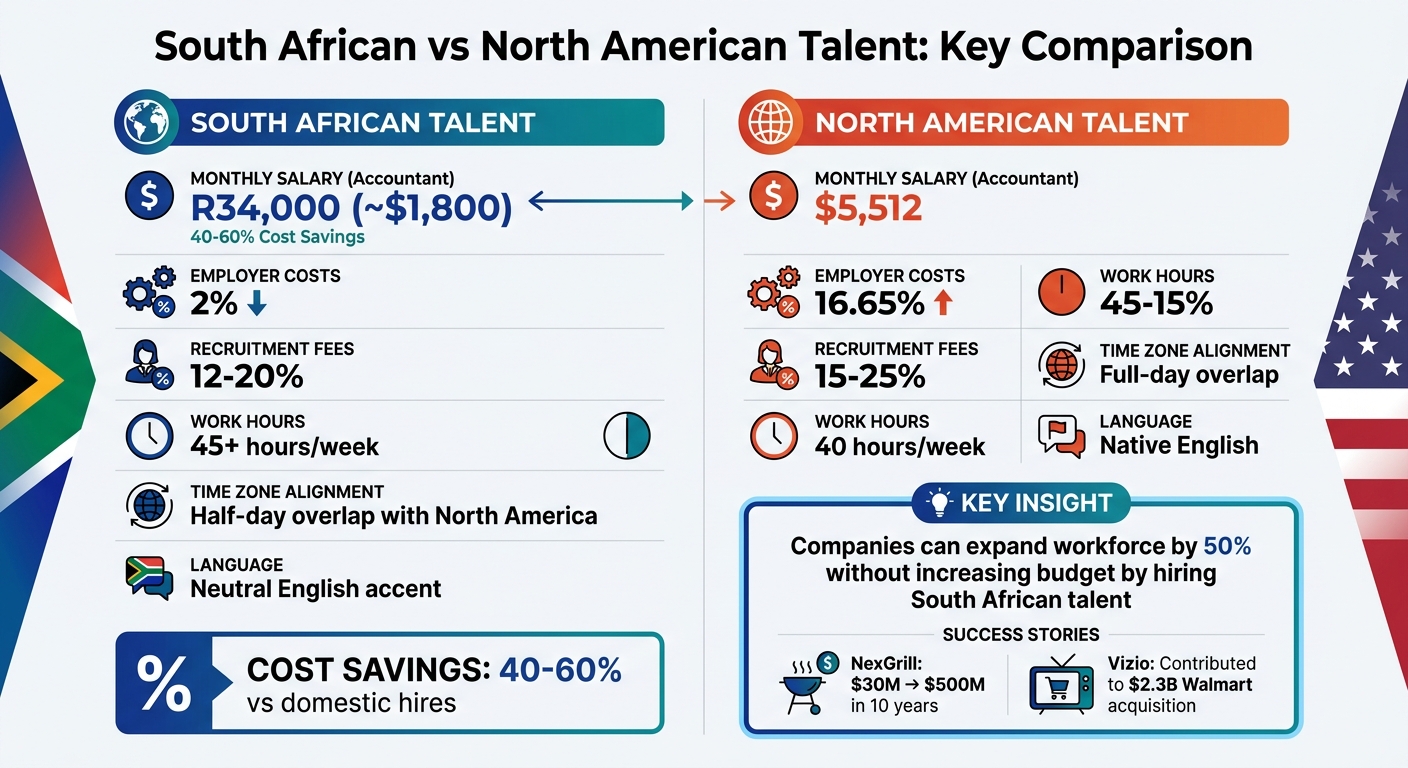
South African vs North American Talent Cost Comparison
1. South African Talent
Cost Efficiency
Hiring professionals from South Africa provides a smart strategy for business growth. This approach allows businesses to tap into skilled talent while keeping costs under control, making it a smart choice for companies looking to balance quality and affordability.
Language Proficiency
Effective communication is essential in any team, especially in cross-border collaborations. In South Africa, English is the primary business language, and professionals often speak it with a neutral accent. This makes it easier for them to connect with North American teams, fostering trust and smooth communication.
Cultural and Work Ethic Alignment
South African professionals are known for their proactive and resilient work ethic, shaped by their experience in navigating challenging environments. They demonstrate accountability and a strong sense of ownership – qualities that are especially valuable in remote work settings. As Therese Otten puts it:
South African professionals succeed globally because they’ve learned to operate calmly in complexity. When things wobble, they don’t freeze. They solve.
This mindset ensures they not only perform well but also integrate seamlessly with North American work practices.
Skill Depth
South African professionals bring more than just cost and communication advantages – they also excel in critical digital and strategic skills. Many are well-versed in areas like SEO, content marketing, and data literacy, making them a valuable asset to businesses. Their expertise has played a key role in scaling U.S. brands. For instance, NexGrill, originally a $30 million South African company, grew to nearly $500 million in annual U.S. revenue within a decade. Similarly, South African-led strategies contributed to Vizio’s expansion, ultimately leading to its $2.3 billion acquisition by Walmart in 2024/2025.
sbb-itb-7512dae
How Remote Work is Opening Global Doors for South Africans!!!
2. North American Domestic Hiring
While hiring domestically in North America has its advantages, it also comes with a unique set of challenges that businesses need to navigate.
Cost Efficiency
The real cost of hiring in North America is high compared to offshore options. Salaries are significantly higher compared to offshore options, and when you factor in benefits, payroll taxes, office space, and equipment, the financial burden grows quickly. For businesses aiming to scale without overspending, these costs can become a major obstacle.
Time Zone Compatibility
One clear advantage of domestic hiring is the ability to collaborate in real time. Being in the same time zone allows teams to hold impromptu meetings, address issues promptly, and maintain smooth, same-day communication. This can be a huge plus for projects requiring constant interaction and quick decision-making.
Skill Depth
Finding and retaining skilled professionals domestically is becoming harder. A global survey of nearly 1,000 companies revealed that fewer than one-third were satisfied with their ability to recruit and effectively utilize talent in critical roles. Even when positions are filled, many organizations struggle to assign employees to roles where they can have the most impact. Additionally, there’s often a lack of strong systems to continuously assess and optimize the performance of skilled workers. These challenges in sourcing and managing domestic talent make offshore options, like South African staffing, increasingly attractive.
The hurdles associated with domestic hiring underscore why many North American businesses are turning to South African talent as a strategic solution.
Pros and Cons
When comparing South African talent to domestic hires in the U.S., the distinctions become evident in both financial savings and workplace dynamics.
For instance, hiring an accountant in South Africa costs approximately R34,000 per month, while the same role in the U.S. averages US$5,512 per month – a 66% reduction in salary costs alone. Employer contributions also highlight a stark contrast: South African employers pay just 2% (covering the Unemployment Insurance Fund and Skills Development Levy), compared to 16.65% in the U.S. (which includes FICA and unemployment insurance). Recruitment fees follow a similar trend, with South African rates ranging from 12–20%, compared to 15–25% for U.S.-based hiring. Paul Byrne from Pnet emphasizes this advantage:
Our labor forces are cost-effective… we produce really strong talent in fields like engineering, IT and finance, and that’s deeply sought after overseas.
Beyond cost, South African professionals bring additional strengths. They often work more than 45 hours per week, exceeding the standard 40-hour workweek typical in North America, which reflects their dedication to productivity. Their strong English language skills and neutral accents ease communication, while their ability to navigate complex environments fosters exceptional problem-solving abilities.
That said, time zones can present challenges. South Africa’s SAST (UTC +2) time zone allows for a half-day overlap with U.S. projects, which may require some flexibility in scheduling. By contrast, North American teams benefit from a full business day of real-time collaboration.
| Factor | South African Talent | North American Domestic Talent |
|---|---|---|
| Monthly Salary (Accountant) | R34,000 | US$5,512 (approx. R101,396) |
| Statutory Employer Costs | 2% | 16.65% |
| Recruitment Fees | 12–20% | 15–25% |
| Work Hours | 45+ hours/week | Standard 40 hours/week |
| Time Zone Alignment | Half-day overlap | Full business day overlap |
| English Proficiency | Excellent, neutral accent | Native proficiency |
The financial benefits are clear: companies hiring in South Africa can expand their workforce by up to 50% without increasing their overall budget. Combined with their strong work ethic and language skills, South African professionals continue to align well with the needs of North American businesses. For a deeper look at this model, see our guide to offshore staffing in South Africa.
Conclusion
South African professionals offer a blend of affordability, dedication, and seamless cultural fit that helps businesses scale effectively. With exceptional English communication skills, they contribute to operational success while showcasing expertise in digital tools, strategic problem-solving, and adaptability. This makes talent from South Africa an excellent option for offshore hiring benefits.
To simplify this process, Talently provides a hassle-free solution for North American companies. Talently connects businesses with full-time remote professionals at competitive rates starting at $2,500 per month. You can also use an offshore hiring benefits analyzer to calculate your specific cost savings. They handle everything – from sourcing and vetting talent to managing payroll and benefits – for roles like customer success, marketing, executive assistance, and business development.
FAQs
Which roles are best to hire from South Africa?
South African professionals thrive in areas like sales, marketing, virtual assistance, bookkeeping, and customer support. Their dedication, fluency in English, and broad range of skills position them well for these roles.
How much U.S. time-zone overlap can I expect?
South Africa provides a window of 7 to 9 hours of overlap with U.S. time zones, making it a practical option for collaboration. For instance, when operating under Eastern Time (ET), South Africa Standard Time (SAST) is 6 hours ahead. This time difference allows for 2 to 4 hours of real-time interaction, depending on the work schedule. This overlap ensures smooth communication and coordination for businesses in North America.
How does Talently handle payroll and compliance?
Talently handles payroll and compliance by managing contracts, payroll, benefits, and HR for the professionals you hire. This approach guarantees complete employment coverage while ensuring strict compliance with legal standards, streamlining the entire process for peace of mind.
Related Blog Posts
Ready to build your dream team?
Book a free consultation and get your first candidate shortlist within 48 hours.
No upfront fee • Only pay if you hire