
Flexible Benefits for South African Remote Teams
 17 min read

When you hire remote staff in South Africa, workers expect more than just competitive salaries from North American employers – they want benefits tailored to their needs. Here’s what stands out:
- Legal Basics: South African labor laws require minimum benefits like 15 days of annual leave, sick leave, and unemployment insurance contributions.
- Preferred Perks: Remote workers value home office stipends, internet allowances, and solutions for power outages (like UPS systems) due to challenges like load-shedding.
- Time-Off Policies: Many companies offer more than the 15-day leave minimum, with extras like wellness days, study leave, or floating holidays for personal or religious observances.
- Healthcare & Retirement: Private medical aid contributions and retirement plans with employer matching (9%-13%) are often expected in professional roles.
- Financial Wellness: Perks like a 13th paycheck, learning stipends, and financial planning support address economic concerns and improve job satisfaction.
Employers who go beyond the minimum – offering flexible schedules, mental health support, and tailored benefits – can attract and retain top South African talent. Services like Talently simplify compliance and payroll management, allowing U.S. companies to focus on offering meaningful perks without navigating complex regulations.
Core Benefits Expectations in South Africa
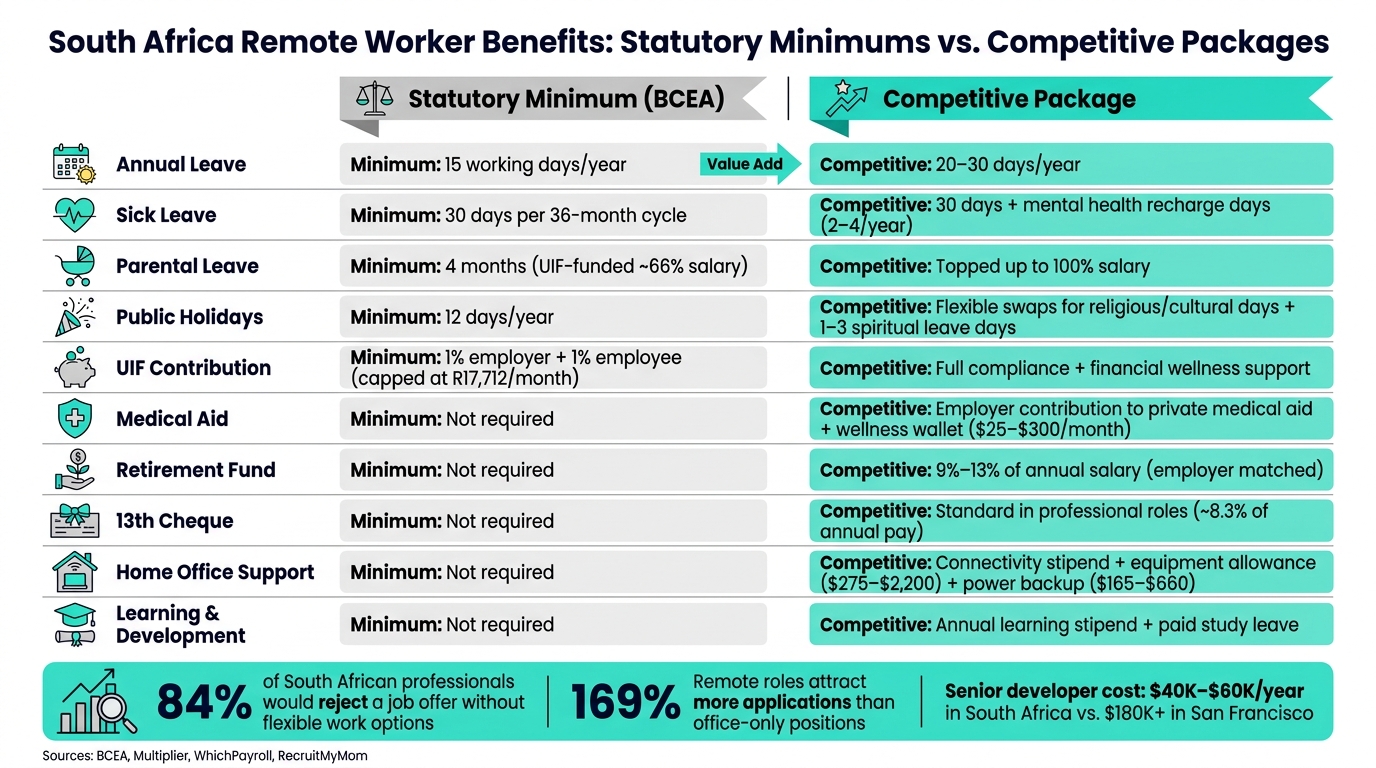
South Africa Remote Worker Benefits: Statutory Minimums vs. Competitive Packages
Before putting together a benefits package for South African employees, U.S. employers must familiarize themselves with the country’s labor laws. Understanding the mandatory requirements and knowing where flexibility exists is crucial.
Mandatory and Common Benefits in South Africa
South Africa’s Basic Conditions of Employment Act (BCEA) outlines the minimum standards for employees working more than 24 hours per month, including those in remote roles. As explained by Multiplier:
“The Basic Conditions of Employment Act (BCEA) sets enforceable minimum standards… employers can offer more generous benefits but cannot contract below the statutory minimums.”
Here’s a breakdown of the legally required benefits:
| Benefit | Statutory Minimum | Paid By |
|---|---|---|
| Annual Leave | 15 working days per year (5-day week) | Employer (full pay) |
| Sick Leave | 30 days per 36-month cycle | Employer (full pay) |
| Parental Leave | 4 months and 10 days (shared) | UIF (~66% of salary) |
| Family Responsibility Leave | 3 days per year | Employer (full pay) |
| Public Holidays | 12 days per year | Employer (full pay) |
In addition to leave, employers must contribute to the Unemployment Insurance Fund (UIF) – with both employer and employee contributing 1% of monthly pay, capped at earnings of R17,712. Employers are also required to provide coverage under the Compensation for Occupational Injuries and Diseases Act (COIDA).
While private medical aid and retirement contributions are not mandatory, they are generally expected in professional roles. Competitive packages often include employer retirement contributions ranging from 9% to 13% of an employee’s annual salary.
These legal requirements form the baseline for benefits, but U.S. employers often go beyond these standards to attract and retain top talent.
How Cross-Border Remote Arrangements Differ
Many U.S.-based employers offering remote roles enhance the statutory benefits by including additional perks. For instance, while South African law mandates a minimum of 15 days of annual leave, remote employers often extend this to 20–30 days.
Maternity leave is another area where progressive companies stand out. Although South African law provides for unpaid leave (with employees relying on UIF for partial salary coverage), leading employers frequently top this up to 100% of the employee’s salary. Another common perk is the 13th cheque – a December bonus. As Anton Van Heerden, CEO of DNA-EOR, highlights:
“Offering a 13th cheque can significantly boost morale, improve retention, and enhance your employer brand.”
One major difference to note is South Africa’s Cost-to-Company (CTC) model. In this system, benefits like medical aid and retirement contributions are included within the gross salary, unlike the U.S. approach where these are typically offered on top of base pay.
How Talently Manages Benefits for U.S. Companies
Navigating compliance while tailoring benefits for South African remote workers can be a challenge for U.S. companies. When comparing popular offshoring destinations, South Africa stands out for its cultural alignment and English proficiency, yet the regulatory landscape remains complex. Establishing a local entity (Pty Ltd) takes two to four months and involves registering with multiple government agencies. Talently simplifies this process by handling everything from talent sourcing and vetting to payroll management for South African professionals.
sbb-itb-7512dae
Time-Off Benefits for South African Remote Workers
South Africa’s Basic Conditions of Employment Act (BCEA) establishes the minimum requirements for paid leave. However, leading U.S. employers often go beyond these legal standards to attract and retain top talent through offshore staffing. Crafting a time-off policy that exceeds the basics can help you stand out in the competitive landscape of remote work.
Offering More Paid Time Off Than the Minimum
South African law requires 15 working days of paid leave annually. Yet, many global employers raise the bar by providing 20–25 days to appeal to highly skilled professionals.
You can also enhance your policy with floating holidays for personal or religious observances and wellness days that employees can use without needing to explain. These wellness days, separate from sick leave, allow team members to rest or recharge without requiring a medical reason. As Bizcraft explains:
“The BCEA sets minimum floors. Your employment contract, company policy, or collective agreement may provide more generous leave than the statutory minimum. More is lawful. Less is not.”
Another great addition is study leave, which isn’t required by law. Offering paid time off for exams or professional certifications shows you value your employees’ growth and development. These enhancements, combined with flexible public holiday policies, demonstrate a commitment to both compliance and employee satisfaction.
Flexible Public Holiday Policies
South Africa observes 12 national public holidays in 2026, from Human Rights Day on March 21 to Christmas Day on December 25. However, not all holidays align with every employee’s cultural or religious practices.
To accommodate diversity, employers can allow employees to swap a statutory public holiday for a personal religious day. For instance, an employee could exchange Family Day (April 6) for Eid al-Adha. This approach is also practical for cross-border teams. A South African employee might work on a local holiday and take off a U.S. company holiday instead, ensuring alignment across time zones.
Some companies also offer 1–3 days of spiritual or cultural leave annually, separate from regular annual leave. This small gesture can go a long way in showing respect for a diverse workforce. By implementing these practices, you create a more inclusive and flexible PTO structure.
Modern PTO Models Worth Considering
Unlimited PTO is an appealing option for South African remote workers, but there’s an important legal consideration. Under the BCEA, the statutory 15-day minimum must still be tracked separately, even when offering unlimited PTO.
“Unlimited PTO therefore doesn’t replace the statutory minimum; it can only sit on top of it.” – CA Financial Appointments
Interestingly, research shows that employees with unlimited PTO take an average of 16 days per year, only slightly more than the 14 days taken under traditional accrued models. While the actual usage difference is small, the perceived value of unlimited PTO is much higher, making it a powerful tool for recruitment and retention. However, the success of this model hinges on leadership. If managers don’t visibly take time off, employees may hesitate to do so.
Another modern option is offering mental health recharge days. These are separate from sick leave and don’t require a medical certificate. With burnout increasingly recognized as a workplace health concern under South Africa’s Occupational Health and Safety Act (OHSA), providing two to four recharge days per year highlights a genuine commitment to your team’s wellbeing.
Remote Work Perks That Address South African Realities
South Africa faces unique challenges when it comes to remote work, including load-shedding, unreliable internet, and the high costs of setting up a home office. Employers who recognize these obstacles and offer meaningful solutions can build strong loyalty with their South African team members.
Home Office and Connectivity Support
To ensure reliable remote work, offering a monthly connectivity stipend is essential. This should cover high-speed fiber and a backup mobile data plan (LTE/5G), as fiber alone often isn’t enough.
Power outages caused by load-shedding can disrupt work for hours, making power backup solutions crucial. A one-time equipment allowance can help employees invest in options like a mini UPS (costing around $165–$330) for keeping a router running or a portable power station such as the EcoFlow River 2, which can power a full workstation and costs between $440–$660. For employees planning to stay long-term, some employers even contribute to larger inverter systems.
In addition to addressing power needs, a home office equipment allowance can help create a professional workspace. This might include a laptop, monitor, ergonomic chair, and desk. In South Africa, a basic setup costs approximately $275–$825, while premium setups can range from $1,100 to $2,200. Covering or sharing these expenses shows employees that their comfort and productivity are priorities.
“For many South African professionals, especially in a period of rising living costs, the full value of a role includes flexibility, reduced commuting, trusted autonomy, and the ability to work in a way that supports long-term sustainability.” – RecruitMyMom
Workspace Flexibility Options
Not everyone thrives in a home office, especially when infrastructure issues arise. Offering a monthly co-working space stipend can be a game-changer. This stipend should cover the cost of a hot desk in major cities like Cape Town, Johannesburg, or Durban, giving employees a professional alternative when home conditions aren’t ideal. It also helps combat the isolation that remote workers often face.
Scheduling and Time-Zone Flexibility
South Africa’s time zone (SAST, UTC+2) provides U.S. East Coast companies with 4–5 hours of daily overlap for collaboration. This logistical advantage is a key factor when scaling operations with South African talent. This overlap is perfect for morning standups and team discussions, especially when paired with outcome-based performance management. It also reduces the need for South African employees to work late into their evenings.
To further ease scheduling stress, rotate meeting times so South African team members aren’t consistently required to join calls at the start or end of their workday. Recording all synchronous meetings ensures that no one misses important updates, even if they can’t attend live. Clear communication protocols, like defined response times for messages, can also alleviate the pressure of feeling “always-on.”
“Companies that treat flexibility as core infrastructure, rather than a reluctant concession, will retain scarce skills, widen their talent pool and protect long-term enterprise value.” – Leonard Roberts, CEO, Moore Infinity
Health, Wellness, and Financial Benefits for South African Remote Employees
Healthcare and Wellness Options
Health, learning, and financial support are essential for addressing challenges specific to South Africa, going beyond the usual perks like time off or flexible workspaces. In professional roles, private medical aid is often a necessity due to the limitations of public healthcare. However, only about 15% of South Africans have private medical aid coverage. Offering contributions toward private medical schemes – or providing a monthly stipend for this purpose – can set employers apart in the job market.
When choosing a plan, consider options that include a Medical Savings Account (MSA). This feature allows employees to manage their outpatient expenses while combining it with network plans that offer strong hospital coverage and reasonable premiums.
In addition to medical aid, many companies now provide flexible “wellness wallets.” These monthly stipends, ranging from $25 to $300, can be used for therapy, fitness apps, or even lifestyle subscriptions. This approach is particularly useful since Employee Assistance Program (EAP) usage in South Africa remains low, with only 17% to 24% of employees taking advantage of such services.
“Financial wellness doesn’t replace medical aid, retirement funding or EAPs, but it does make them more effective.” – Alex Cook, CEO, Wealthbit
Learning and Development Opportunities
An annual learning stipend has become a sought-after benefit among South African remote professionals. As the focus shifts from academic degrees to skills, employees increasingly value opportunities to stay relevant in their fields.
A well-designed learning benefit should cover expenses for online courses, virtual conferences, and professional certifications. Popular areas of interest include software development, cybersecurity, data science, and cloud computing. To maximize the impact of this benefit, pairing it with dedicated time off for skill-building is highly effective. Research shows that organizations with structured training programs see a 62% boost in new hire productivity.
Financial Security and Retirement Contributions
Financial stress is a persistent issue for many South African workers. A staggering four out of five employees worry about money regularly, and 82% report that this stress impacts their job performance. Additionally, only 6% of South Africans are on track to retire comfortably. These statistics highlight the importance of offering strong retirement contributions and financial wellness support.
In South Africa, the standard employer contribution to retirement plans ranges between 9% and 13% of an employee’s annual salary. Starting in 2026, retirement contributions will follow the Two-Pot System. This system splits contributions into a “savings pot” (one-third of the total) that employees can access early and a “retirement pot” (two-thirds) that remains locked until age 55.
Another common practice is the 13th cheque, equivalent to 8.3% of annual pay, which is often expected as part of competitive compensation packages.
“The 13th cheque is not statutory but is the cultural and contractual norm in finance, professional services, and senior tech, and an offer letter that omits it usually reads as below-market.” – WhichPayroll
For U.S. employers managing South African teams, compliance can be challenging, as South African talent vs. North American labor laws differ significantly. Obligations include UIF contributions (1% each from employer and employee), a 1% Skills Development Levy for payrolls over R500,000, and COIDA assessments. Companies like Talently simplify this process by handling compliance, ensuring employees receive the correct benefits without requiring employers to navigate complex South African tax laws directly.
How to Structure Tiered Benefit Packages
Core, Flexible, and Premium Benefit Layers
Creating a tiered benefits package is essential for addressing the needs of South African remote workers while staying cost-effective and compliant with local regulations.
The core layer includes all legally required benefits, such as UIF contributions, the Skills Development Levy, COIDA assessments, and statutory leave. These are mandatory and serve as the foundation for any compliant package.
The flexible layer is where companies start to stand out. While not required by law, offerings like private medical aid, retirement fund contributions, and a 13th paycheck are deeply ingrained in South Africa’s professional landscape. Without these, your package may be perceived as below market standards.
Finally, the premium layer caters to senior or specialized roles, offering perks like international medical coverage, higher retirement matching (up to 13% of annual salary), unlimited paid time off, and dedicated budgets for learning and development. These benefits are crucial for retaining top talent in competitive markets.
“The retention risk is not the absence of benefits that employees do not expect. It is the absence of benefits that local market practice has made standard.” – Alex Harrington, HR Technology Analyst
After defining these layers, the next challenge is to strike the right balance between cash and non-cash benefits.
Mixing Cash and Non-Cash Benefits
South Africa’s cost-to-company (CTC) model integrates benefits into an employee’s gross salary, which can significantly impact take-home pay.
“South Africa’s cost-to-company model is unusual. An employee earning ZAR 30,000/month CTC doesn’t receive ZAR 30,000. Medical aid, retirement fund contributions and UIF all come out of that figure.” – Employsome
To maximize value, employers can balance direct cash payments with non-cash perks. For example, retirement contributions are tax-deductible up to 27.5% of gross income (capped at R350,000 annually), reducing taxable income. Non-cash benefits like home office stipends and data allowances are also highly valued without inflating base salaries. Providing a total compensation statement helps employees understand the full value of their package.
Given the complexities of structuring these packages effectively, outsourcing to specialists can save time and ensure compliance.
Managing Benefits with Talently
Navigating South African labor and tax laws can be daunting, especially for U.S.-based HR teams unfamiliar with local practices. PAYE withholding, SARS filings, UIF caps, and the Two-Pot retirement system all require local expertise.
Talently simplifies this process. For a fixed monthly rate starting at $2,500, Talently handles everything from employment contracts to payroll and benefits administration. This allows U.S. companies to offer competitive, tiered benefits packages without the headache of managing South African labor regulations directly.
Conclusion: Building Competitive Benefit Packages for South African Remote Talent
A staggering 84% of South African professionals would turn down a job offer if it lacked flexible work options. And here’s another eye-opener: remote or hybrid roles attract 169% more applications than positions requiring full-time office attendance. For U.S. companies hiring internationally, this makes benefits more than just a nice-to-have – they’re a critical factor in attracting top talent.
South Africa offers a compelling advantage: the balance between cost and quality. For example, hiring a senior developer costs around $40,000–$60,000 per year, compared to $180,000+ for similar expertise in San Francisco. This cost gap allows companies to allocate resources toward meaningful benefits – such as power backup stipends, private medical aid, and retirement contributions – while still staying well below domestic hiring expenses.
“Companies that treat flexibility as core infrastructure, rather than a reluctant concession, will retain scarce skills, widen their talent pool and protect long-term enterprise value.” – Leonard Roberts, CEO, Moore Infinity
These cost savings and thoughtful benefits underscore the importance of efficient compliance management. Services like Talently simplify the process by handling contracts, payroll, compliance, and benefits administration. With no upfront fees and monthly rates starting at $2,500, they make hiring across borders seamless.
The key isn’t offering the most benefits but the right ones. By addressing challenges unique to South Africa – like load shedding and rising living costs – and aligning with local expectations, companies can show they genuinely value their employees, no matter where they’re based.
FAQs
What benefits are legally required for South African remote employees?
Under the Basic Conditions of Employment Act, employers in South Africa are required to provide paid leave benefits to their employees. Here’s a breakdown of what’s included:
- Annual leave: Employees are entitled to 21 consecutive days of paid leave each year.
- Sick leave: Workers can take up to 30 days of paid sick leave within a 36-month cycle.
- Family responsibility leave: Employees are granted 3 days of paid leave annually for family-related matters.
Additionally, employers must offer 4 months of maternity leave and ensure employees are registered for the Unemployment Insurance Fund (UIF). They are also required to contribute to COIDA (Compensation for Occupational Injuries and Diseases Act), which provides coverage for work-related injuries, including those occurring in home office setups.
How do cost-to-company (CTC) salaries affect take-home pay?
A cost-to-company (CTC) salary represents the total expense a company incurs to employ someone. This includes components like the basic salary, various allowances, and both employer and employee statutory contributions.
On the other hand, take-home pay is the actual amount an employee receives after certain deductions are made. These deductions typically include the employee’s share of statutory costs, such as 1% Unemployment Insurance Fund (UIF) and PAYE income tax, as well as optional deductions like contributions to medical aid or retirement savings plans. These subtractions mean that take-home pay is always less than the total CTC figure.
Which remote-work stipends matter most in South Africa?
In South Africa, remote-work stipends that hold the most appeal typically address financial security and home office setup. Creating a functional workspace can cost anywhere from R5,000 to R40,000, so stipends covering furniture and equipment are highly valued. Employers also focus on supporting health and financial well-being by offering contributions toward medical aid, pension plans, and income protection. Tools like Talently streamline the process of managing these benefits, helping businesses draw in and keep top-tier South African professionals.
Related Blog Posts
Ready to build your dream team?
Book a free consultation and get your first candidate shortlist within 48 hours.
No upfront fee • Only pay if you hire