
South Africa vs. North America: Leave Policy Comparison
 16 min read

When hiring across borders, understanding leave policies is critical. South Africa and North America differ significantly in their approaches to employee leave entitlements:
- South Africa: Employees receive 15 days of annual leave, 30–36 days of sick leave over three years, and 12 paid public holidays, as mandated by the Basic Conditions of Employment Act (BCEA). Parental leave includes 4 months for mothers (partially funded by UIF) and 10 days for other parents.
- United States: No federal requirements exist for paid vacation, sick leave, or parental leave. Leave policies are employer-driven, with 11 vacation days and 8 public holidays being the private sector average.
- Canada: Provincial laws mandate 10–20 days of vacation and 7–13 public holidays, alongside 5–10 days of sick leave. Parental leave offers 40 weeks at 55% pay or 69 weeks at 33% pay.
Key Takeaway: South Africa enforces structured, employee-centric leave policies, while the U.S. provides minimal statutory protections. Canada offers a middle ground with a mix of federal and provincial leave standards.
Quick Comparison
| Region | Annual Leave | Sick Leave | Public Holidays | Parental Leave |
|---|---|---|---|---|
| South Africa | 15 days | 30 days (3 years) | 12 days | 4 months (mothers), 10 days (other parents) |
| United States | 0 days (federal) | Varies (state/employer-driven) | 0 days (federal) | 12 weeks unpaid (FMLA) |
| Canada | 10–20 days | 5–10 days | 7–13 days | 40 weeks (55%) or 69 weeks (33%) |
For businesses hiring in South Africa, compliance with the BCEA is essential to avoid fines and ensure employee satisfaction. Tools like Talently simplify this process by managing payroll, leave tracking, and legal compliance.
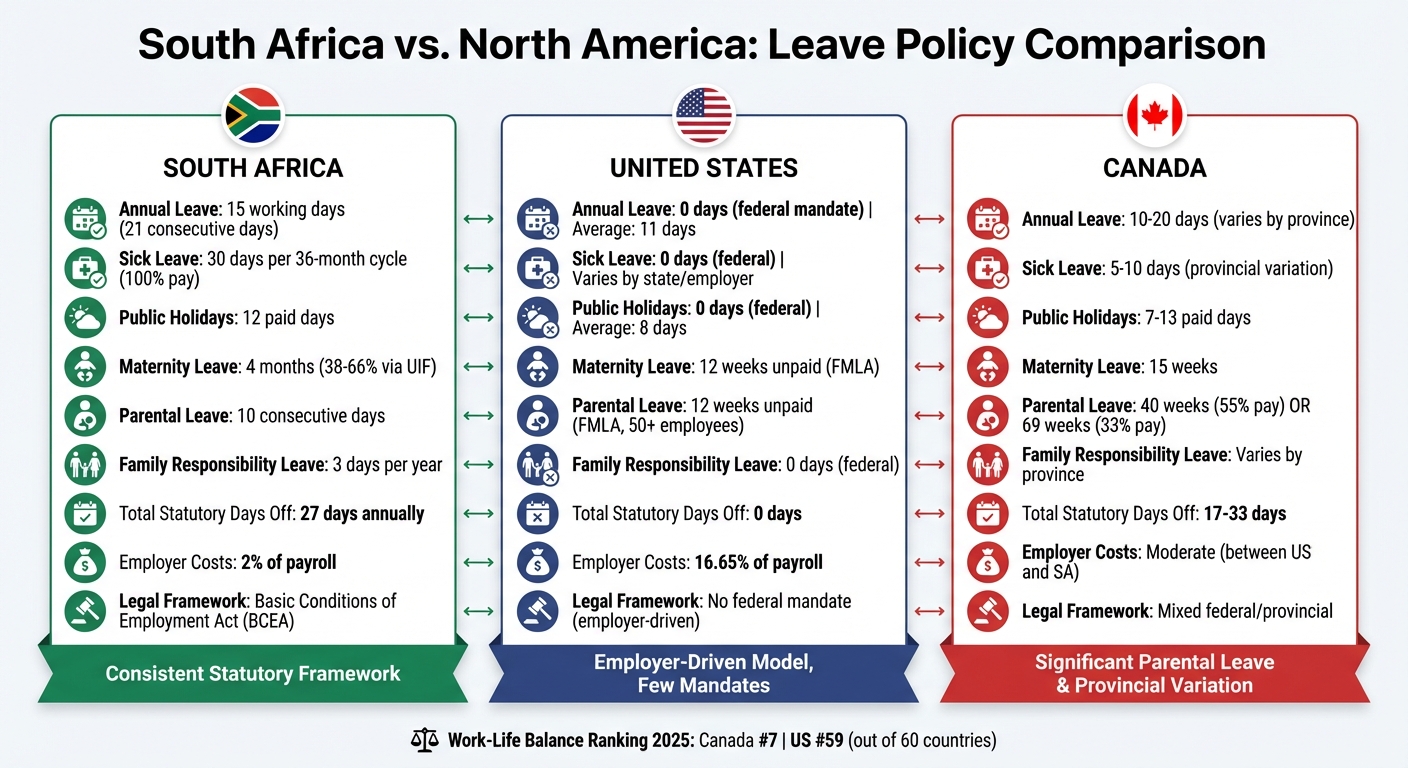
South Africa vs North America Leave Policy Comparison Chart
Vacation and Annual Leave: South Africa vs. North America
Statutory Leave Entitlements
When it comes to vacation entitlements, South Africa and North America operate under vastly different systems. In South Africa, employees are entitled to 15 working days of annual leave (equivalent to 21 consecutive days for a standard five-day workweek), along with 12 paid public holidays. This adds up to 27 paid days off each year. These regulations highlight the structured approach South Africa takes, compared to the more flexible – or often nonexistent – requirements in North America.
In the United States, there’s no federal mandate for paid vacation or public holidays. Employers have complete discretion over offering such benefits, meaning vacation time is not guaranteed. On average, private-sector employees receive just 11 vacation days after one year of service, along with approximately 8 public holidays – neither of which are legally required.
Canada occupies a middle ground. Most provinces require employers to provide 10 days of vacation after one year of employment, with this number increasing based on tenure. Canadian employees also benefit from 7 to 13 paid public holidays, depending on the province. Saskatchewan stands out by offering three weeks of vacation after just one year – a notable exception.
"The United States stands alone among industrialized nations with no federal law mandating paid annual vacation, paid sick leave, or paid family leave." – Acciyo
South Africa also enforces additional protections that are absent in the U.S. For instance, if a public holiday falls during an employee’s scheduled vacation, South African law grants an extra day off. Unused leave must be carried over and used within six months of the new leave cycle, and cash payouts for unused leave are only allowed upon termination. In contrast, U.S. policies vary significantly depending on the state and the employer, with no overarching federal guidelines.
Vacation Entitlements Comparison Table
| Region | Statutory Vacation (Working Days) | Paid Public Holidays | Total Statutory Minimum | Increases with Tenure |
|---|---|---|---|---|
| South Africa | 15 days | 12 days | 27 days | Standard from year one |
| Canada | 10–20 days | 7–13 days | 17–33 days | Yes (typically after 5 and 10 years) |
| United States | 0 days | 0 days | 0 days | Not applicable (no statutory requirement) |
Globally, the average statutory paid vacation is about 18.2 days per year, with public holidays averaging 11–12 days. South Africa’s 27-day minimum comfortably exceeds this global benchmark, while the U.S. lags far behind. Rankings from the 2025 Global Life-Work Balance Index reflect this disparity: Canada secured the #7 spot, while the U.S. ranked a dismal #59 out of 60 countries.
In the next section, we’ll take a closer look at how sick leave policies compare across these regions. These differences are critical for North American companies navigating compliance when hiring South African employees, offering further insight into the broader regulatory landscape.
sbb-itb-7512dae
Sick Leave Policies: South Africa vs. North America
South Africa’s Paid Sick Leave
South Africa’s sick leave policies are outlined in the Basic Conditions of Employment Act (BCEA), offering a structured and employee-friendly approach. Employees working a standard five-day week are entitled to 30 days of paid sick leave over a 36-month cycle.
For the first six months of employment, sick leave accrues at the rate of one day per 26 days worked. After this period, employees gain access to the full 30-day entitlement. Importantly, sick leave is compensated at 100% of an employee’s regular wages, ensuring financial stability during illness. However, employers are allowed to request a medical certificate if an employee is absent for more than two consecutive days. If proper documentation isn’t provided, they can withhold pay.
"During each sick leave cycle, an employee is entitled to an amount of paid sick leave equal to the number of days the employee would ordinarily work during a period of six weeks." – Rivermate
North America’s Sick Leave Framework
Sick leave policies in North America are far less uniform than in South Africa. In the United States, there are no federal mandates for paid sick leave. The Family and Medical Leave Act (FMLA) does offer up to 12 weeks of unpaid, job-protected leave for serious health conditions, but this applies only to companies with 50 or more employees. Beyond this, sick leave rules are determined by individual states or employers.
By late 2025, 19 U.S. states were expected to implement their own statutory paid sick leave laws. These often feature different accrual methods. For instance, some states require employees to earn one hour of sick leave for every 30 hours worked. In practice, U.S. private-sector workers average 14–15 days of total time off, which often combines sick leave with vacation in a general PTO system.
Canada provides more coverage than the U.S. but operates under a mixed federal and provincial framework. Federal private-sector employees can accrue up to 10 days of paid sick leave annually. At the provincial level, policies vary widely. For example:
- British Columbia mandates 5 days of paid sick leave after 90 days of employment.
- Quebec provides 2 days per year after three months of service.
- Prince Edward Island offers 1 to 3 days, depending on tenure.
As of 2023, 64% of Canadian workers had access to paid sick leave, with British Columbia leading the way at 69.1% coverage.
Sick Leave Comparison Table
Here’s a side-by-side look at how sick leave policies differ across South Africa, Canada, and the United States:
| Feature | South Africa | Canada | United States |
|---|---|---|---|
| Statutory Entitlement | 30 days per 36-month cycle | Varies (5–10 days annually) | 0 days (federal); varies by state |
| Accrual Rate | 1 day per 26 days worked (first 6 months) | 1 day per month (federal); varies by province | Varies by state (e.g., 1 hour per 30 hours worked) |
| Payment Rate | 100% of ordinary wages | Typically 100% for mandated days | Varies (often 100% where mandated) |
| Cycle/Reset | 3-year cycle | Annual | Annual (where applicable) |
| Medical Certificate | Required after 2 consecutive days | Varies by province/employer | Varies by state/employer |
On average, Canadian workers take 12.5 days off annually for illness, which is higher than the statutory minimums in most provinces. In South Africa, the 30-day entitlement over three years averages out to 10 days per year, making it comparable to Canada’s federal standard. Meanwhile, the lack of federally mandated sick leave in the U.S. leaves many workers without guaranteed protection, creating a stark contrast with the other two regions.
Parental Leave: South Africa vs. North America
South Africa’s Parental Leave Framework
In October 2025, South Africa streamlined its parental leave policies into a unified system, offering four months and ten days of leave. This applies to all parents – biological, adoptive, and those using surrogacy. Employers aren’t responsible for funding this leave. Instead, birth mothers can claim benefits from the Unemployment Insurance Fund (UIF), which covers 38% to 66% of their salary, capped at $960 (R17,712) per month. Birth mothers are required to take at least six weeks of recovery leave unless cleared earlier by a doctor.
Currently, non-birthing parents are excluded from UIF benefits, though Parliament has until October 2028 to address this gap. This system creates a clear framework for comparison with North America’s policies.
North America’s Parental Leave Variations
In the United States, there is no federal mandate for paid parental leave. The Family and Medical Leave Act (FMLA) allows eligible employees at companies with 50 or more workers to take 12 weeks of unpaid, job-protected leave. However, only about 55% of employers voluntarily offer some form of paid maternity leave. On the state level, some states like Minnesota, Delaware, and Maine have introduced paid family leave programs by 2026.
Canada, on the other hand, provides a more structured system. Through Employment Insurance (EI), parents receive 15 weeks of maternity leave, followed by shared parental leave options. Families can choose between 40 weeks at 55% pay or 69 weeks at 33% pay. Starting in 2026, the maximum weekly benefits are $729 for standard leave or $437 for extended leave. Parents also have the flexibility to spread their leave over 18 months.
"The United States is the only industrialized nation in the world that does not mandate any form of paid maternity or parental leave at the federal level." – Acciyo
Parental Leave Comparison Table
| Feature | South Africa | United States | Canada |
|---|---|---|---|
| Maternity Leave | 4 months (unpaid by law) | 12 weeks (unpaid) | 15 weeks |
| Paternity/Parental Leave | 10 consecutive days | 12 weeks (unpaid, shared) | 40 weeks (standard) or 69 weeks (extended) |
| Shared Leave Option | Yes (unified pool) | No (individual entitlement) | Yes (shared between parents) |
| Statutory Pay Rate | 38%–66% (via UIF, birth mothers only) | 0% (federal) | 55% (standard) or 33% (extended) |
| Adoption Leave | Same as parental leave | 12 weeks (unpaid) | Same as parental leave |
| Job Protection | Guaranteed under BCEA | Guaranteed under FMLA (50+ employees) | Legally guaranteed |
Canada offers the most extended leave duration with partial income replacement, South Africa provides a gender-neutral structure with moderate coverage, and the U.S. focuses on job protection without financial support at the federal level.
Public Holidays and Additional Leave Benefits
Public Holiday Entitlements
In South Africa, employees are entitled to 12 paid public holidays annually, as outlined in the Public Holidays Act. These include notable days like Freedom Day, Youth Day, and Heritage Day. If a public holiday falls on a Sunday, the following Monday is observed as a paid holiday. Employees required to work on public holidays must be compensated at double their regular wage. Employers managing offshore teams in South Africa need to account for these statutory benefits when planning payroll and schedules.
In contrast, the United States does not have a federal law mandating paid public holidays. While the federal government observes 11 holidays, offering paid holidays in the private sector is entirely at the employer’s discretion. On average, private-sector workers in the U.S. receive about 8 paid public holidays, but 25% of employees do not receive any paid vacation or holiday benefits.
"The United States is virtually unique among developed economies in offering no federally mandated paid vacation." – HR.Software
Canada takes a middle-ground approach, offering 7 to 13 paid public holidays, depending on the province or territory and the employee’s seniority. While more structured than the U.S., Canada’s system lacks the uniformity of South Africa’s national standard.
Additional Leave Benefits
In addition to public holidays, South Africa provides 3 days of Family Responsibility Leave (FRL) per year for employees who work at least four days a week and have been employed for four months. This leave applies to specific circumstances, such as a child’s illness or the death of an immediate family member, including a spouse, parent, child, or sibling. FRL is separate from annual leave, and unused days do not carry over to the next cycle.
"As per the Public Holidays Act, 1994, an employee cannot be made to work on public holidays unless they agree to do so." – Plane
In North America, no federal law guarantees family responsibility leave. In the U.S., the Family and Medical Leave Act (FMLA) provides 12 weeks of unpaid leave for family-related reasons, but it only applies to companies with 50 or more employees and offers no pay. Bereavement or family care leave is typically determined by employer policies or state-specific mandates. By late 2025, 19 U.S. states had introduced some form of statutory paid sick or family leave, but coverage remains inconsistent across the country.
Public Holidays Comparison Table
| Region | Statutory Paid Public Holidays | Payment Status | Key Examples |
|---|---|---|---|
| South Africa | 12 days | Mandatory (Double pay if worked) | Freedom Day, Youth Day, Heritage Day |
| United States | 0 (Federal Mandate) | Discretionary (Private Sector) | Thanksgiving, Independence Day, Labor Day |
| Canada | 7–13 days (Provincial) | Mandatory | Canada Day, Victoria Day, Family Day |
For businesses operating in North America, understanding the additional leave entitlements in South Africa is crucial. South African employees benefit from stronger statutory protections for family-related emergencies, whereas U.S. workers often rely on their employer’s PTO policies or state-specific laws.
Why South African Talent Works for North American Businesses
How Talently Simplifies Offshore Staffing
Hiring South African talent comes with its own set of challenges for North American businesses – think unfamiliar labor laws, payroll systems, and compliance hurdles. That’s where Talently steps in, making offshore staffing much easier by handling payroll, taxes, and social contributions. This means businesses don’t need to establish a local entity to get started.
The cost benefits are hard to ignore. In South Africa, employer-side costs are around 2%, compared to a hefty 16.65% in the U.S. On top of that, salary arbitrage can save businesses about 66%. Talently wraps all these services into a fixed monthly fee starting at $2,500, ensuring compliance with South Africa’s Basic Conditions of Employment Act (BCEA) and Labour Relations Act (LRA).
"South African labour law is well-defined and enforced, and any non-compliance can be expensive. Modern Day Talent provides a fully compliant HR, payroll, and legal framework for building high-performing offshore teams." – Leigh Daniels, Modern Day Talent
Talently doesn’t just save money – it also manages the seven statutory leave types required by the BCEA, including annual, sick, maternity, parental, adoption, commissioning parental, and family responsibility leave. This takes the burden off North American managers, who no longer need to keep track of South African public holidays or calculate sick leave cycles. Plus, Talently steps in to handle workplace disputes through the Commission for Conciliation, Mediation and Arbitration (CCMA), shielding international employers from potential legal risks.
This streamlined approach creates a foundation for improved workforce stability and productivity.
Benefits of South African Leave Policies for Remote Teams
When businesses tap into Talently’s solutions, they also unlock the benefits of South Africa’s leave policies, which are designed to enhance employee well-being and retention. For example, annual and sick leave provisions ensure employees can take time off without worrying about financial strain.
These policies go a long way in creating a healthier and more dependable remote workforce. South African professionals, fluent in English and working within North American time zones, are well-positioned for real-time collaboration. Statutory leave options like family responsibility leave (3 days annually) and parental leave (10 days) promote work-life balance, which directly impacts engagement and loyalty. Considering the U.S. ranks #59 out of 60 countries for work-life balance, South Africa’s structured legal framework offers a more supportive environment for offshore employees.
Paid Leave In The US vs. The World – Cheddar Explains
Conclusion
Our review highlights striking differences in statutory leave policies across regions. South Africa, under the Basic Conditions of Employment Act (BCEA), guarantees 21 consecutive days of annual leave, 30 to 36 days of sick leave over a three-year cycle, and defined parental leave options. On the other hand, the United States stands out as the only industrialized nation without federally mandated paid vacation, sick leave, or parental leave. Canada falls in between, offering 10 to 20 days of annual leave, depending on tenure, with provincial rules governing sick leave.
These disparities present both challenges and opportunities for businesses in North America. South Africa’s structured leave policies not only help control employer costs – estimated at 2% of payroll, compared to 16.65% in the U.S. – but also contribute to a more stable and engaged workforce. For example, the BCEA’s inclusion of three paid family responsibility leave days per year helps reduce burnout and improve employee retention. In contrast, the lack of federal leave mandates in the U.S. has led to 32% of workers reporting that work interferes with family life.
For North American businesses navigating these complexities, platforms like Talently offer practical solutions. With services that handle payroll, statutory contributions, and compliance with South Africa’s seven types of leave under the BCEA, Talently eliminates the need to establish a local entity. Starting at a fixed monthly fee of $2,500, this approach ensures legal compliance while simplifying operations.
FAQs
How do I calculate South Africa’s 15 days of annual leave in a 5-day workweek?
South African labor laws ensure that full-time employees receive at least 15 working days of fully paid vacation each year. For those working a standard 5-day week, this translates to 1 day of leave for every 17 days worked. With a typical work year consisting of 260 days, this adds up to the required minimum of 15 days of leave annually.
Can U.S. employers legally cap or pay out unused leave for South African employees?
Employers in the U.S. cannot arbitrarily limit or withhold payouts for unused leave when it comes to South African employees. South African labor law requires a minimum of 21 consecutive days (or 15 working days) of fully paid annual leave. This includes specific rules regarding how leave is accrued, carried over, and paid out upon termination. To ensure compliance, employers should seek legal advice and review their leave policies to meet South African legal standards.
What funding and job protection apply to parental leave in South Africa vs. the U.S. and Canada?
In South Africa, parents are entitled to at least 10 weeks of unpaid maternity leave with some level of job protection. However, financial assistance during this period largely depends on whether employers choose to offer it, as government support is minimal.
In the U.S., the Family and Medical Leave Act (FMLA) grants up to 12 weeks of unpaid leave with job security. Meanwhile, Canada stands out by offering up to 12 months of paid parental leave through government programs, coupled with job protection. This makes it one of the most financially supportive systems for parents.
Related Blog Posts
Ready to build your dream team?
Book a free consultation and get your first candidate shortlist within 48 hours.
No upfront fee • Only pay if you hire