
South African Talent vs. North American Labor Laws
 22 min read

Hiring South African talent can cut business costs by 40%-60% compared to U.S. or U.K. employees, but compliance with South Africa’s strict labor laws is non-negotiable. Unlike the U.S.’s “at-will” system, South African laws require valid reasons and detailed procedures for terminations. Misclassifying workers or ignoring local regulations can lead to costly legal disputes.
Key takeaways:
- Cost Advantage: South African wages, at R30.23/hour (~$1.60 USD), are significantly lower than U.S. federal minimum wage ($7.25/hour).
- Strict Labor Protections: Terminations require documented reasons and hearings. Missteps may result in up to 12-24 months’ salary in compensation.
- Worker Rights: Employees receive 15 paid leave days annually, 30 sick days over three years, and mandatory overtime pay (up to 2x regular rates).
- Compliance: North American companies must adhere to South African laws, even when hiring remotely, including proper worker classification and overtime limits.
For U.S. and Canadian firms, understanding these differences is crucial to avoid legal risks while leveraging South Africa’s skilled workforce.
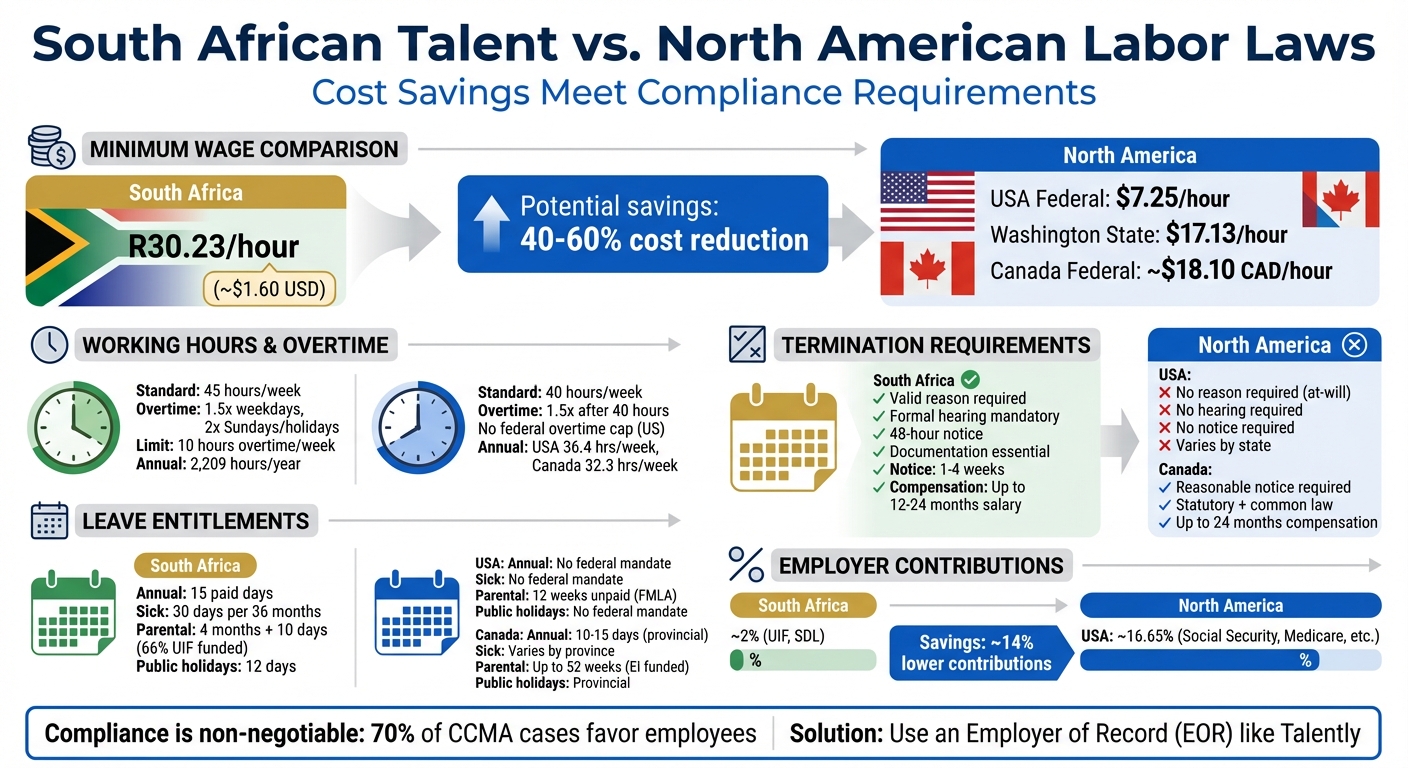
South African vs North American Labor Laws: Cost and Compliance Comparison
Minimum Wage and Compensation
South African National Minimum Wage Act (2018)
South Africa enforces a national minimum wage that applies broadly to workers across the country. As of March 1, 2026, the rate is R30.23 per hour, marking the first time the minimum wage has surpassed R30. This increase reflects ongoing efforts to protect workers from exploitative pay and ensure fair compensation.
“The national minimum wage was introduced to protect vulnerable workers from unreasonably low pay and to promote social justice and a decent standard of living.” – Mayet & Associates
It’s important to note that this calculation excludes overtime, tips, allowances, or in-kind benefits unless they are legally recognized. Additionally, workers employed for less than four hours a day must still be paid for a minimum of four hours, amounting to R120.92 daily. However, there’s an exception for workers in the Expanded Public Works Programme (EPWP), who receive a reduced wage of R16.62 per hour.
North American Minimum Wage Variations
The minimum wage systems in North America vary greatly. In the United States, the federal minimum wage has been stuck at $7.25 per hour since 2009. However, a “triple-layer” system allows states and cities to set higher rates, with employers required to follow the most favorable rate for workers.
For 2026, Washington state leads with $17.13 per hour, while certain cities surpass even that – Seattle has set its rate at $21.30, Tukwila at $21.65, and West Hollywood at $20.25. California has also introduced industry-specific rates, such as $20 per hour for fast-food workers. In addition, 14 states and Washington, D.C. adjust their minimum wages annually based on the Consumer Price Index (CPI), ensuring wages keep up with inflation.
Canada uses a dual system. The federal minimum wage is projected to reach approximately $18.10 CAD per hour by April 1, 2026, applicable to federally regulated sectors like banking and telecommunications. For other industries, provinces and territories set their own minimum wages. Nunavut leads with the highest rate at $19.75 CAD per hour. Like the U.S., many Canadian regions adjust wages annually using CPI indexing.
These differences in wage policies result in significant cost variations, which are a key factor in offshore hiring decisions.
What This Means for Offshore Hiring
The wage gap between South Africa and North America creates a clear cost-saving opportunity for companies. At the current exchange rate, South Africa’s R30.23 per hour equates to about $1.60 USD – a fraction of the U.S. federal minimum wage. This allows North American businesses to potentially save up to 75% on labor costs, hiring skilled South African professionals for as low as $1,100 per month.
However, businesses must ensure compliance with South African labor laws. For example, certain industries may have higher wage requirements under a “Sectoral Determination” or “Bargaining Council Agreement”. Additionally, employers of domestic workers can deduct up to 10% of wages for accommodation, provided the housing meets health and safety standards. Failing to comply can lead to investigations, claims through the Commission for Conciliation, Mediation, and Arbitration (CCMA), or even penalties imposed by labor inspectors.
| Jurisdiction | 2026 Minimum Wage | Adjustment Mechanism |
|---|---|---|
| South Africa | R30.23/hour (~$1.60 USD) | Annual Statutory Review |
| USA (Federal) | $7.25/hour | Legislative Action (Congress) |
| Washington (US State) | $17.13/hour | Annual CPI Indexing |
| Canada (Federal) | ~$18.10 CAD/hour | Annual CPI Indexing |
| Nunavut (CA Territory) | $19.75 CAD/hour | CPI & Average Wage Indexing |
sbb-itb-7512dae
Working Hours and Overtime Regulations
South African Workweek Regulations
In South Africa, the standard workweek is 45 hours, which is five hours more than the typical North American workweek. For employees working a five-day schedule, the daily limit is 9 hours, while those on a six-day schedule are capped at 8 hours per day. Including overtime, no workday can exceed 12 hours total.
Overtime is strictly voluntary and must be agreed upon in writing. It’s limited to 3 hours per day or 10 hours per week. Pay for overtime is 1.5x the regular rate on weekdays, and 2x the regular rate for Sundays and public holidays.
“Overtime cannot be imposed unilaterally. Section 10 of the BCEA mandates that overtime work must be agreed upon by the employee.” – SchoemanLaw Inc
Overtime agreements signed during the first three months of employment automatically expire after one year unless renewed. This was highlighted in the 2023 case AMCU obo Mkohonto & others v ANDRU Mining, where five employees were dismissed for refusing overtime. The court ruled in favor of the employees, citing that the employer’s overtime agreements had expired, and reinstated them with back pay.
North American Workweek Standards
In the United States, the Fair Labor Standards Act (FLSA) defines a 40-hour workweek and mandates overtime pay at 1.5x the regular rate for any hours beyond that limit. Unlike South Africa, there’s no federal cap on the number of overtime hours an employee can work. Some states, like California, add extra rules, such as requiring overtime pay after 8 hours in a single day, even if the weekly total is under 40 hours.
Canada also follows a 40-hour federal workweek with 1.5x overtime pay. However, total weekly hours, including overtime, are capped at 48 hours. Both countries generally don’t require higher pay for weekends or holidays unless overtime thresholds are exceeded.
The number of hours worked annually varies greatly between these regions. South African employees average 2,209 hours per year, the highest among 37 affluent countries analyzed. This far exceeds the U.S. average of 36.4 hours per week and Canada’s 32.3 hours per week. Additionally, 18.1% of South African workers clock over 50 hours weekly, compared to 11.1% in the U.S. and just 3.7% in Canada.
These differences highlight the importance of adapting compliance strategies to local labor laws.
How to Stay Compliant
For North American companies employing South African talent, compliance with South African labor laws is essential – even in remote work setups. The first step is implementing reliable time-tracking systems as part of your offshore staffing technology stack to ensure employees don’t exceed the 10-hour weekly overtime limit. In the case of Venter v Symington & De Kok, a South African court accepted computer login and logout times as evidence in an unpaid overtime dispute because the employer failed to maintain accurate records.
It’s also crucial to renew overtime agreements annually, especially those signed during the first three months of employment. A pre-approval system for overtime can help avoid unauthorized hours. Courts have emphasized that management must authorize overtime in advance. For example, in Glencore Operations SA (Pty) Ltd v NUMSA obo Motsepe, the court ruled that employees cannot create overtime situations on their own.
“The court established that valid overtime must be authorised in advance by management. Self-directed schedule adjustments designed to generate overtime claims are not legitimate.” – Global Business
When planning budgets, account for the 2x pay rate required for Sundays and public holidays. Many North American employers opt to align their South African teams with U.S. federal holidays instead of South African public holidays to maintain consistent workflows across teams.
Leave Entitlements and Benefits
South African Leave Laws
South Africa’s Basic Conditions of Employment Act (BCEA) provides employees with 15 working days of paid annual leave for every 12-month cycle. Employers are required to allow unused leave to roll over, and any accrued leave must be paid out when an employee leaves the company.
Sick leave operates on a 36-month cycle, offering employees on a five-day workweek 30 days of paid sick leave over this period. For the first six months of employment, sick leave accrues at a rate of one day for every 26 days worked. Employers may request a medical certificate for absences longer than two days.
In October 2025, South Africa introduced a shared parental leave system, replacing the previous gender-specific policies. Parents now share 4 months and 10 days of leave, though this is unpaid by employers. Instead, the Unemployment Insurance Fund (UIF) covers 66% of monthly wages, capped at R17,712 (approximately $980 USD). Interestingly, 48% of surveyed companies now offer top-up payments to cover the remaining 34% of salaries for up to 16 weeks.
“The Constitutional Court has now confirmed the 2023 ruling, finding that the family leave provisions in the BCEA and UIA violate constitutional rights to equality and human dignity.” – WTW
Employees are also entitled to 3 days of paid family responsibility leave annually. This covers events like the birth of a child (if not on parental leave), caring for a sick child, or the death of an immediate family member. Additionally, South Africa observes 12 statutory public holidays each year. If a holiday falls on a Sunday, the following Monday becomes a paid holiday.
These benefits highlight the importance of adhering to local regulations while balancing cost-effective policies.
North American Leave Policies
In the United States, there is no federal requirement for paid vacation days, though many employers voluntarily provide 10–15 days. The Family and Medical Leave Act (FMLA) offers 12 weeks of unpaid leave for qualifying family or medical situations, but only for companies with 50 or more employees.
Canada offers more extensive benefits through its Employment Insurance (EI) system. New parents can access up to 52 weeks of combined maternity and parental leave, with EI covering a portion of their salary. Additionally, most Canadian workers receive 10–15 days of annual leave, though the exact amount depends on provincial laws.
For sick leave, neither the U.S. nor Canada has a federal policy comparable to South Africa’s 36-month sick leave cycle. Instead, policies vary by state, province, or employer.
| Leave Type | South Africa | United States | Canada |
|---|---|---|---|
| Annual Leave | 15 working days | No federal mandate | 10–15 days (provincial) |
| Parental Leave | 4 months + 10 days | 12 weeks (unpaid FMLA) | Up to 52 weeks (EI-funded) |
| Sick Leave | 30 days per 36 months | No federal mandate | Varies by province |
| Funding | UIF (66% of pay) | Typically unpaid | Employment Insurance (EI) |
The differences in leave policies emphasize the need for tailored approaches when managing international teams.
Managing Leave Policies for Remote Teams
When employing South African talent in North American teams, employers must comply with South African labor laws. One common solution is the Employer of Record (EOR) model, which handles payroll, UIF contributions, and leave tracking without requiring a local legal entity.
Some offshore employers align public holidays with U.S. schedules to simplify operations.
“Annual leave: Aligned with the client’s UK or US policies, rather than South African statutory leave… This approach helps offshore teams mirror the working patterns and culture of their UK and US counterparts.” – Leigh Daniels, Modern Day Talent
HR systems need to account for South Africa’s 36-month sick leave cycle. Additionally, many South African businesses enforce mandatory December shutdowns, requiring employees to use their annual leave – a factor North American employers should consider during year-end planning.
Providing a parental leave top-up can be a game-changer. Since UIF only covers 66% of wages, offering the additional 34% can attract top talent. These top-up benefits should be clearly outlined in contracts to avoid confusion about payment responsibilities.
Navigating these differences is essential for ensuring compliance and employee satisfaction in cross-border teams. Tools like Talently can simplify this process by managing UIF registration, tracking sick leave cycles, and coordinating parental leave claims. This allows North American companies to focus on operations while ensuring South African employees receive their full entitlements.
Termination and Dismissal Practices
South African Labor Law Requirements
In South Africa, dismissals must meet two key criteria: they must have a valid reason (substantive fairness) and follow a fair process (procedural fairness). Valid reasons include misconduct, incapacity, or operational needs, while procedural fairness involves conducting a proper investigation, providing 48-hour notice, allowing representation, and ensuring a neutral hearing.
“A fair dismissal must be both substantively and procedurally fair.” – CMS Expert Guide
The Commission for Conciliation, Mediation and Arbitration (CCMA) oversees most workplace disputes, typically scheduling hearings within 30 days of a referral. Interestingly, about 70% of unfair dismissal cases end in favor of the employee.
Compensation for unfair dismissals can reach up to 12 months’ salary. However, cases deemed “automatically unfair” (e.g., dismissals tied to pregnancy, whistleblowing, or union activity) may result in awards of up to 24 months’ salary. Notice periods are based on tenure: 1 week for employees with less than six months of service, 2 weeks for six to twelve months, and 4 weeks for those employed over a year. Even during probationary periods (typically 3–6 months), employers must provide feedback and follow fair procedures before terminating employment.
By comparison, termination practices in North America are less structured.
North American At-Will Employment Model
The United States operates under the “at-will” employment model.
“At-will means an employer can terminate an employee at any time, for any reason – or no reason at all – as long as it’s not illegal.” – Grace Simpson, Director of HR, AllWork
This model allows U.S. employers to terminate employees without a reason, formal hearing, or advance notice, provided the termination doesn’t violate anti-discrimination or other legal protections. Some states, such as California, require immediate payment of final wages upon involuntary termination.
In Canada, the approach is slightly different. While employers can terminate employees without cause, they must provide “reasonable notice” or compensation in lieu of notice. Statutory notice periods vary by province, typically ranging from 1 to 8 weeks. Under common law, long-serving or senior employees may be entitled to as much as 24 months’ notice or compensation.
Given these differences, handling South African terminations requires a more structured approach.
| Feature | South Africa | United States | Canada |
|---|---|---|---|
| Reason Required? | Yes (Substantive Fairness) | No (Any or no reason) | No (If notice/pay provided) |
| Formal Hearing? | Yes (Procedural Fairness) | No | No |
| Notice Period | 1–4 weeks (Statutory) | None (Unless contracted) | Statutory plus Common Law |
| Max Compensation | 12–24 months | Varies (Damages-based) | Up to 24 months (Common Law) |
How to Handle Termination Correctly
When managing cross-border teams, especially in South Africa, following proper termination procedures is critical. Applying the U.S. at-will model to South African employees can lead to costly legal disputes. Employers in South Africa must conduct a thorough investigation and hold a formal disciplinary hearing with at least 48 hours’ notice. For performance-related issues, a Performance Improvement Plan (PIP) should be implemented, setting clear goals and timeframes before considering dismissal.
Maintaining detailed records is essential to defend against claims at the CCMA. Documentation such as performance reviews, written warnings, counseling notes, and meeting minutes can serve as critical evidence. For instance, in 2024, InnovaTech lost a CCMA case and was ordered to pay 12 months’ salary because it failed to issue warnings before terminating an employee for poor performance.
In cases of retrenchment, employers must follow the Section 189 consultation process with affected employees. A 2024 case involving ManufactureCo highlighted the consequences of skipping this step. The company retrenched 30% of its staff without proper consultation, leading the Labour Court to reinstate the employees with full back pay and restart the consultation process.
For businesses looking to navigate these complexities, Talently offers support by managing CCMA representation, documentation, statutory notice, and final payments. This allows North American companies to focus on their operations while avoiding legal pitfalls.
Discrimination and Equity Measures
South African Affirmative Action Policies
South Africa’s approach to workplace equity is deeply tied to its history of apartheid. The Employment Equity Act (EEA) of 1998 doesn’t just prohibit discrimination – it actively requires employers to create opportunities for groups that were historically marginalized. These include African, Coloured, and Indian individuals, as well as women and people with disabilities.
“The EEA was originally enacted to counter the enduring effects of apartheid-era exclusion. Its central aim is to guarantee fairness in the workplace by promoting equality, banning unfair discrimination, and implementing affirmative action where necessary.” – Mayet & Associates
A major update came into effect on January 1, 2025, redefining what it means to be a “designated employer.” Now, any business with 50 or more employees falls under this category, regardless of turnover. These businesses must create employment equity plans and submit annual reports to the Department of Employment and Labour. Smaller companies, with fewer than 50 employees, are exempt. Another key change in 2025 was the introduction of sector-specific numerical targets for 18 industries, such as finance, IT, and mining. Instead of setting their own goals based on local demographics, employers must now meet government-mandated benchmarks.
Non-compliance can be costly. Fines start at $83,000 (ZAR 1.5 million) or 2% of turnover for first offenses, escalating to $150,000 (ZAR 2.7 million) or 10% of turnover for repeat violations. Additionally, companies bidding for state contracts must hold a compliance certificate, valid for 12 months, which confirms they meet sectoral targets or have justified any gaps.
North American Anti-Discrimination Laws
North America takes a different approach, focusing on preventing discrimination rather than mandating affirmative action. In the United States, laws like Title VII and the Americans with Disabilities Act (ADA) protect against discrimination based on characteristics such as race, gender, religion, and age. The Equal Employment Opportunity Commission (EEOC) oversees enforcement, and employers are required to provide reasonable accommodations for disabilities unless it would cause undue hardship.
Canada enforces anti-discrimination through its provincial human rights codes and the Canadian Charter of Rights and Freedoms. Employers must accommodate disabilities to the point of “undue hardship.” Interestingly, conditions like alcoholism and drug addiction are recognized as disabilities under Canadian law.
“In Canada, disability-based discrimination is prohibited under human rights codes and the Canadian Charter of Rights and Freedoms. Employers have a duty to accommodate an employee’s disability up to the point of undue hardship to the employer.” – Torys LLP
| Feature | South Africa (EEA) | United States (Title VII/ADA) | Canada (Human Rights Codes) |
|---|---|---|---|
| Primary Goal | Address historical inequities | Prevent discrimination | Promote equity and accommodation |
| Targeting | Specific designated groups | Broad protected classes | Protected groups defined by law |
| Enforcement | Sectoral targets and compliance certificates | EEOC oversight and litigation | Human Rights tribunals |
| Disability Standard | Reasonable accommodation | Reasonable accommodation | Accommodation to “undue hardship” |
| Small Business | Exempt if <50 employees | Applies to 15+ employees | Varies by province |
Building Equity in Offshore Teams
When working with South African talent as part of a North American team, understanding these differing legal frameworks is essential. For businesses employing 50 or more people in South Africa, compliance with the EEA’s affirmative action requirements is mandatory. This includes crafting equity plans that align with the 2025 sectoral targets.
It’s not enough to rely on U.S. anti-discrimination standards when managing South African employees. Employers must actively monitor workplace demographics, compare them to government benchmarks, and address representation gaps to avoid audits. Balancing compliance with both South African and North American laws ensures legal security while fostering a workplace that values inclusion.
Talently helps North American companies navigate these challenges. The platform handles equity reporting, ensures sectoral target compliance, and manages submissions to the Department of Employment and Labour. Services include maintaining proper documentation, conducting diversity assessments, and offering training programs that cover both North American anti-discrimination laws and South African equity requirements.
Compliance Strategies for North American Employers
Using Talently for Compliance
Managing South African labor laws from North America can be a maze of complexities. Setting up a local entity isn’t just time-intensive – it’s expensive. Tackling tax filings, payroll administration, and potential legal risks from the Commission for Conciliation, Mediation and Arbitration (CCMA) can quickly overwhelm a business. That’s why many companies opt for an Employer of Record (EOR) solution instead.
Talently steps in as the legal employer for your South African hires, letting you focus on day-to-day operations without the administrative burden. They handle everything from drafting contracts that comply with the Basic Conditions of Employment Act (BCEA) to managing Pay-As-You-Earn (PAYE) income tax and mandatory contributions, such as the 1% Unemployment Insurance Fund (UIF) and Skills Development Levy (SDL). For a fixed monthly fee starting at $2,500 per full-time role, Talently simplifies international payroll and ensures compliance with cross-border tax obligations.
“We handle recruiting, contracts, payroll, benefits, compliance, and HR. 100% Employment covered.” – Talently
Talently has helped businesses cut costs by 50% while improving operational efficiency, particularly through better time zone alignment. Their services also cover essential statutory requirements, like registering under the Compensation for Occupational Injuries and Diseases Act (COIDA), and they offer local representation for CCMA disputes.
With these streamlined solutions, companies can confidently navigate international employment while staying compliant.
Best Practices for Cross-Border Employment
Building on Talently’s compliance framework, adopting these best practices can help ensure adherence to South African labor laws while optimizing costs and processes. These strategies also highlight the key differences between South African and North American employment standards.
Create localized contracts and maintain detailed performance records.
South African employment contracts must meet specific legal requirements, such as including earnings thresholds (which determine overtime eligibility), probation terms, and notice periods. For example, notice periods range from 1 week for employees with less than six months of service to 4 weeks for those employed over a year. Worker classification is equally critical – South Africa uses the “dominant impression test” to differentiate employees from independent contractors. Misclassification can lead to steep penalties. Unlike North America’s “at-will” employment model, South African law requires that terminations be based on valid reasons, such as misconduct or poor performance, and follow a fair, documented process – even during the standard 3-month probation period.
“South African labour law is well-defined and enforced, and any non-compliance can be expensive.” – Leigh Daniels, Modern Day Talent
Adapt leave policies thoughtfully.
To maintain team cohesion, consider aligning South African public holidays with North American schedules. However, contracts must meet statutory requirements, such as offering at least 21 consecutive days of annual leave. While South Africa recognizes 12 official public holidays, employers are obligated to honor at least 10.
Prepare for infrastructure challenges.
Frequent load-shedding in South Africa can disrupt remote work. Providing employees with backup power solutions, like UPS systems or inverters, can help ensure uninterrupted operations.
Stay updated on regulations.
Labor laws in South Africa are dynamic. For instance, the National Minimum Wage Commission reviews rates annually, with the minimum wage set at ZAR 28.79 per hour (around $1.50) as of March 1, 2026. Additionally, sector-specific targets under the Employment Equity Act are updated periodically, such as the 2025 benchmarks for 18 industries.
South Africa HR Employment Laws and Labour Relations Act
Conclusion
South Africa’s labor laws stand in stark contrast to the at-will employment system in North America. While U.S. employers can often terminate employees without providing a reason, South African labor law demands justifiable cause and adherence to documented procedures from day one – even during probation.
From a cost perspective, hiring talent in South Africa can be 40% to 60% less expensive than filling similar roles in the United States. Employer contributions are also much lower – around 2% in South Africa compared to approximately 16.65% in the U.S.. However, these savings come with the need for strict compliance. Missteps, such as misclassifying workers or relying on North American-style contracts, can lead to disputes at the CCMA and potential compensation awards of up to 12 months’ salary. This highlights the balancing act between reducing costs and navigating South Africa’s rigorous labor regulations.
To streamline this process, Talently acts as the legal Employer of Record for South African hires. For a fixed monthly fee starting at $2,500, they handle everything – drafting BCEA-compliant contracts, managing PAYE tax filings, UIF and SDL contributions, and even offering support in the event of disputes. This service enables North American businesses to access South Africa’s skilled workforce without the need to establish a local entity or grapple with unfamiliar labor laws.
Offshore hiring isn’t just about cutting costs – it’s about building compliant and sustainable teams across borders. By combining cost savings with a strong focus on compliance, North American employers can confidently tap into South Africa’s talent pool while respecting the labor protections that define its market. With the right approach and support, your cross-border team can thrive.
FAQs
Do I need to follow South African labor laws if my company is based in the U.S. or Canada?
If your company operates in the U.S. or Canada, South African labor laws generally don’t apply to you – unless you have a physical presence in South Africa or hire employees working there. The key factor is jurisdiction, which is determined by where the work is carried out and where the employment relationship exists.
What’s the biggest legal risk when hiring South African talent remotely?
The most pressing legal concern is failing to comply with South African employment laws, which regulate critical areas like payroll, taxation, and mandatory contributions (such as UIF and PAYE). Ignoring these laws can result in hefty penalties, legal battles, or harm to your company’s reputation. Partnering with an Employer of Record (EOR) can help navigate these challenges. An EOR handles employment contracts, payroll, and tax responsibilities in line with South African regulations, ensuring businesses stay on the right side of the law.
How can Talently help me stay compliant without setting up a South African entity?
Talently simplifies compliance with South African labor laws by serving as your Employer of Record (EOR). They take care of crucial responsibilities such as drafting employment contracts, managing payroll, handling tax deductions, and ensuring statutory benefits are provided. This setup allows you to legally hire remote talent from South Africa without the hassle of setting up a local entity or navigating the intricate compliance requirements yourself.
Related Blog Posts
Ready to build your dream team?
Book a free consultation and get your first candidate shortlist within 48 hours.
No upfront fee • Only pay if you hire