
Why US Companies Choose South African Teams
 16 min read

US companies are increasingly turning to South African teams for remote staffing. Why? The country offers a unique combination of cost savings, skilled professionals, and time zone compatibility. Here’s what you need to know:
- Cost Savings: Hiring from South Africa can reduce expenses by 45%–65%. For example, a $65,000 US-based sales role costs only $15,000–$25,000 in South Africa.
- Skilled Workforce: South Africa produces over 200,000 university graduates annually, with expertise in fields like finance, tech, and customer service.
- English Proficiency: Ranked “high proficiency” globally, South African professionals speak fluent, neutral-accented English, ideal for client-facing roles.
- Time Zone Advantage: With a 4–6 hour overlap with US Eastern Time, real-time collaboration is easier compared to other offshore markets.
- Reliable Infrastructure: Strong communications networks and a growing renewable energy sector ensure consistent service.
South African professionals are known for their problem-solving skills, familiarity with US business practices, and long-term commitment. This makes them a strong choice for companies looking to build effective global teams while keeping costs under control.
Offshore but On Point: Why South Africa is the Future of Recruitment Outsourcing with Ross Thompson
sbb-itb-7512dae
Cost Savings and Financial Benefits
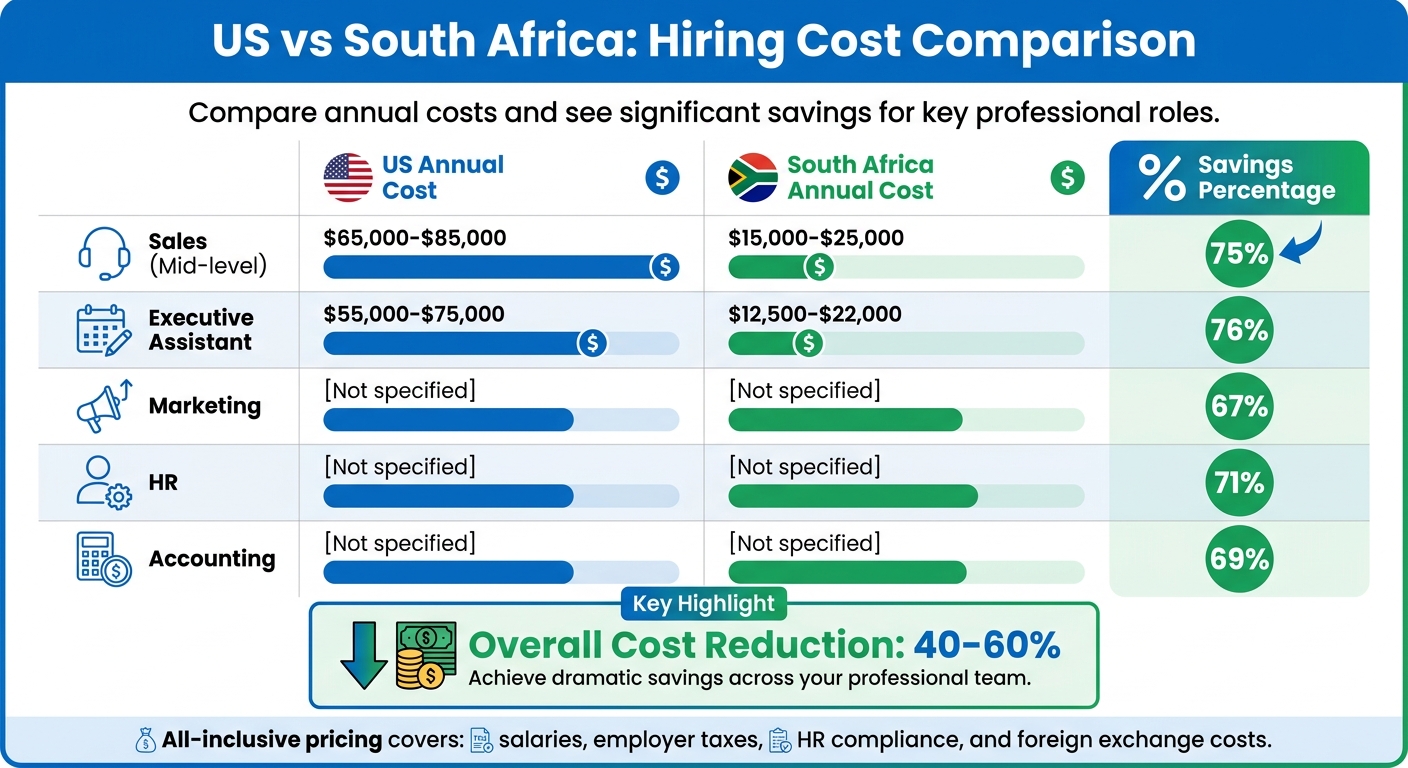
Cost Savings: US vs South Africa Hiring Comparison by Role
Lower Labor Costs Compared to US Markets
Hiring South African professionals allows US companies to cut costs by 40% to 60% compared to hiring domestically. For example, a mid-level sales role that typically costs $65,000–$85,000 annually in the US can be filled for just $15,000–$25,000 in South Africa – an impressive 75% reduction. Similarly, executive assistant roles, which command $55,000–$75,000 in the US, cost only $12,500–$22,000 when sourced from South Africa, saving around 76%. Other roles see similar savings: marketing positions save about 67%, HR roles 71%, and accounting jobs around 69%.
These savings are driven by South Africa’s lower wage structures and the consistently favorable exchange rate between the US Dollar and South African Rand. Additionally, with an unemployment rate hovering around 30%, South Africa offers a highly competitive job market, enabling US employers to access exceptional talent at a fraction of the cost.
“It is not outsourcing anymore. It is building a better team – for less.” – Talent Flow Partners
This cost efficiency provides a reliable foundation for businesses aiming to expand their operations.
Scalability Without Budget Overruns
South African teams not only offer lower labor costs but also provide financial predictability, offering key benefits of offshore staffing for businesses looking to scale. Traditional outsourcing often comes with hidden expenses, such as rework, management overhead, and inconsistent quality. In contrast, South African teams minimize these risks through strong communication and alignment with Western business standards.
An all-inclusive pricing model simplifies budgeting by covering everything – salaries, employer taxes, HR compliance, and foreign exchange costs. Remarkably, this comprehensive approach often costs less than the base salary of a comparable US employee. This predictable structure allows small and medium-sized businesses to scale quickly and confidently, adding team members across departments like sales, marketing, customer success, or operations without worrying about unexpected financial surprises.
Time Zone Compatibility and Real-Time Collaboration
Benefits of Time Zone Overlap
South Africa’s GMT+2 time zone offers a 4–6 hour overlap with US Eastern Time, making real-time communication and quick issue resolution much easier for East Coast companies. This alignment eliminates the delays often associated with offshore teams in other regions, ensuring smoother workflows.
Unlike teams in Asian markets, where feedback loops can stretch to 24 hours, South African professionals provide real-time collaboration during overlapping hours. This allows US managers to conduct stand-up meetings, hold live training sessions, and address issues while both sides are online. The result? Increased productivity and better team integration.
Additionally, many South African professionals are willing to adjust their schedules to accommodate US business hours. Some even extend their shifts until midnight, making it easier to maintain consistent communication. Leigh Daniels from Modern Day Talent highlights this flexibility:
“South African teams are also willing to work US hours, and while this can mean later shifts that run until around midnight, it is still far more manageable than full overnight work”.
These practices not only streamline operations but also position South Africa as a strong contender when compared to other offshore markets.
Comparison to Other Offshore Markets
Other offshore markets often struggle with time zone challenges. India, for example, has a significant time difference that can slow down feedback cycles. Meanwhile, the Philippines (UTC+8) aligns better with US West Coast companies but requires East Coast teams to manage staff working full overnight shifts. This setup can lead to employee fatigue and a drop in work quality over time.
South Africa offers a more balanced solution. Its time zone enables US coverage without the need for full overnight shifts, making it a sustainable option for long-term employee well-being and retention. Paired with its high English proficiency – South Africa ranks 12th globally on the EF English Proficiency Index – communication during overlapping hours remains smooth and effective. This is especially crucial for roles like sales, account management, and executive support, where immediate responses are key to maintaining client satisfaction.
English Proficiency and Communication Standards
South Africa ranks in the high proficiency category on the EF English Proficiency Index, making it an ideal choice for smoother customer interactions and efficient workflows. This high level of fluency ensures better internal communication and minimizes the risk of misunderstandings, especially when compared to other offshore markets.
One standout feature is accent neutrality. South African professionals typically speak with neutral accents that are easy for US clients and colleagues to understand. This clarity is a significant asset in client-facing roles like sales, account management, and customer support, where clear communication is critical. Importantly, no additional accent training is necessary.
South African professionals also align well with Western business practices. They are familiar with US corporate norms, communication styles, and workplace expectations, requiring little to no extra training. As Exclusively Remote Staffing notes, “South African remote staff tend to integrate into company culture more naturally. They don’t feel like an external vendor. They feel like part of the team.” This cultural alignment complements the cost savings and real-time collaboration benefits mentioned earlier. It also helps reduce management overhead and ensures smoother project execution with fewer misunderstandings.
By addressing potential communication issues upfront, South African teams help avoid hidden costs like rework, miscommunication, and excessive oversight. This allows US managers to focus on strategic priorities rather than micromanaging.
Reduced Training and Onboarding Time
These strong communication skills also lead to faster and more efficient training and onboarding processes.
With high English proficiency and significant international experience, South African professionals require little to no language training. They are often already familiar with Western business terminology, project management frameworks, and industry-specific jargon. This familiarity shortens the ramp-up period compared to entry-level talent from other regions, saving both time and money.
As one study highlights, “Clear communication isn’t just about language. It affects: Customer experience, Internal workflows, Training speed”. When new hires can quickly understand instructions and ask the right questions, training cycles become much shorter. Many US companies report that South African hires achieve full productivity faster than their counterparts from other offshore locations. This accelerated ramp-up period supports the scalability and cost efficiencies discussed earlier.
To fully capitalize on these advantages, it’s essential to emphasize communication skills during the interview process. Assessing candidates on their ability to solve problems, articulate solutions, and demonstrate critical thinking ensures that they require minimal oversight once onboarded.
Skilled Workforce Aligned with Industry Needs
South Africa’s skilled workforce adds another layer of appeal for US companies, complementing the cost savings and time zone advantages. The country produces over 200,000 university graduates each year and has seen a 41% growth in its Global Business Services sector since 2015, driven by increasing demand for digital, tech, and engineering expertise. This steady growth ensures a talent pool that meets the diverse needs of the US market.
South Africa’s workforce is equipped to handle critical business functions. In finance and accounting, for example, the country is a hub for Chartered Accountants (CA(SA)), who are globally recognized as the most trusted professionals in their field. Many of these accountants, along with actuaries, bring experience from Big Four firms and possess international expertise. In the tech sector, the talent pool includes software engineers, data analysts, and technical support professionals specializing in areas like fintech, e-commerce, and enterprise systems. Sales and marketing roles are also well-covered, with professionals such as Business Development Representatives, Sales Development Representatives, Account Executives, and digital marketing experts readily available.
South Africa’s reputation for customer service is another standout. The country was named the “Most Favored Global Offshore Customer Experience Delivery Location” in 2021. Its workforce is known for neutral accents and high levels of empathy, making it ideal for customer service and support roles. Beyond this, executive assistants, Chiefs of Staff, HR professionals, and legal experts round out the spectrum of talent available to US businesses.
This diverse talent pool supports a range of industries, with specific strengths in certain sectors.
Key Sectors with Available Talent
Different cities in South Africa have become specialized hubs for various industries. Cape Town, for example, leads in creative, marketing, and tech, with more than 450 tech firms employing over 40,000 people. Johannesburg is a center for finance and leadership, Durban excels in customer service, and Pretoria focuses on legal and research roles. Top universities like the University of Cape Town, Stellenbosch University, and the University of the Witwatersrand ensure a steady supply of highly educated professionals.
With unemployment rates exceeding 30%, US employers can access a highly competitive job market, allowing them to select talent from the top tier.
Critical Thinking and Problem-Solving Abilities
South African professionals bring more than technical skills to the table – they are also recognized for their critical thinking and problem-solving abilities. The challenges faced locally have fostered a resourceful and adaptable workforce. This translates into measurable results: South African offshoring and outsourcing providers deliver an 18% better customer experience compared to global averages and achieve 4–5% higher customer retention rates.
“What global teams are really looking for now is not just additional capacity, but confidence. Confidence that the people joining their teams will integrate quickly, communicate clearly and take shared ownership of outcomes. That’s where South Africa has earned its reputation.”
- Nick Durrant, Managing Director, Bluegrass Digital
This mindset fits seamlessly into agile work environments, where independent decision-making is essential. South African teams don’t just complete tasks – they take ownership of outcomes. This is one reason why US companies are increasingly incorporating South African professionals into their long-term strategies as part of a smart strategy for business growth rather than relying on short-term solutions.
Platforms like Talently (https://hirewithtalently.com) make it even easier for US companies to connect with South African talent, simplifying the recruitment process and ensuring smooth integration into teams.
Shared Values and Workforce Retention
Shared Business Values and Work Ethic
South African professionals bring a work culture that aligns effortlessly with Western business practices. They communicate effectively and follow US business norms, with South Africa’s high level of English proficiency making collaboration smooth and efficient. But it’s not just about language skills – South African teams go beyond the offshore vs onshore staffing models. Instead of waiting for instructions, they take initiative, ask thoughtful questions, and fully integrate into company workflows. As Matt Banks from Talent Flow Partners puts it:
“These professionals do not just process tasks – they build relationships, take ownership, and bring energy to the work”.
Another advantage is their familiarity with standard US collaboration tools, which speeds up onboarding and improves early retention rates. South African professionals are also known for being approachable, reliable, and deeply engaged, which strengthens team dynamics and fosters loyalty.
Long-Term Employee Retention
This alignment in values often results in long-term commitment. South African talent tends to stay in roles longer than professionals from many other offshore markets. This is partly because they are highly skilled and globally experienced, yet often underutilized in their local job market. Stable, meaningful employment encourages retention, which helps companies avoid the recurring costs of re-hiring and retraining. By reducing turnover, businesses save time and money, making South Africa a smart choice for building dependable teams.
US companies are shifting their focus from finding the cheapest labor to identifying where they can build the most effective teams. South Africa’s mix of cultural compatibility, strong communication, and proactive engagement makes it a standout option for creating cohesive, long-term teams.
Platforms like Talently (https://hirewithtalently.com) make it easy to connect with South African talent. They handle everything from vetting to payroll, allowing US companies to focus on building high-performing teams.
Infrastructure and Support Systems
Reliable Communications and Technology
South Africa’s major cities – Cape Town, Johannesburg, Pretoria, and Durban – are well-equipped with modern infrastructure that supports international contact centers and back-office operations. This strong foundation allows South African teams to work seamlessly with US-based operations. A significant boost to this comes from the improved telecommunications network, which has benefited from a broadband spectrum auction. This initiative lowered data costs and expanded network coverage.
While power reliability has been a challenge due to issues with the national grid, leading BPO providers have taken proactive steps to address this. Investments in backup power systems, renewable energy solutions, and advanced technologies ensure uninterrupted service. Over the past five years, an additional 2,500 MW of renewable energy has been integrated into the grid. These advancements help maintain consistent connectivity, critical for 24/7 operations.
“South Africa has built a reliable tech and infrastructure environment. Fortunately, heavy investment in renewable energy, backup systems, and advanced technology has improved resilience.” – 1840 & Company Editorial Team
The country’s infrastructure now supports more than just basic outsourcing tasks. It has evolved to deliver advanced digital and engineering services, enabling South African teams to scale operations as seamless extensions of US-based operations. This shift reflects the country’s ability to provide the governance and technical frameworks needed for efficient collaboration.
Established Business Process Outsourcing (BPO) Ecosystem
South Africa’s well-developed BPO ecosystem plays a key role in supporting complex international operations. The industry is not new to outsourcing – it has been growing at an impressive annual rate of 22% since 2017 and now contributes about 9% to South Africa’s GDP. This growth has created over 112,000 jobs, with the sector projected to reach a market value of approximately $3.6 billion by 2027.
Currently, more than 25% of the BPO workforce serves international clients, and by 2020, the sector employed over 270,000 people. Projections suggest this number could climb to 500,000 by 2030. This established track record ensures that US companies entering the market can rely on a proven system capable of supporting their needs.
Government initiatives have further fueled this growth. Training subsidies and infrastructure investments play a large role. For instance, the Western Cape government offers monthly subsidies of R3,500 (around $200) per trainee to outsourcing firms, supporting approximately 4,500 trainees annually. Of these, 80% secure full-time employment. Additionally, the Skills Development Levy requires employers to allocate 1% of their payroll toward workforce training, ensuring a steady supply of skilled professionals.
For US companies exploring partnerships in South Africa, it’s wise to focus on providers operating in major urban centers. These areas typically experience fewer infrastructure challenges and are equipped with reliable backup systems. Platforms like Talently (https://hirewithtalently.com) simplify the process by connecting businesses with vetted South African professionals while managing operational details. This mature ecosystem, combined with government support and a skilled workforce, underscores why South Africa is an increasingly popular choice for offshore support.
Conclusion
US companies are increasingly turning to South African teams for good reason: they offer operational savings of 45% to 65%, high levels of English proficiency, and overlapping time zones with the East Coast, making collaboration easier. South African professionals seamlessly integrate into teams, sharing Western business values and a strong work ethic.
This shift from traditional outsourcing to remote staffing represents a major change in how US businesses approach global talent. As Talent Flow Partners aptly put it:
“It is not outsourcing anymore. It is building a better team – for less”.
South African professionals excel in problem-solving, are well-versed in modern tech stacks, and bring the right attributes for client-facing roles like sales, customer success, and account management. Their ability to combine cost efficiency, real-time collaboration, and specialized skills is reshaping the concept of offshore staffing. With a steady pipeline of skilled talent, South Africa is well-positioned to support long-term partnerships.
For US companies looking to build distributed teams, Talently (https://hirewithtalently.com) simplifies the process. From sourcing and vetting to payroll and onboarding, they handle the heavy lifting, allowing businesses to focus on growth. Their thorough screening ensures South African professionals meet both technical needs and cultural expectations, making them an ideal choice for sustainable success.
South African talent delivers real results. With the right partner, building a cost-effective, high-performing team is no longer a challenge – it’s an opportunity waiting to be seized.
FAQs
Which roles are the best fit to hire in South Africa first?
When starting to build a team in South Africa, some of the top roles to consider hiring include customer service representatives, bookkeepers, and other positions that demand strong English proficiency and can be handled remotely. These roles are not only in high demand but also widely available, making them ideal for establishing a reliable and efficient South African workforce.
How do I manage contracts, compliance, and payroll for South African hires?
Managing contracts, compliance, and payroll for hires in South Africa can be much easier with the help of specialized offshore staffing providers. For example, Talently takes care of everything from sourcing and vetting talent to handling payroll and ensuring compliance, making the entire process smoother for businesses.
If you prefer to manage things directly, it’s crucial to have clear contracts that align with South African labor laws. You’ll also need to ensure proper payroll processing and adhere to local tax and employment standards. Taking these steps can help reduce potential legal risks.
How do South African teams handle load-shedding and internet reliability?
South African teams tackle the challenges of load-shedding (scheduled power outages) by adopting strategies to reduce disruptions. One common approach is relying on backup power solutions, like generators or battery systems, to keep operations running smoothly. Although internet reliability can sometimes be affected, many teams take proactive measures to maintain stable connectivity. These efforts ensure that remote work remains a practical option, even amidst the country’s ongoing energy struggles.
Related Blog Posts
Ready to build your dream team?
Book a free consultation and get your first candidate shortlist within 48 hours.
No upfront fee • Only pay if you hire