
English Proficiency in South African Talent: Key Benefits
 13 min read

Looking for offshore talent? South Africa offers a unique edge for North American businesses. Here’s why:
- Top-tier English proficiency: Ranked 13th globally in the 2025 EF English Proficiency Index, South Africa outperforms outsourcing hubs like the Philippines and India. English is widely spoken, with over 31 million fluent speakers and consistent high scores across major cities like Johannesburg and Cape Town.
- Smooth communication: South African professionals excel in understanding business nuances, making them ideal for roles requiring clear collaboration, like customer service and marketing. Their neutral accents are easy for North American clients to understand.
- Time zone compatibility: South Africa’s time zone (UTC+2) allows for 2–3 hours of overlap with U.S. Eastern Time, enabling real-time collaboration and efficient workflows.
- Cost-effective talent: Hiring South African professionals can reduce costs by 50–65% compared to North American salaries, with roles like customer service agents starting at $1,200–$1,800 per month.
- Long-term reliability: High unemployment rates locally make international roles highly sought after, resulting in strong employee retention.
South Africa combines language skills, affordability, and time zone alignment, making it a smart choice for outsourcing. Platforms like Talently streamline hiring, offering full-time professionals starting at $2,500/month, including payroll and benefits.
Benefits of English Proficiency for North American Businesses
Clear Communication for Better Collaboration
South African professionals bring a significant advantage to North American businesses with their strong command of English, which is the primary language of instruction in South Africa. Their fluency goes beyond just vocabulary – they grasp context, business nuances, and even subtle references, making collaboration smoother and more effective.
A London-based CEO shared:
They don’t just do the job; they find better ways to do it.
This level of communication allows South African talent to express ideas clearly, ask insightful questions, and engage in meaningful discussions. They don’t just follow instructions – they actively contribute, clarify uncertainties, and solve problems on the spot.
This strength is particularly noticeable in customer-facing roles. As one U.K. e-commerce director explained:
Our South African customer support team gets the highest customer satisfaction scores. Their empathy and ability to articulate solutions are outstanding.
Such communication skills not only strengthen client relationships but also elevate a company’s reputation. Clear and effective communication reduces misunderstandings and ensures quicker problem-solving, improving overall efficiency.
Fewer Errors and Higher Productivity
Strong English skills ensure that instructions are understood accurately, which keeps workflows efficient, helping you scale operations with South African talent while minimizing errors. This clarity is a key factor in boosting productivity across various roles. South African professionals are also recognized for their calm approach to resolving complex challenges, ensuring that issues are addressed promptly without causing delays.
This alignment in language and understanding leads to smoother project execution and fewer setbacks. Whether in customer success, marketing, or back-office operations, their ability to communicate effectively directly contributes to higher productivity and improved outcomes across the board.
sbb-itb-7512dae
Cultural and Business Compatibility
Shared Business Practices
South African professionals stand out for their cultural and business alignment with North American teams, thanks in part to their strong English proficiency and shared workplace values.
In South Africa, the workplace culture mirrors many of the principles found in U.S. and Canadian organizations. Professional hierarchy, transparency, and corporate accountability are central to their work environment, which helps minimize the adjustment period that often comes with offshore hiring. This compatibility ensures smoother integration into North American business operations.
South African teams also excel in communication. They value direct dialogue, provide constructive feedback, and aren’t afraid to ask clarifying questions. Unlike regions where indirect communication or “saving face” is the norm, South Africans embrace a straightforward approach that resonates well with North American teams.
Their meeting culture further reinforces this alignment. Punctuality is taken seriously as a sign of respect and professionalism, and team members come prepared, focusing critiques on ideas rather than individuals. This approach fosters productive discussions and collaborative problem-solving.
On a more informal level, there’s a natural cultural connection that enhances team bonding. Shared interests in areas like entertainment, technology, and sports create common ground. Additionally, South Africa’s “making a plan” mindset – a focus on resourcefulness and adaptability – pairs seamlessly with the North American “can-do” attitude. As Eli La Ronde, a Daytime MBA student at Duke University, noted during a visit to South Africa:
In South Africa, social impact felt foundational. Everywhere we went, social impact was not a nice-to-have, it was built into the business model.
Time Zone Overlap and Real-Time Communication
South African teams bring another advantage to the table: their time zone, which allows for meaningful real-time collaboration with North American businesses.
South Africa Standard Time (SAST) is UTC+2, creating a manageable 6-hour difference with Eastern Daylight Time (EDT) and 7 hours with Eastern Standard Time (EST). This results in a valuable 2–3 hour overlap during the North American morning (9:00 AM to 12:00 PM Eastern Time), aligning with the South African afternoon.
This overlap is ideal for real-time collaboration on key tasks. Teams can hold stand-up meetings, brainstorm ideas, and address urgent issues without delays. Many companies are now adopting hybrid models that use this overlap for high-priority discussions while reserving the rest of the day for independent work.
The time difference also supports “follow-the-sun” workflows. North American teams can hand off projects at the end of their workday, allowing South African teams to pick them up immediately. By the time North American teams start their next day, substantial progress has often been made. This creates a near 24-hour work cycle without the challenges of managing larger time gaps, such as the 10–12 hour difference with Southeast Asia.
These overlapping hours and efficient workflows make South African professionals a strategic choice for North American businesses looking to enhance productivity and collaboration.
Skilled & Affordable: Why South Africa is the Hiring Hotspot
English Proficiency in Specialized Roles
Specialized roles benefit significantly from South Africa’s strong language skills, building on the advantages highlighted earlier.
Customer Success and Client-Facing Positions
South African professionals are known for their neutral English accent, which North American clients find easy to understand. As Modern Day Talent explains:
South Africa’s greatest strength lies in its workforce’s neutral English accent. Unlike heavily accented English from other international destinations, South African professionals speak with a clear, easily understood accent that customers genuinely appreciate.
This clarity translates into exceptional performance. For example, in June 2025, a South African customer service agent named Nikira joined Save My Exams. Within her first week, she was independently handling customer inquiries, impressing the Head of Customer Service with her quick adaptation. Additionally, South African customer service teams typically cost 40% to 50% less than their North American counterparts while maintaining high-quality standards. Top global brands like Amazon and British Airways have already set up international support teams in South Africa, leveraging a workforce experienced in global operations.
These same language skills also give South African marketing professionals a unique edge in creating impactful content.
Marketing and Content Creation
South African marketing professionals excel at producing content tailored to North American audiences. Their strong English skills, combined with a natural understanding of Western business communication, make their work stand out.
A German marketing executive shared:
They bring a fresh, engaging perspective. It’s a perfect blend of professionalism and a warm, engaging personality.
This combination of linguistic ability and cultural understanding helps South African marketers craft content that feels authentic and relatable to North American consumers. Whether it’s email campaigns, social media posts, or website copy, their work reflects a deep understanding of consumer behavior, brand positioning, and messaging nuances. The result? Content that connects seamlessly with its intended audience, free from the barriers often present in other offshore regions.
These examples highlight why South African professionals are a valuable resource for North American businesses seeking expertise in specialized roles. By leveraging offshore staffing solutions, companies can tap into this talent pool to enhance their operations.
Cost Savings and Talent Retention
South African talent brings more than just linguistic and regional advantages – it offers substantial cost savings and impressive retention rates, making it a smart choice for businesses looking to optimize their workforce.
Lower Costs Compared to Other Regions
For North American businesses, hiring South African talent can cut operational costs by 50%–65%. For example, a customer service agent in the UK, costing $3,500–$4,500 per month, can be hired in South Africa for just $1,200–$1,800. Similarly, financial analysts in South Africa cost between $1,800 and $2,800 monthly, compared to $5,000–$7,000 in higher-cost regions.
Despite these lower costs, quality remains high. South African professionals deliver an 18% higher customer experience satisfaction rating compared to peers in other countries. Suky Sodhi, Founder of Recruitment Agency Accelerator, highlights the financial appeal:
The potential for companies to save up to 60% on costs by partnering with South African offshore teams.
Platforms like Talently make it easy for North American companies to hire full-time South African professionals starting at $2,500 per month. These packages include offshore payroll management, benefits, and compliance, simplifying the hiring process.
A real-world example: In late 2024, Dr. Rachel Simmons, a family medicine physician in Austin, introduced a hybrid staffing model by hiring two South African virtual assistants. By outsourcing tasks like insurance verification and scheduling, her practice saved $38,000 annually on administrative salaries while also improving appointment booking responsiveness.
These cost advantages are further enhanced by South Africa’s strong retention rates.
High Retention Rates and Long-Term Commitment
The cost savings are amplified by the high retention rates of South African talent, which stem from their competitive local compensation. With a national unemployment rate of 31.9% and youth unemployment around 32%, remote roles with international companies are highly sought after. What’s considered affordable for North American businesses is seen as excellent pay locally, fostering long-term employee loyalty.
In 2024 alone, South Africa’s business process outsourcing (BPO) sector added over 20,000 new jobs. Dr. James Holloway, a neurologist in Cedar Park and Round Rock, shared his experience with a South African virtual assistant:
My South African VA understood American insurance quirks – PPOs, HMOs, pre-authorizations, coordination of benefits – faster than two of my Austin hires who’d been working in healthcare for years.
Andy Schachtel, CEO of Sourcefit, underscores the strategic approach to hiring in South Africa:
The companies getting the best results from South Africa are those that treat it as a strategic talent location, not just a cost arbitrage play.
When businesses invest in training and view their South African team members as strategic partners, retention rates improve even further. This creates a workforce that’s not only affordable but also reliable and committed for the long term.
South Africa vs. Other Outsourcing Regions
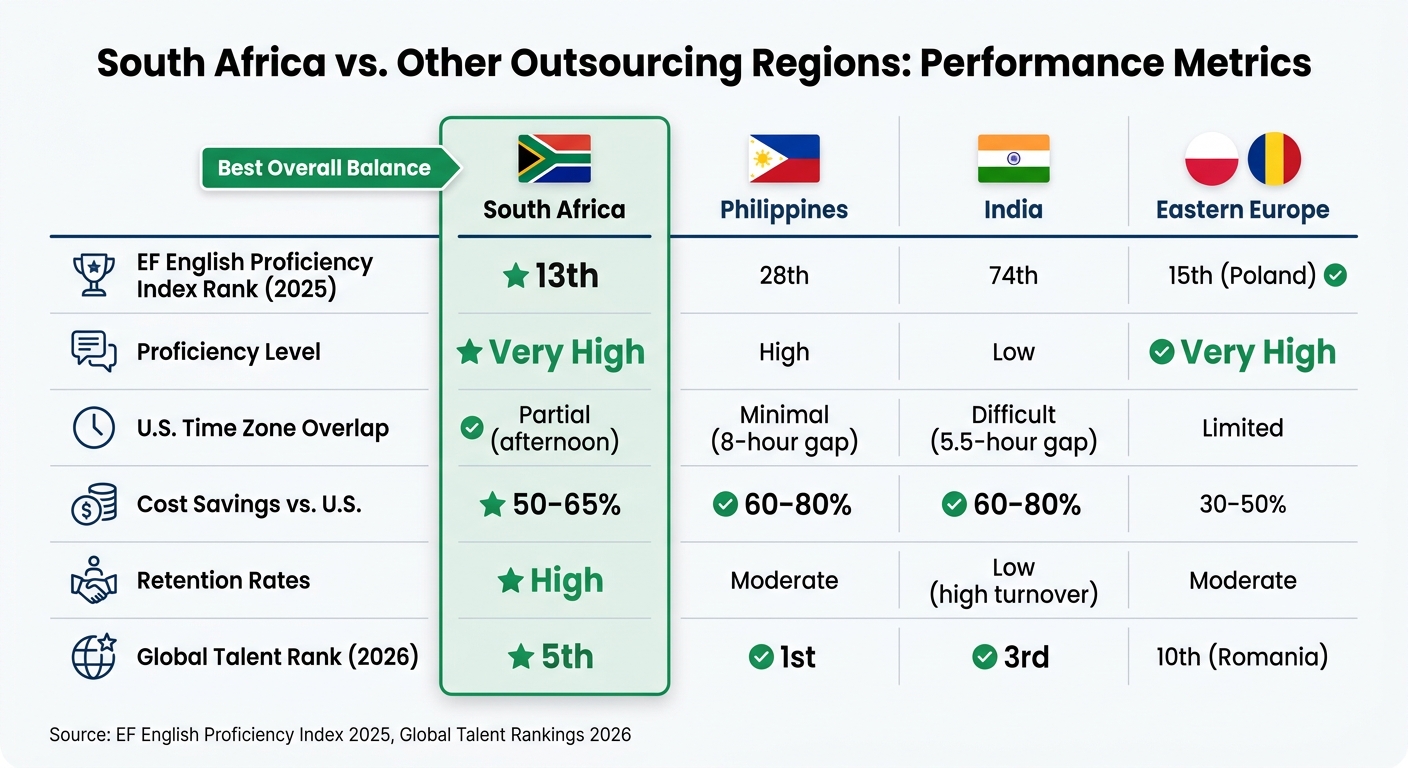
South Africa vs Other Outsourcing Regions: Key Metrics Comparison
When North American companies consider outsourcing destinations, South Africa stands out thanks to its linguistic strengths and alignment with Western cultural norms – advantages already discussed in earlier sections. These benefits are further emphasized when comparing key performance metrics across popular outsourcing regions.
One of South Africa’s standout features is its time zone advantage, which facilitates real-time collaboration. Unlike India and the Philippines, which face time differences of 4.5 to 8 hours, South Africa’s GMT+2 time zone allows for a valuable overlap with U.S. East Coast working hours, typically from 2 p.m. to 5 p.m. ET. This overlap supports live meetings and on-the-spot problem-solving. Leigh Daniels of Modern Day Talent highlights this advantage:
South Africa offers the best overall balance. It combines highly skilled, English-speaking professionals with strong cultural alignment and convenient time zones.
Comparison Table: Key Metrics
| Metric | South Africa | Philippines | India | Eastern Europe |
|---|---|---|---|---|
| EF EPI Rank (2025) | 13th | 28th | 74th | 15th (Poland) |
| Proficiency Level | Very High | High | Low | Very High |
| U.S. Time Zone Overlap | Partial (afternoon) | Minimal (8-hour gap) | Difficult (5.5-hour gap) | Limited |
| Cost Savings vs. U.S. | 50–65% | 60–80% | 60–80% | 30–50% |
| Retention Rates | High | Moderate | Low (high turnover) | Moderate |
| Global Talent Rank (2026) | 5th | 1st | 3rd | 10th (Romania) |
This comparison underscores why South Africa commands slightly higher costs for specialized roles requiring Western business expertise. While South Africa’s pricing is about 15–30% higher than that of the Philippines for similar roles, the value it delivers justifies the premium. Its superior output quality, better time zone alignment, and reduced management overhead make it a compelling choice. Andy Schachtel, CEO of Sourcefit, explains:
South Africa delivers compelling value when you factor in the quality of output, timezone alignment, and reduced management overhead that comes from cultural compatibility.
For roles like sales, marketing, and executive support, South Africa’s higher costs are balanced by significantly lower training and management expenses. Services like Talently offer full-time South African professionals starting at $2,500 per month, including payroll and benefits. This makes top-tier talent accessible without the complexities of managing international teams.
With its mix of linguistic expertise, cultural alignment, and strategic time zone benefits, South Africa continues to position itself as a top outsourcing destination for North American businesses. For companies new to this model, following a complete guide to offshore hiring can help navigate the transition.
Conclusion
South African professionals bring together native-level English fluency and the ability to adapt seamlessly to diverse environments. Ranked 13th globally in the 2025 EF English Proficiency Index with a “very high proficiency” rating, South Africa’s educational system prioritizes English as the main language of instruction. This focus has helped develop outstanding language skills.
But it’s not just about language. Growing up in a multicultural and multilingual society equips South Africans with exceptional cultural awareness, making them well-suited for global business. As Steven Gordon and Jaqueline Harvey from the Human Sciences Research Council explain, “English proficiency in South Africa is linked to socio-economic advancement”. This connection fosters professionalism and a strong drive to succeed.
These strengths translate into clear operational advantages. Thanks to their alignment with U.S. time zones, South African professionals can collaborate in real-time with North American teams. By leveraging an efficient offshore staffing platform, businesses can simplify talent acquisition, ensure rigorous candidate screening, and handle payroll management with ease – making South African talent an attractive option.
Talently makes tapping into this talent pool simple. With full-time professionals starting at $2,500 per month, North American companies can build high-performing teams while avoiding the usual hiring headaches. This blend of skill, efficiency, and cost-effectiveness cements South Africa’s reputation as a strategic offshore staffing hub.
FAQs
Which roles benefit most from South African English proficiency?
Strong communication skills and fluency in South African English are particularly advantageous in roles such as customer success management, marketing, and business development. These abilities improve client engagement and foster better collaboration, especially for businesses operating in North America.
How do South African teams handle U.S. customer expectations and tone?
South African teams consistently deliver when it comes to meeting U.S. customer expectations. They emphasize professionalism, maintain clear and effective communication, and approach interactions with a strong sense of cultural awareness. By aligning with American customer service standards and tailoring their approach to client needs, they ensure a smooth and efficient experience for all parties involved.
What’s the fastest way to hire vetted South African talent through Talently?
The fastest way to bring onboard vetted South African talent through Talently is by leveraging their streamlined, full-service recruitment process. It begins with a free consultation, where you’ll outline your requirements and share insights about your team culture. From there, Talently takes care of everything – sourcing, vetting, and conducting interviews – usually wrapping up the entire process in around 2 weeks. Plus, their AI-powered interview tools help pinpoint the best candidates quickly, making the hiring process smooth and efficient.
Related Blog Posts
Ready to build your dream team?
Book a free consultation and get your first candidate shortlist within 48 hours.
No upfront fee • Only pay if you hire