
International Hiring Guide: What to Look for When Hiring Remote Employees Internationally
 15 min read
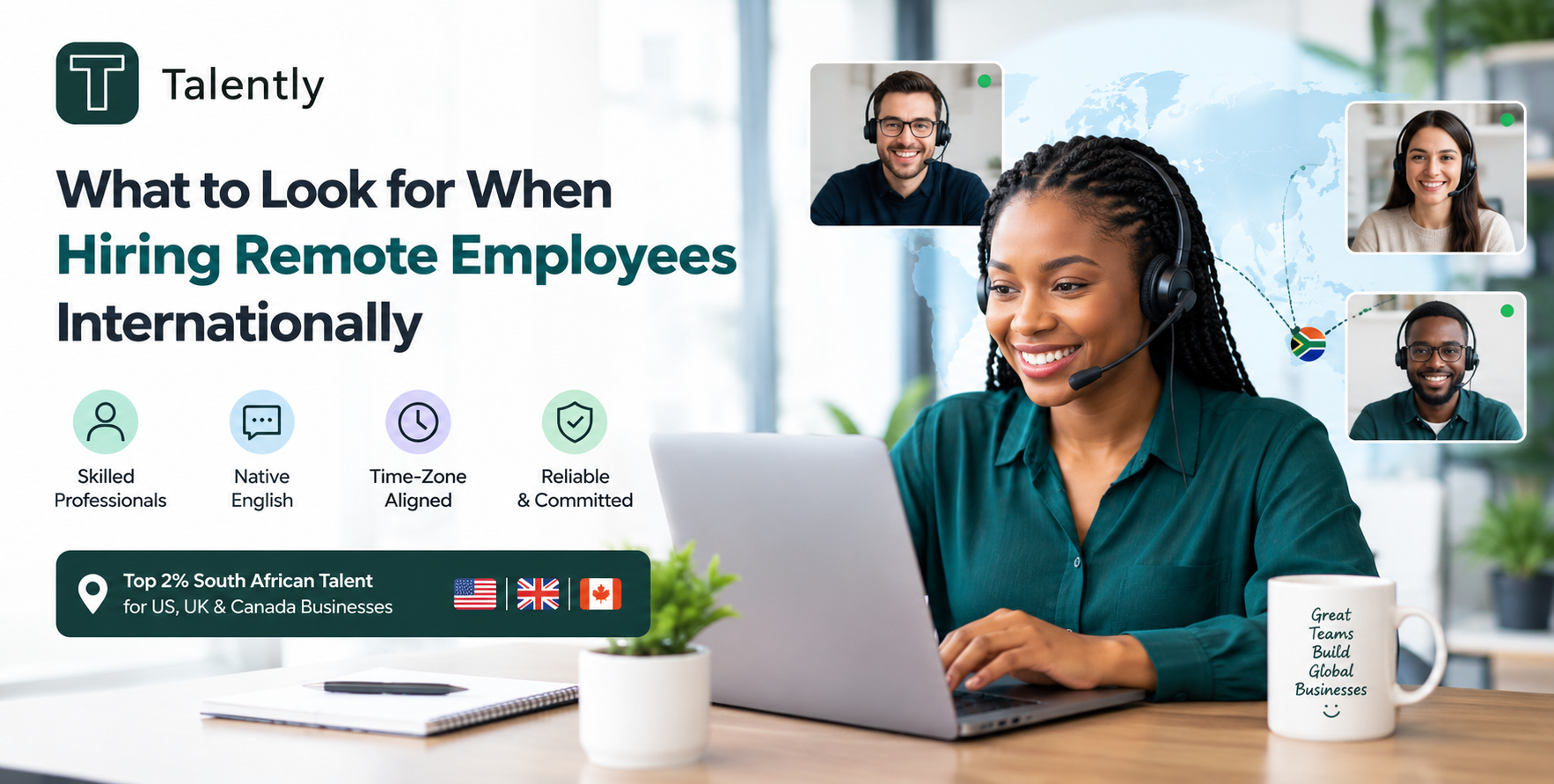
For a growing number of US, UK, and Canadian companies, “we can’t find the talent locally” isn’t an excuse anymore – it’s a decision. Not enough senior developers. Salaries that eat half the budget for a single support hire. A hiring manager who’s been trying to fill an executive assistant role for eleven weeks. So the conversation shifts: what if we hired outside our own borders?
That question sounds simple until you’re the one signing the offer letter. Suddenly you’re weighing payroll compliance in a country you’ve never operated in, wondering whether your new hire is legally a contractor or an employee, and hoping the “8-hour time difference” your recruiter promised doesn’t turn into missed standups every morning.
This international hiring guide breaks down exactly what to look for when hiring remote employees internationally – the legal structures, the screening process, the compliance traps, and the practical checklist experienced HR leaders actually use before they extend an offer abroad. By the end, you’ll know what separates a smooth international hire from an expensive mistake.
What Is International Remote Hiring?
International remote hiring is a process that helps businesses employ workers who live and work in a different country from company headquarters, typically without requiring the employee to relocate. It covers everything from sourcing and screening candidates abroad to structuring legally compliant employment – usually through direct entity setup, an Employer of Record (EOR), or a properly classified independent contractor agreement.
Done correctly, it gives companies access to skilled professionals at a lower total cost while staying compliant with both home-country and host-country labor law. Done carelessly, it exposes the business to tax penalties, misclassification fines, and data security risks.
Why International Hiring Has Become a 2026 Priority
This isn’t a niche strategy anymore – it’s mainstream operating procedure. According to Slasify’s 2026 workforce data, cross-border hiring on major global employment platforms grew 42% year-over-year through early 2026, while remote job postings with international scope rose 44% compared to 2024. The Employer of Record market alone reached roughly $5.97 billion in 2026.
More telling is what’s driving that growth. Research covering 3,650 HR leaders across 10 countries found that 73% expect the majority of their new hires to be based outside their primary country by the end of 2026 – yet 60% of multinationals are still running cross-border payroll manually or through fragmented systems. That gap between ambition and infrastructure is exactly where most international hiring mistakes happen.
Expert Insight: After years of watching companies scale distributed teams, the pattern is consistent – businesses rarely fail at international hiring because they picked the wrong country. They fail because they treated it like a domestic hire with a longer commute, skipping the compliance groundwork that should happen before, not after, the first paycheck goes out.
Key Takeaways
- Global remote work has settled at roughly half the workforce, not receded – this is a permanent structural shift, not a pandemic hangover.
- Cross-border hiring concentrates fastest among growth-stage companies: 88% of top-funded startups hire cross-border again within 18 months of their first international hire, per Deel’s 2026 data.
- The biggest risk isn’t finding talent abroad – it’s structuring the employment relationship correctly once you do.
- Employer of Record services now handle the compliance layer that used to require opening a local legal entity.
The Core Criteria: What to Look for When Hiring Remote Employees Internationally
1. The Right Legal Employment Structure
Before you post a single job description, decide how the person will actually be employed. You generally have three options: open a local legal entity, hire through an Employer of Record, or engage the person as an independent contractor. Each carries a different cost, timeline, and risk profile, and the wrong choice is the single most common – and most expensive – mistake in international hiring.
2. Compliance and Worker Classification
This is where companies get burned. Misclassifying an employee as a contractor isn’t a paperwork slip – it’s a legal exposure that compounds fast. According to a 2026 breakdown of IRS misclassification penalties, unintentional misclassification can trigger penalties including 1.5% of wages, 40% of unpaid employee FICA, 100% of unpaid employer FICA, and a $50 fine per unfiled W-2, while intentional misclassification escalates to 20% of all wages, full FICA liability on both sides, and criminal fines up to $1,000 per worker. A signed contractor agreement doesn’t protect you either – classification is determined by conduct, not paperwork, and clauses like required schedules or exclusivity can actively work against you by documenting employer-style control.
Run every hire through a proper employee vs. contractor classification check before you decide how to structure the role.
3. A Real Screening and Vetting Process
Remote employee screening internationally needs to go beyond a résumé and a Zoom call. Look for providers or internal processes that verify identity, education, employment history, and – where legally permitted – criminal background checks in the candidate’s home country. A structured vetting checklist that covers skills, culture, and legal compliance protects you from the two most common failure modes: candidates who misrepresent experience, and candidates who are a great technical fit but a poor communication fit.
4. Time Zone and Communication Overlap
A brilliant hire in a time zone that never overlaps with your team is still a coordination problem. Before you hire, map out how many working hours will actually overlap for meetings, reviews, and real-time collaboration – not just what the recruiter’s pitch deck claims. Some regions offer far better time zone alignment with North American business hours than others, which materially changes how a distributed team functions day to day.
5. Transparent Salary Benchmarking
International hiring only pays off if you understand the local market rate, not just what feels cheap relative to home. Underpaying relative to the local market increases turnover; overpaying relative to it erodes the cost advantage you hired internationally to capture in the first place. Build your offer around real regional salary data rather than a flat percentage discount off your domestic pay bands.
6. Payroll, Benefits, and Payment Infrastructure
Ask directly: how does this person get paid, in what currency, and who withholds and remits local taxes? Statutory leave, public holidays, and mandatory benefits vary significantly by country – comparing leave policy differences between South Africa and North America is a good example of how easy it is to accidentally under-deliver on legally required benefits if you assume your home-country policy applies.
7. Data Security and Privacy Compliance
Remote employees often touch customer data, financial systems, or proprietary code from day one. Before onboarding, confirm device security standards, access controls, and how the arrangement satisfies overlapping privacy regimes. If your workforce spans multiple countries, you’re likely dealing with several frameworks at once – GDPR, POPIA, and PIPEDA compliance requirements each impose different rules on what you can monitor and how you store it, and getting this wrong is a data privacy risk that’s much cheaper to prevent than to clean up.
8. Cultural and Language Fit
Native or near-native English fluency, cultural alignment with your company’s communication style, and comfort working asynchronously all affect how fast a new hire becomes productive. This matters most in client-facing roles – sales, support, and customer success – where accent neutrality and communication style directly affect customer perception. Strong English proficiency in a candidate pool shortens ramp-up time and reduces the friction that otherwise shows up in every client call.
Employer of Record vs. Direct Entity vs. Independent Contractor
| Factor | Employer of Record (EOR) | Direct Local Entity | Independent Contractor |
| Setup time | Days to 2 weeks | Months (often 3–6) | Days |
| Upfront cost | Low (monthly fee per employee) | High (legal, registration, banking) | Lowest |
| Compliance risk | Low – EOR is the legal employer | Low, but you own it directly | High if misclassified |
| Best for | Testing a market, 1–50 hires | Large, long-term country presence | Short-term, project-based work |
| Who handles payroll/tax | The EOR | Your internal or local team | The worker themselves |
According to the Professional employer organization model that underpins most EOR services, a third-party entity becomes the legal employer of record on your behalf, which lets you employ someone compliantly in a country where you have no registered business presence. For most companies making their first few international hires, this is the lowest-risk path – you get an employee protected by proper local labor law without the six-figure cost of standing up a foreign subsidiary.
Common Mistakes People Make When Hiring Remote Employees Internationally
Treating a contractor agreement as a compliance shortcut. Companies default to 1099-style contractor agreements because they’re fast and cheap to set up – then discover the working relationship (set hours, exclusivity, ongoing supervision) legally looks like employment anyway. The fix: classify the role honestly before you write the contract, not after a labor authority does it for you.
Ignoring statutory local benefits. Assuming “at-will employment” or minimal leave policies from home apply everywhere is a fast way to violate labor law. Many countries mandate paid leave, notice periods, and severance far beyond what US employers are used to. Review a remote staff hiring checklist before finalizing any offer letter.
Skipping reference and background checks because the hire is remote. Distance doesn’t reduce risk – it increases the importance of verification, since you can’t rely on in-person interviews or local reputation to catch red flags. Solid background check practices matter just as much for a remote hire as an in-office one, arguably more.
Underestimating the true cost comparison. Comparing only base salary against a domestic hire ignores payroll taxes, benefits, EOR fees, and management overhead on both sides. A proper cost comparison between local and offshore hiring accounts for the full picture, not just the headline salary gap.
No plan for time zone-driven attrition. Hiring someone into a role that requires them to work through their own midnight for months on end burns out even highly motivated employees. Build the schedule around genuine overlap, not just “they said they’re flexible.”
Why South Africa Is a Strong Answer to “Where Should We Hire?”
Once the legal structure and compliance questions are settled, the next question is where. South Africa has become one of the more consistently recommended answers for US, UK, and Canadian companies, for a few concrete reasons rather than just a lower price tag.
Cost efficiency that’s real, not marketing copy. South African wages average significantly below US and UK equivalents, and companies typically report payroll savings in the 60–75% range when hiring South African professionals for roles like customer support, sales development, and administrative work, compared to hiring the same role domestically.
Genuine time zone overlap. South Africa sits in a time zone (SAST, UTC+2) that overlaps meaningfully with both US East Coast and UK working hours – a structural advantage over talent pools in Asia-Pacific, where overlap with North American hours is minimal without someone working overnight.
Native-level English and client-facing readiness. Unlike outsourcing markets where English is a strong second language, South African professionals typically speak English as a first or co-first language with neutral, easily understood accents – a meaningful factor for sales, support, and customer success roles where every client interaction matters.
A well-educated, remote-ready talent pool. South Africa has a mature BPO and remote services sector, meaning candidates often arrive with real experience using the same tools (Slack, HubSpot, Salesforce, Zendesk) that Western teams already run on, not a learning curve you have to manage from scratch.
This is precisely the space Talently operates in: connecting US, UK, and Canadian companies with vetted, top 2% South African professionals across sales, support, marketing, and operations, with recruiting, contracts, payroll, and compliance handled as one flat monthly fee rather than five separate vendor relationships. It’s worth reading how South African talent has become a genuine competitive advantage for companies that made the switch, not just a cost play.
How to Vet International Candidates: A Practical Process
- Define the role and required overlap hours first, before sourcing candidates – this filters out mismatches before you waste anyone’s time.
- Verify identity, education, and employment history through documentation, not just a candidate’s word.
- Test the actual skill, not just the resume – a live task or work sample beats a portfolio link every time.
- Run a structured, scored interview rather than an unstructured chat, so you can compare candidates apples-to-apples.
- Check references from actual former managers, not just names the candidate hand-picked.
- Confirm classification and payment structure before the offer goes out, not after the candidate has already started.
- Set a 30/60/90-day onboarding plan with clear check-ins, since remote hires lose the informal feedback loops an in-office employee gets automatically.
Selection Guide: What to Look for Before You Choose a Hiring Partner

If you’re evaluating an international staffing partner or EOR provider rather than building this in-house, look for:
- Transparent, all-in pricing – one flat fee covering recruiting, payroll, and compliance beats a patchwork of hourly agency fees and surprise line items.
- Proof of vetting rigor – ask what percentage of applicants make it to your shortlist; a real vetting process rejects most candidates before you ever see them.
- Compliance ownership – confirm in writing who is legally responsible for local tax withholding, benefits, and labor law compliance.
- Speed without corner-cutting – a two-week time-to-hire is achievable with a mature process; anything promising same-day placement should raise questions.
- References from companies your size – a partner that mainly places enterprise hires may not serve a 10-person startup well, and vice versa.
Compare providers against your own hiring volume and see what South African hiring costs actually look like before you commit to a structure.
Pricing Considerations Before You Sign
Most international staffing and EOR pricing falls into one of three models: a flat monthly fee per employee, a percentage of the employee’s salary, or a hybrid recruiting-fee-plus-EOR-fee structure. A flat monthly fee is usually easiest to budget against and scales predictably as you add headcount – you know your total cost per hire before you sign anything. Percentage-based pricing can look attractive at low salaries but grows more expensive as you hire more senior, higher-paid roles, which is worth modeling out before committing to a provider long term.
Watch for hidden costs too: recruiting fees charged separately from payroll fees, contract termination penalties, or minimum-commitment clauses that lock you in for a year regardless of performance. A transparent provider will walk you through the full cost stack – recruiting, payroll processing, statutory benefits, and any local employer contributions – before you ever see a candidate.
DIY vs. Professional Service: Companies with an existing HR and legal function in-house sometimes handle international hiring themselves, especially once they’re hiring at scale in one specific country. For most companies making their first five to twenty international hires, though, the calculus favors a professional service – the cost of one misclassification penalty or one botched termination under unfamiliar local labor law typically outweighs years of provider fees combined.
Ready to Hire Internationally the Right Way?
International hiring done well is one of the highest-leverage moves a growing company can make – but only when the legal structure, compliance, and vetting are handled up front instead of discovered the hard way. If you’d rather skip the trial-and-error and start with a vetted shortlist, book a free consultation with Talently and get matched with pre-vetted South African professionals within 48 hours, with recruiting, payroll, and compliance already built in.
Prefer to explore first? Browse Talently’s pricing or read the complete guide to hiring South African talent to see how the process works end to end.
Frequently Asked Questions
What is the best way to hire remote employees internationally?
Most companies start with an Employer of Record, which lets you employ someone compliantly abroad without opening a local entity. It’s faster and lower-risk than direct incorporation, and more compliant than treating the hire as an independent contractor.
How much does it cost to hire an employee internationally?
Costs vary by country and role, but typically include salary, EOR or entity fees, and any local statutory benefits. Many companies hiring from cost-competitive markets like South Africa save 40–70% versus domestic hiring for comparable roles.
Is it legal to hire remote employees in other countries?
Yes, as long as the employment relationship is structured correctly – through a local entity, an EOR, or a properly classified contractor agreement that matches local labor law, not just your home country’s rules.
What’s the difference between an EOR and a PEO?
An EOR becomes the legal employer in a country where you have no entity, ideal for international hires. A PEO co-employs workers alongside your existing domestic entity, typically used within a single country you already operate in.
How do I avoid misclassifying an international remote worker?
Evaluate the actual working relationship – schedule control, exclusivity, and supervision – not just the contract label. If it looks like employment in practice, it should be classified and paid as employment.
What questions should I ask before hiring remote staff abroad?
Ask about local labor law requirements, who handles tax withholding, what statutory benefits apply, how payment currency and timing work, and how data security and device access will be managed.
Why do companies hire remote workers from South Africa specifically?
Native-level English, meaningful time zone overlap with US and UK business hours, a mature remote-work culture, and salary levels that typically run 40–70% below US and UK equivalents for comparable roles.
How long does it take to hire someone internationally?
With an EOR or staffing partner, sourcing to offer can take as little as two weeks. Opening a local legal entity to hire directly usually takes several months.
Do international remote employees get benefits?
Yes – and often benefits are legally mandated, not optional. Statutory leave, holidays, and sometimes retirement contributions vary by country and must be honored regardless of where your headquarters sits.
What happens if I misclassify a remote worker as a contractor?
In the US, unintentional misclassification can trigger IRS penalties covering unpaid FICA, income tax withholding, and per-form fines; intentional misclassification adds steeper penalties and potential criminal exposure. Host-country labor authorities can impose separate penalties on top of that.
Ready to build your dream team?
Book a free consultation and get your first candidate shortlist within 48 hours.
No upfront fee • Only pay if you hire