
South Africa vs. Other Regions: Time Zone Benefits
 17 min read

When outsourcing, time zone alignment can make or break collaboration. South Africa’s UTC+2 time zone offers a 6–7 hour difference with U.S. Eastern Time (EST), creating a 6–9 hour overlap during U.S. mornings and South African afternoons. This setup enables real-time communication, faster task turnaround, and smooth workflows compared to regions like India, the Philippines, or Latin America.
Key Takeaways:
- Real-Time Collaboration: South African teams work late afternoon/evening shifts, ensuring live interactions during U.S. mornings.
- “Follow-the-Sun” Workflow: Projects progress overnight (U.S. time) and are ready for review by the next U.S. workday.
- Consistency: No Daylight Saving Time means predictable scheduling year-round.
- Additional Strengths: High English proficiency (ranked 12th globally) and a strong talent pool with 160,000+ annual graduates.
Quick Comparison:
| Region | Time Zone (UTC) | EST Difference | Daily Overlap (EST) | Shift Type for U.S. Coverage | Urgent Task Handling |
|---|---|---|---|---|---|
| South Africa | UTC+2 | +6–7 hours | 6–9 hours | Afternoon/Evening (until midnight) | Same-day resolution |
| India | UTC+5:30 | +10.5–13.5 hrs | 0–4 hours | Full overnight | Often next-day |
| Philippines | UTC+8 | +12–13 hours | Minimal | Full overnight | Delayed or night staff |
| Latin America | UTC-3 to -6 | 0–3 hours | 6–8 hours | Regular U.S. hours | Real-time |
South Africa stands out for roles requiring real-time collaboration and client-facing work, offering a balance of cost savings, time zone compatibility, and professional expertise.
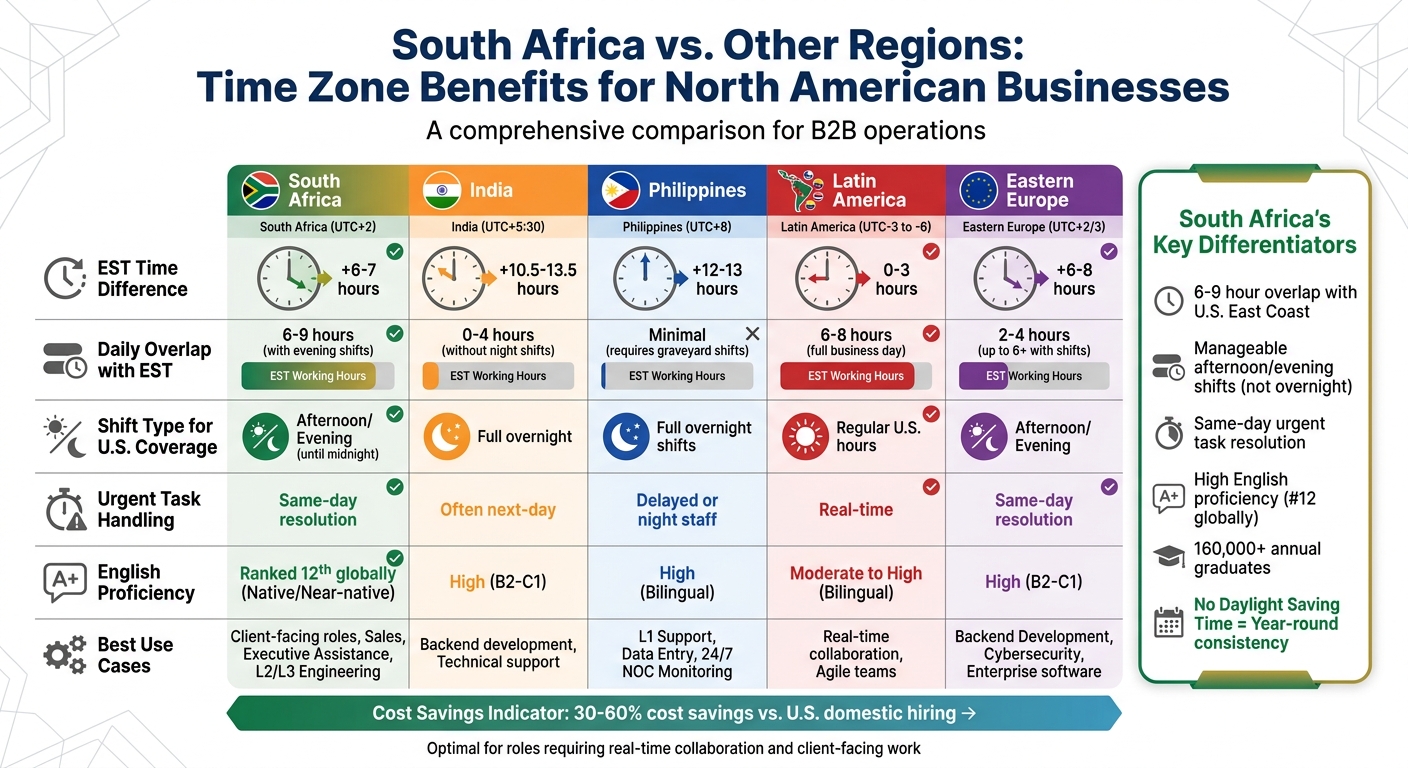
South Africa vs Global Outsourcing Regions: Time Zone Comparison Chart
Virtual Assistants & Time Zones. An Unexpected Benefit?
sbb-itb-7512dae
South Africa vs. India: Time Zone Comparison
Looking at South Africa and India side by side reveals how time zone alignment can influence productivity. India operates on UTC+5:30, creating a 10.5–13.5-hour difference with North American time zones. This gap makes real-time collaboration challenging, as Indian teams often need to work overnight – sometimes until 3:30 AM IST – to match a standard 9 AM–5 PM EST workday.
South Africa, on the other hand, operates on UTC+2, offering a more manageable 7-hour difference from EST and 10 hours from PST. South African teams can cover North American business hours by working late afternoon and evening shifts, typically ending around midnight. This schedule is far easier to maintain compared to the overnight shifts required in India.
“South African teams are also willing to work US hours, and while this can mean later shifts that run until around midnight, it is still far more manageable than full overnight work.”
– Leigh Daniels, Modern Day Talent
The difference is clear in daily operations. South Africa provides 6–9 hours of real-time overlap with the East Coast, allowing meetings to be scheduled during US mornings and South African afternoons. In contrast, India’s 9.5–12.5-hour gap forces meetings into inconvenient early morning or late evening slots. For urgent tasks, South Africa’s closer alignment enables same-day resolutions, whereas India’s time difference often delays responses to the following day.
Daily Overlap and Collaboration Windows
These time zone differences significantly impact collaboration. When a US-based manager starts their day at 9 AM EST, it’s already 4 PM in Cape Town – prime working hours. This overlap enables live problem-solving, quick feedback, and efficient daily check-ins that keep projects on track.
However, at 9 AM EST, it’s already 7:30 PM in Mumbai. Indian teams working regular hours have usually wrapped up their day, meaning real-time collaboration often requires overnight shifts. This can lead to increased fatigue and a decline in work quality. Studies indicate that 62% of remote workers view time zone compatibility as critical for efficiency, and overnight work increases burnout risk by 40%.
“The minimal time difference allows for synchronised communication, decision-making, and project development without significant delays.”
– Oliver Thomsett, Employmate
West Coast businesses also benefit from South Africa’s time zone. While the 10-hour difference with PST is larger, it still allows for 2–4 hours of overlap during key afternoon hours. By contrast, India’s 13.5-hour gap with PST makes synchronous collaboration nearly impossible without someone working overnight.
Table: Time Zone Overlap Comparison
The table below highlights the key differences between South Africa and India:
| Feature | South Africa (UTC+2) | India (UTC+5:30) |
|---|---|---|
| EST Time Difference | 7 Hours | 10.5 Hours |
| PST Time Difference | 10 Hours | 13.5 Hours |
| Daily Overlap (EST) | 6–9 Hours (with evening shifts) | 0–4 Hours (without night shifts) |
| Real-Time Meetings | High (US Morning / SA Afternoon) | Low (US Early Morning / India Late Night) |
| Shift Type for US Coverage | Afternoon/Evening (until midnight) | Full Overnight |
| Communication Delay | Minimal; same-day resolution | Moderate; often next-day resolution |
| Collaboration Feasibility | Seamless for real-time work | Requires asynchronous workflows |
Since neither South Africa nor India observes Daylight Saving Time, their UTC offsets remain constant year-round, making scheduling more predictable. Up next, we’ll explore how South Africa compares to the Philippines in terms of time zone compatibility.
South Africa vs. Philippines: Time Zone Comparison
The Philippines operates on UTC+8, which places it 12–13 hours ahead of U.S. East Coast time. This means teams in the Philippines often need to work full overnight shifts to collaborate in real-time with U.S. counterparts. For example, when a U.S. manager begins their day at 9 AM EST, it’s already 9–10 PM in Manila.
South Africa, on the other hand, follows UTC+2, resulting in a 7-hour difference from EST. This time zone allows for 6–7 hours of overlap with U.S. East Coast business hours. South African teams typically cover U.S. business hours by working afternoon and evening shifts, extending until around midnight. These shifts require only minor adjustments compared to the graveyard schedules common in the Philippines. This difference significantly impacts how North American teams can handle urgent tasks during their mornings.
The advantage is clear: South Africa’s time zone supports 6–7 hours of direct overlap with U.S. East Coast work hours, enabling smoother collaboration through daily standups, real-time problem resolution, and immediate feedback. In contrast, the Philippines offers limited natural overlap, which can lead to delays in communication and a higher annual attrition rate of 30–40%. This gap in working hours creates distinct challenges in collaboration workflows.
“For collaborative, client-facing roles, South Africa’s time zone is a significant advantage.”
– NetOps Africa
These time zone differences make South Africa an ideal choice for roles that require strong communication and problem-solving skills, such as L2/L3 engineering, executive assistance, and client-facing sales. Meanwhile, the Philippines remains a strong option for tasks like high-volume L1 support or 24/7 network operations center (NOC) monitoring, where continuous coverage matters more than real-time collaboration.
Workflow and Communication
The workflow dynamics between these regions differ sharply due to time zone alignment. South African teams can address urgent issues in real-time during their afternoon shifts, which overlap with U.S. mornings. In contrast, Filipino teams often handle urgent matters asynchronously, with responses delayed until the next day. Alternatively, they rely on night-shift staff, which can lead to fatigue and reduced efficiency.
South Africa’s work culture emphasizes direct communication and proactive problem-solving, aligning closely with Western norms. This cultural alignment, combined with better time zone overlap, facilitates quicker resolution of complex issues. On the other hand, the Philippines’ relationship-focused and deferential approach may require different management strategies, particularly for roles demanding technical independence.
Many South African professionals adjust their schedules to align with U.S. East Coast hours (e.g., working 7 AM to 4 PM ET), ensuring full-day collaboration without resorting to overnight shifts. This setup promotes higher retention rates, as employees prefer stable, internationally integrated roles. Filipino teams, however, face intense competition for talent, with frequent job-hopping and burnout due to graveyard shifts.
For U.S. West Coast businesses, the time offset introduces additional challenges. South Africa’s 10-hour difference allows for some overlap later in the day, while the Philippines’ wider offset reduces natural overlap, making scheduling for real-time interaction more difficult.
Table: Collaboration and Overlap Analysis
| Feature | South Africa (UTC+2) | Philippines (UTC+8) |
|---|---|---|
| EST Time Difference | 7 Hours | 12–13 Hours |
| PST Time Difference | 10 Hours | 16 Hours |
| Daily Overlap (EST) | 6–7 Hours (High) | Minimal (Graveyard shifts) |
| Daily Overlap (PST) | 3–4 Hours (Limited) | 2–3 Hours (Early U.S./Late PH) |
| Shift Type for U.S. Coverage | Afternoon/Evening (until midnight) | Full overnight shifts |
| Urgent Task Handling | Real-time during U.S. morning | Delayed or handled by night staff |
| Communication Style | Synchronous; real-time feedback | Often asynchronous; handoffs |
| Staff Attrition Rate | Lower; stable roles | High (30–40% annually) |
| Best Use Cases | L2/L3 Engineering, Sales, Executive Assistance | L1 Support, Data Entry, 24/7 NOC Monitoring |
While both regions offer cost savings of 30–40% compared to U.S. domestic hiring, South Africa often delivers better overall value for collaborative roles. This is a core component of a successful offshore staffing strategy. This is due to higher retention rates and reduced management overhead, even though South African engineers may earn a 10–20% premium over their Filipino counterparts.
Next, we’ll explore how South Africa’s time zone compares to Eastern Europe for North American businesses.
South Africa vs. Eastern Europe: Time Zone Comparison
Eastern Europe operates on UTC+2/3, which places it very close to South Africa’s UTC+2. Both regions are about 6–7 hours ahead of U.S. Eastern Time. While Eastern Europe, particularly countries like Poland and Bulgaria, is known for its deep technical talent – Poland alone boasts over 295,000 software developers – South Africa offers advantages in areas like communication quality and cultural alignment. Let’s break down how these factors impact work and collaboration.
South Africa ranks 12th globally on the EF English Proficiency Index, reflecting a high level of fluency that simplifies client interactions. In comparison, Eastern European professionals generally operate at B2-C1 English proficiency, solid but often as a second language.
Work culture also plays a key role, especially for North American businesses. South African professionals tend to adopt Western business practices, emphasizing flexibility and relationship-building. Eastern European teams, on the other hand, often lean toward structured, process-driven workflows, with communication styles resembling the directness of German business culture. This makes South Africa a better fit for client-facing roles like customer success and sales, where empathy and adaptability are crucial. Meanwhile, Eastern Europe shines in technical execution and cybersecurity projects.
Both regions are willing to adjust schedules to collaborate with U.S. teams. However, South Africa’s lack of Daylight Saving Time ensures year-round consistency, unlike Eastern Europe, where clock changes occur twice a year.
Flexibility and Real-Time Collaboration
South African teams can tackle urgent issues during their afternoon and evening hours, which align with U.S. mornings. This overlap allows for real-time problem-solving and immediate feedback without relying on asynchronous workflows. Eastern Europe offers a similar time zone advantage but occasionally faces language challenges in nuanced client interactions, despite its strong technical expertise.
South Africa’s 95% literacy rate and a robust educational system, producing over 160,000 graduates annually, ensure a steady talent pipeline across IT, financial services, and other professional roles. Eastern Europe, meanwhile, excels in specialized fields like blockchain, cybersecurity, and enterprise software development. Choosing between the two often depends on the role: South Africa is ideal for positions requiring strong communication and cultural awareness, while Eastern Europe is better suited for highly technical, process-driven tasks.
Cost differences also play a role. South African developers typically charge $25–$50 per hour. In Eastern Europe, rates vary significantly: Polish mid-level developers earn between $2,300 and $5,200 monthly, while rates in Bulgaria and Moldova range from $1,700 to $3,500. South Africa’s total cost per full-time employee is often 15–25% lower, offering better time zone alignment for Western businesses.
Infrastructure is another key factor. South Africa’s major cities, like Cape Town and Johannesburg, have invested in reliable backup power systems, ensuring 24/7 operational continuity. Eastern Europe benefits from EU regulations like GDPR, which simplify compliance for data-sensitive projects. Neither region is prone to natural disasters, which adds to their appeal as stable outsourcing destinations.
Table: Productivity and Time Zone Alignment
| Feature | South Africa (UTC+2) | Eastern Europe (UTC+2/3) |
|---|---|---|
| EST Time Difference | 7 Hours | 6–8 Hours |
| PST Time Difference | 10 Hours | 9–11 Hours |
| Daily Overlap (EST) | 2–4 hours (up to 6+ with shifts) | 2–4 hours (standard) |
| English Proficiency | Native/Near-native (Ranked 12th globally) | High (B2-C1 baseline) |
| Accent & Communication | Neutral; familiar with Western idioms | Varies; strong technical English |
| Work Culture | Relational, Western-aligned, flexible | Structured, process-oriented, direct |
| Daylight Saving Time | No (year-round consistency) | Yes (clocks change twice yearly) |
| Primary Talent Strength | Professional services, Sales, Customer Success | Backend Development, Cybersecurity, Infrastructure |
| Hourly Rate Range | $25–$50 | $15–$45 (varies by country) |
| Best Use Cases | Client-facing roles, Integrated project management | Technical execution, Enterprise software, Blockchain |
South Africa vs. Latin America: Time Zone Comparison
Latin America operates on time zones ranging from UTC-3 to UTC-6. Countries like Colombia, Peru, and Ecuador align with U.S. Eastern Time, while Mexico and parts of Central America follow U.S. Central Time. This setup creates a 6–8 hour overlap with U.S. business hours. South Africa, on the other hand, is in the UTC+2 time zone, which places it 6–7 hours ahead of U.S. Eastern Time. This limits overlap to just 2–4 hours during U.S. mornings.
For roles requiring constant, real-time interaction, Latin America’s time zones are a clear advantage. Studies show that every additional hour of time difference between workers reduces voice and video calls by 11%. However, South Africa’s time zone supports a “follow-the-sun” workflow. Teams in South Africa can progress projects overnight (U.S. time) and deliver completed tasks to North American teams at the start of their workday. This setup enables nearly 75% of a 24-hour work cycle to be covered in continuous development. Ultimately, the choice between these regions depends on specific role requirements and collaboration needs.
Advantages Beyond Alignment
While Latin America offers better time zone overlap, South Africa stands out in areas like English proficiency and specialized skills. Ranked 12th globally on the EF English Proficiency Index, South Africa is known for its neutral accents and strong business communication. Latin American professionals also bring bilingual capabilities and familiarity with U.S. norms, though English proficiency levels vary significantly by country.
“South Africa is recognised for its strong cultural alignment with Western markets, native English speakers, and excellent communication skills. This makes it ideal for client-facing roles such as sales, virtual assistance and bookkeeping.” – Leigh Daniels, Modern Day Talent
Cost is another factor to consider. Developers in Latin America typically cost 40–60% less than their U.S. counterparts, with mid-level monthly salaries ranging from $3,800 in Argentina to $4,800–$6,500 in Mexico. Similarly, South African professionals offer salaries 40–60% lower than Western markets while excelling in fields like financial services, IT, and other knowledge-based sectors. South Africa produces over 160,000 graduates annually in these areas, while Latin America generates over 500,000 STEM graduates each year. These factors, combined with time zone alignment, make both regions attractive for different collaboration models.
Operational stability also plays a role. Latin American countries observe 10 to 19 public holidays annually, which can interrupt collaboration if not planned for. Brazil’s Carnival, for example, can shut down operations for nearly a week. In contrast, South Africa offers year-round consistency and dependable infrastructure, supporting uninterrupted 24/7 operations.
Table: Time Zone and Talent Comparison
| Feature | South Africa (UTC+2) | Latin America (UTC-3 to UTC-6) |
|---|---|---|
| EST Time Difference | 6–7 Hours Ahead | 0–3 Hours (matching or slightly behind) |
| PST Time Difference | 10 Hours Ahead | 3–6 Hours (matching or slightly behind) |
| Daily Overlap (EST) | 2–4 hours (U.S. morning) | 6–8 hours (full business day) |
| Collaboration Style | Hybrid (asynchronous/synchronous) | Real-time (synchronous) |
| English Proficiency | Native/Near-native (Ranked 12th globally) | Moderate to High (Bilingual) |
| Monthly Cost (Mid-Level) | ~40–60% below U.S. rates | $3,800–$6,500 |
| Annual Graduates | 160,000+ (in IT, Finance, Professional fields) | 500,000+ (in STEM fields) |
| Public Holidays | Standard (consistent year-round) | 10–19 per year (varies by country) |
| Best Use Cases | Client-facing roles, specialized knowledge work, follow-the-sun development | Real-time collaboration, agile teams, technical support |
These comparisons show how South African talent compatibility and time zone alignment create unique opportunities for North American businesses, especially in roles requiring specialized expertise or asynchronous workflows.
Why South Africa’s Time Zone Works for North American Businesses
South Africa’s time zone offers a distinct advantage for North American businesses, thanks to its excellent overlap with U.S. working hours. South Africa Standard Time (SAST, UTC+2) is six hours ahead of Eastern Time, creating a live collaboration window from 9:00–11:00 AM EDT (3:00–5:00 PM SAST). This overlap supports real-time meetings and ensures seamless, continuous project progress.
The time difference also enables a “follow-the-sun” workflow. South African teams begin their workday hours before the East Coast starts, allowing them to prepare deliverables that are ready for review when U.S. teams log on. This setup ensures uninterrupted progress and smooth handoffs between teams. South African professionals typically work shifts ending around midnight local time, offering a sustainable schedule that minimizes fatigue while maintaining high productivity. Importantly, South Africa does not observe Daylight Saving Time, so scheduling remains consistent year-round, even when the U.S. adjusts its clocks.
“South African teams are also willing to work US hours, and while this can mean later shifts that run until around midnight, it is still far more manageable than full overnight work.” – Leigh Daniels, Modern Day Talent
When combined with high English proficiency and strong familiarity with Western business practices, South Africa’s time zone makes it an ideal location for specialized, client-facing roles such as sales, executive assistance, financial analysis, and customer success management.
Key Time Zone Benefits for North American Businesses
South Africa’s time zone alignment offers several key advantages:
- The six-hour difference allows for real-time communication during U.S. morning hours.
- Non-observance of Daylight Saving Time simplifies scheduling for recurring meetings and deadlines.
- South African professionals can align with U.S. business hours without requiring extreme overnight shifts.
- Beyond time zone alignment, South Africa boasts a growing talent pool, with over 160,000 graduates annually and salary levels 40–60% lower than those in Western markets.
How Talently Simplifies Offshore Staffing
To maximize these time zone benefits, Talently streamlines the offshore hiring process for North American businesses. Talently specializes in connecting companies with top South African talent, managing every step of the hiring journey – from sourcing and vetting candidates to handling payroll and benefits. This platform is particularly effective for roles where time zone alignment is critical, such as customer success management, executive assistance, business development, marketing, and graphic design.
The process begins with a free consultation to identify your specific needs and time zone requirements. Talently then provides a shortlist of pre-vetted candidates who have undergone thorough screening for both skills and cultural fit. Once you choose a candidate, Talently handles employment contracts, benefits, payroll, and even equipment, allowing you to focus on onboarding your new team member.
Pricing starts at $2,500 per month for full-time remote employees working 40 hours per week, with rates for specialized roles varying based on expertise. This fixed monthly pricing makes budgeting straightforward, and all Talently professionals operate in time zones aligned with North American business hours, ensuring your team experiences the collaboration benefits discussed here every day.
FAQs
What US hours can a South African team realistically cover?
A South African team is well-positioned to cover US business hours, typically from 9:00 AM to 5:00 PM Eastern Time. Thanks to South Africa’s GMT+2 time zone, they can adjust with early or late shifts to accommodate specific scheduling requirements, offering flexibility for seamless collaboration.
How does South Africa’s no-Daylight-Saving-Time policy affect scheduling?
South Africa sticks to a no-Daylight-Saving-Time policy, keeping its standard time at UTC+2 all year round. This steady approach removes the hassle of seasonal clock changes, simplifying coordination with international teams. It allows for smooth and predictable collaboration across different time zones without any interruptions.
Which roles benefit most from South Africa’s time zone overlap?
South Africa’s time zone alignment is a major plus for roles that depend on real-time interaction and fast responses. Jobs in sales, virtual assistance, customer support, and marketing stand to gain the most. The overlap with North American business hours ensures smoother collaboration and quicker communication, which are crucial for these positions.
Related Blog Posts
Ready to build your dream team?
Book a free consultation and get your first candidate shortlist within 48 hours.
No upfront fee • Only pay if you hire