
Guide to Remote Team Performance Reviews
 11 min read
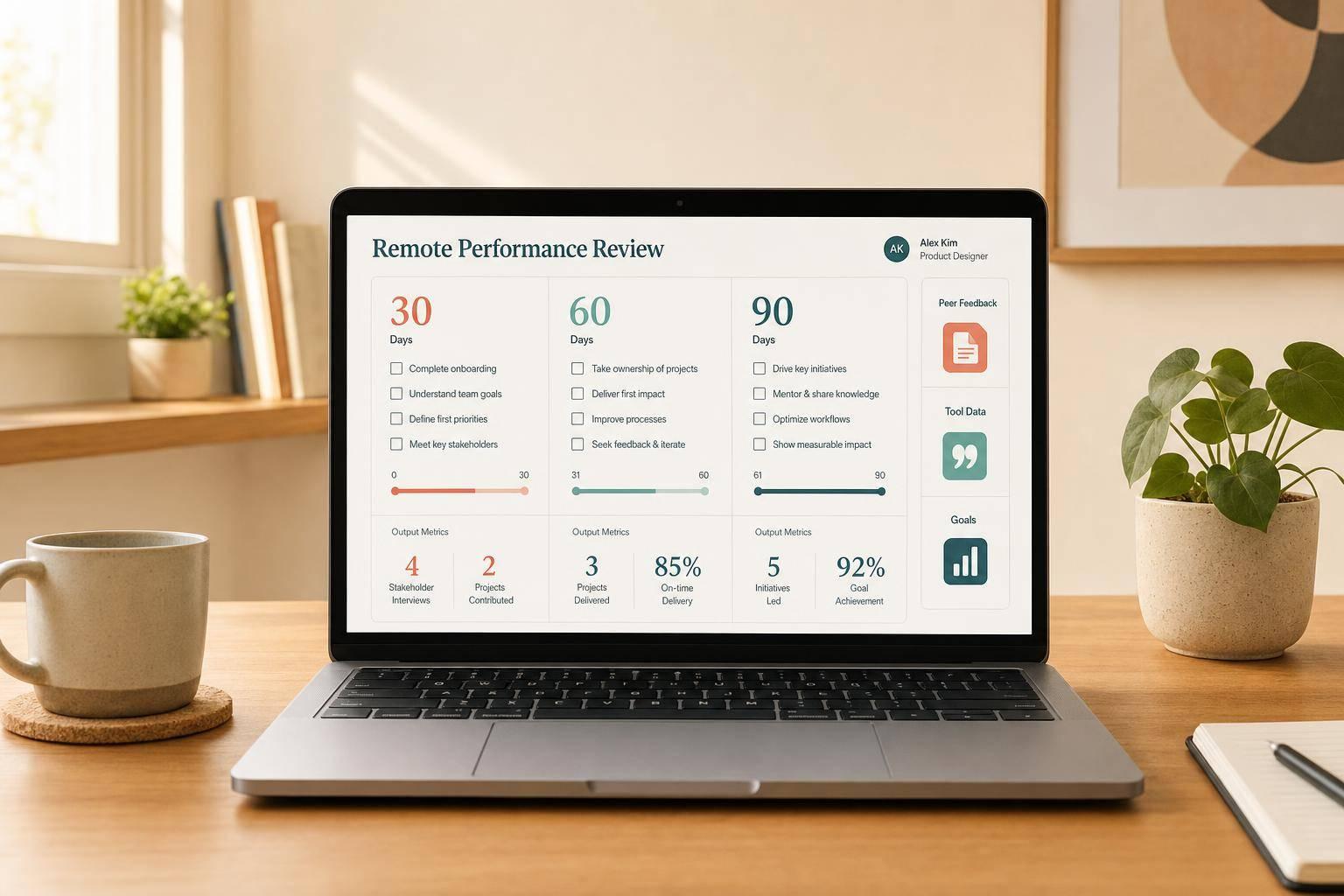
Remote reviews should measure output, not online visibility. If I run reviews for a distributed team, I need a clear review period, written standards, proof from work tools, peer input, and a short action plan after the meeting. That matters because 64% of managers still think in-office staff perform better, despite the potential drawbacks of this strategy, while some research shows remote employees can be about 15% more productive.
Here’s the short version:
- I set a fixed review window, such as 90 days, 6 months, or a quarter
- I score people against written goals, role expectations, and work results
- I use records from tools like Jira, Asana, Slack, GitHub, and CRM systems
- I ask for a self-review and short peer feedback before the call
- I send the written review 48 hours early
- I use the meeting to discuss results, gaps, support, and next-step goals
- I end with a 30/60/90-day plan and a follow-up date
A remote review works best when it answers simple questions: What did this person ship? Where did they get stuck? What should change next? That cuts guesswork and keeps the review tied to work that can be shown.
Quick comparison of review cadences
| Cadence | Frequency | Best for | Main risk |
|---|---|---|---|
| Annual | Once a year | Pay or policy reviews | Too much weight on recent work |
| Semiannual | Twice a year | Many SMB teams | More admin work |
| Quarterly | 4 times a year | Fast-moving teams | Can feel repetitive |
| Continuous | Monthly or biweekly | Remote-first teams | Needs steady manager follow-through |
I’d treat the live meeting as a discussion, not a surprise. The article’s main point is simple: document work, review against clear standards, and leave with specific next steps.
How to Conduct Performance Reviews for Remote Employees
sbb-itb-7512dae
How to prepare for a remote performance review
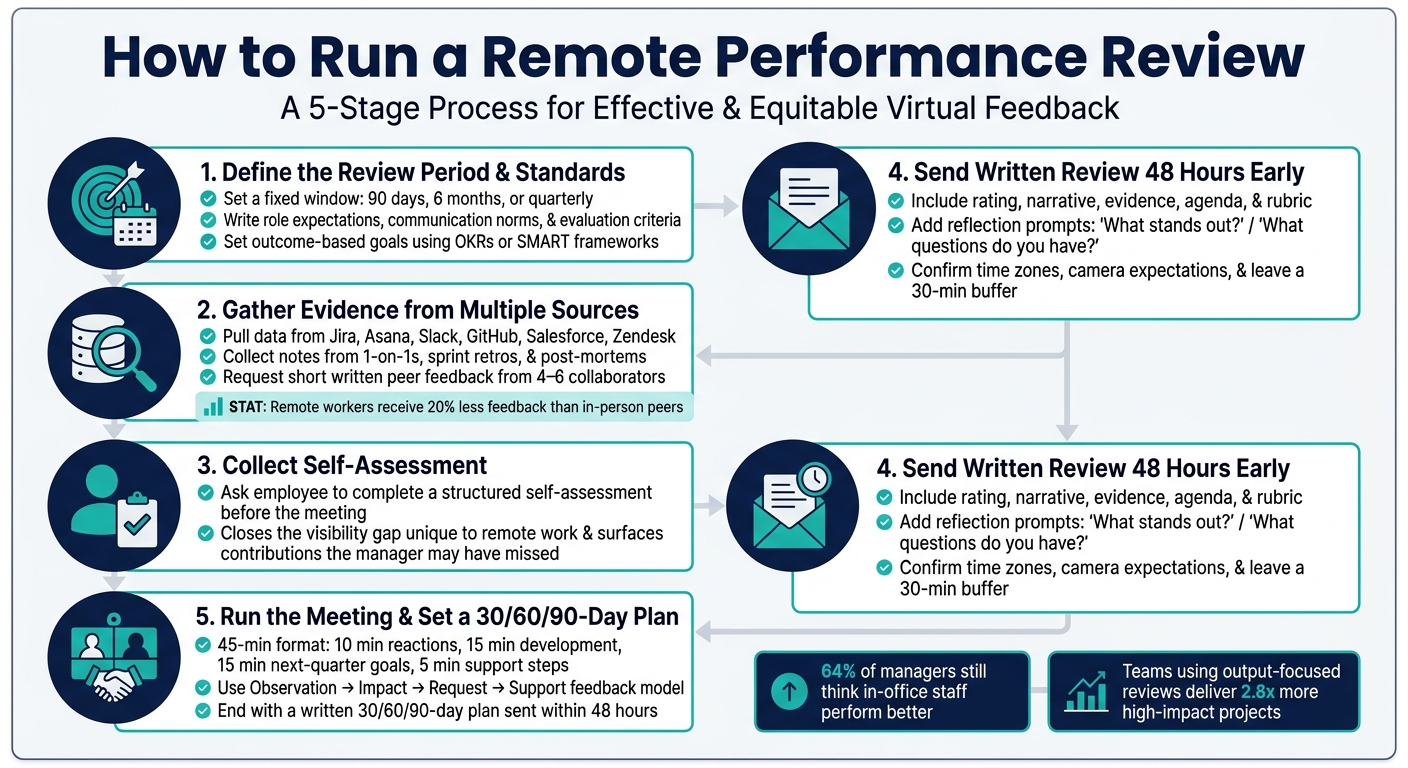
How to Run a Remote Performance Review: 5-Step Process
Remote reviews work best when you rely on a written record, not memory. Put that record together before the meeting so feedback reflects outcomes, blockers, and progress – not just who was most visible online. That written record should guide the review conversation itself.
Define the review period, standards, and success measures
Start by setting a clear review window – usually the last 90 days, 6 months, or a quarterly cycle – and write down the role expectations, communication norms, and evaluation criteria for that stretch of time. Then set outcome-based goals with OKRs or SMART goals that focus on deliverables and business impact. After that, spell out what success looks like with measurable standards such as quality, business impact, and collaboration frequency.
For SMBs, this means getting very specific about role-level outcomes. For example:
- customer success: onboarding speed
- marketing: on-time campaign delivery
- business development: lead quality and conversion
- executive assistants: calendar accuracy and task completion
When the standards are clear, the review is much easier to explain and much harder to argue with.
Collect manager notes, peer input, and employee self-assessments
Once the criteria are set, gather proof from more than one source – not just your own memory. Pull data from tools your team already uses: project records from Jira or Asana, communication history from Slack or Teams, code contributions from GitHub, and CRM data from Salesforce or Zendesk. That way, the review ties back to documented work. Then check that against notes from past one-on-ones, sprint retrospectives, and project post-mortems from the review period.
Ask four to six collaborators for short written peer feedback focused on behaviors like responsiveness, documentation quality, reliability, and how well the employee helps unblock teammates. At the same time, ask the employee to complete a self-assessment before the meeting. This helps close the visibility gap that remote work can create, and it often brings up work a manager may have missed. Remote workers receive 20% less feedback than their in-person colleagues, so the self-assessment should be treated as a main input.
Use the same evidence sources in every review so managers and employees are working from the same record:
| Preparation Task | Manager | Employee |
|---|---|---|
| Evidence Gathering | Synthesize data from project tools and 1-on-1 notes | Update contribution log with links to shipped work and outcomes |
| Feedback Collection | Initiate short written peer feedback requests | Complete a structured self-assessment reflecting on goals and challenges |
| Standardization | Apply the company’s role standards and skill assessment scorecard | Review agreed-upon KPIs and success measures for the period |
| Drafting | Create a narrative draft and resolve any data contradictions | Prepare a list of growth goals and support needs for the next period |
| Pre-Meeting Sync | Send the written review 48 hours in advance | Review the manager’s written feedback and prepare questions |
Send the written review 48 hours before the live call so the employee has time to process the feedback in private and show up ready for a real discussion. Once the review is drafted, the next step is shaping the meeting so the conversation stays clear and direct.
How to structure the remote review before the meeting
Once the written review is done, make the live meeting clear and easy to follow. That kind of structure helps cut bias and keeps the focus on outcomes, not who seemed most visible. The aim is simple: make the review a growth discussion, not a last-minute feedback drop.
Send the full written review before the call, including the rating, narrative, and evidence used in the evaluation. Include a clear agenda, the evaluation rubric or scoring criteria, and reflection prompts such as “What stands out?” or “What questions do you have?”. Start the conversation with the self-assessment.
In the invite, list all time zones, confirm camera expectations in writing, and leave a 30-minute buffer on both sides in case of tech issues or a longer discussion. Once the meeting setup is clear, the next step is choosing a cadence that fits your team.
Choose the right review cadence for your team
Remote teams need a review rhythm that fits how fast work changes and how much structure the team needs.
| Cadence | Frequency | Best Use Case | Strengths | Tradeoffs |
|---|---|---|---|---|
| Annual | Once per year | Compliance or pay review | Standardized; clear yearly milestone | High pressure; more likely to overvalue recent work; goals often outdated |
| Semiannual | Twice per year | SMBs/Growth teams | Balanced and practical | Requires more administrative time than annual |
| Quarterly | Four times per year | Fast-paced/Agile teams | Keeps goals current | Can feel repetitive if not kept lightweight |
| Continuous | Biweekly/Monthly | Remote-first teams | Best for fast feedback | Requires high manager discipline and documentation |
Once you set the cadence, shape the live conversation so it stays balanced and useful.
Build a meeting structure that supports honest conversation
A clear meeting order helps keep things steady. For a 45-minute review, one solid format is:
- 10 minutes for reactions
- 15 minutes for development
- 15 minutes for next-quarter goals
- 5 minutes for support steps
Use those last few minutes to agree on next steps, not just recap what was said.
The meeting should bring concerns into the open early, then shift into development and planning for what comes next.
How to deliver balanced feedback and turn it into action
Once the meeting starts, tie your feedback to evidence and leave with a clear action plan.
Give feedback that is specific and backed by evidence
Start with accomplishments. Opening with clear wins helps the employee relax a bit and shows the review is based on actual work, not gut feel. Then move to gaps, but only the ones you can support with specific examples.
A simple way to do this is Observation, Impact, Request, and Support. Say what happened, explain the effect, state what needs to change, and spell out how you’ll help. For example: “Include a brief status, blockers, and next steps in async updates.”
Those categories help you keep feedback specific and steady from one review to the next.
| Remote Review Category | Specific Focus Areas | Evidence Sources |
|---|---|---|
| Communication | Documentation quality, async judgment, clarity in writing | Notion/Confluence docs, Slack threads, Linear updates |
| Responsiveness | Reliability in unblocking others, adhering to team norms | Peer feedback (360 reviews), response times to critical blockers |
| Independence | Initiative, problem-solving without oversight, ownership | Contribution logs, self-assessments, project milestones |
| Collaboration | Cross-functional support, time zone coordination | 360-degree feedback, GitHub pull request reviews |
| Results/Output | OKR completion, quality of deliverables, impact on goals | CRM data, Jira/Asana task completion, GitHub merges |
Before you lock in your view, let the employee respond.
Ask for the employee’s perspective before you share your final judgment. That extra pause often brings out context you didn’t have.
Set goals, deadlines, and support steps after the discussion
Wrap up with a 30/60/90-day plan that includes goals, deadlines, and success measures.
Keep goals focused on output. “Improve documentation quality for async handoffs” gives someone something clear to work toward. “Improve documentation” is too vague. Other useful examples include finishing an async communication workshop within 30 days and sharing a key-takeaways doc as the deliverable, or writing down standards so expectations are clear and documented.
It also helps to separate skill gaps from expectation gaps. Training addresses the first. Clearer standards address the second.
Send the agreed plan within 48 hours, including next-quarter goals and the next check-in date.
Then track those goals in regular check-ins so the review feeds into an ongoing system.
Build a continuous remote review system
To make follow-up check-ins stick, set up a system that tracks performance between reviews, especially for distributed and offshore teams.
The big shift is simple: move from memory-based reviews to a continuous contribution log. Ask each team member to update a shared employee record every week or every other week with their top outputs, blockers, and goal progress. Tie each update to proof like pull requests, finished tasks, or closed deals. Then, when review time comes around, you’re not relying on memory. You’re looking at documented work from the full review period.
Use that log during regular check-ins and quarterly formal reviews. It gives managers and employees the same source of truth, which cuts down on guesswork.
Teams using this output-focused approach deliver 2.8x more high-impact projects than teams that rely on hourly tracking.
Bias can do just as much damage. That’s why the same evidence used in the review should also be used to calibrate ratings across managers. Managers are 67% more likely to view remote workers as replaceable when reviews aren’t structured. Calibration sessions help catch that drift before it shapes pay or promotion decisions. In those sessions, managers compare ratings against a shared leveling rubric instead of going with gut feel.
For North American teams hiring South African talent, Talently can handle sourcing, vetting, payroll, and employment administration.
To pull it all together, the habits that make remote reviews work stay the same across this guide:
- Define clear expectations before the cycle starts
- Anchor every rating in documented evidence
- Deliver feedback as a two-way conversation
- Follow through with measurable next steps within 48 hours
Build those habits into a repeatable system, and the review stops being a one-off event. It becomes part of how your team works day to day.
FAQs
How do I avoid bias in remote performance reviews?
Focus on objective outcomes, not visibility or activity. Look at documented contributions like project completions and OKR results, instead of responsiveness or Slack presence.
Use consistent, year-round documentation rather than memory to cut recency bias. It also helps to use calibration sessions, blind scoring for artifacts, peer feedback, and clearly defined, role-specific success criteria.
What metrics matter most for remote team reviews?
For remote teams, the metrics that matter most are the ones tied to results and impact – not busyness or screen time.
Focus on task and milestone completion, progress against OKRs or quarterly goals, KPI performance, and the quality and dependability of what gets delivered. It also helps to look at 360-degree feedback, especially around responsiveness, teamwork, documentation quality, and good async judgment.
Skip vanity metrics like hours worked, message volume, or login times. Those numbers may look neat on a dashboard, but they rarely tell you who’s doing good work.
How often should remote employees get formal reviews?
Annual reviews on their own usually aren’t enough for remote employees. They can leave long gaps between feedback, and they often lean too heavily on what happened most recently.
A better approach is quarterly formal reviews, backed by weekly or biweekly one-on-one check-ins. That way, feedback stays timely, and managers have a clear, documented record from across the year to use during formal reviews.
Related Blog Posts
Ready to build your dream team?
Book a free consultation and get your first candidate shortlist within 48 hours.
No upfront fee • Only pay if you hire