
Why Remote Work Policies Matter for Offshore Teams
 10 min read

If you hire in South Africa without a written remote work policy, you don’t just risk confusion – you risk delays, payroll issues, and data trouble.
I’d boil the whole article down to this: a remote work policy sets the rules for hours, handoffs, ownership, security, and compliance before problems start. That matters even more across U.S. and South Africa teams, where time gaps, South African and North American labor laws, and data laws can turn small gaps into missed deadlines or legal costs.
Here’s the short version:
- Productivity drops when work hours, response times, and task tracking aren’t written down.
- Accountability slips when no one knows who owns a task or when to escalate.
- Compliance risk grows when policies don’t cover overtime, worker status, tax exposure, and POPIA data rules.
- 85% of companies say communication barriers are their main offshore challenge.
- About 30% of outsourcing relationships fail in the first year, and the issue is often the work setup, not the people.
If I were setting this up, I’d make sure the policy covers:
- daily overlap hours between teams
- what “done” means for each task
- which tool tracks work
- response times by channel
- decision rights and escalation steps
- weekly hours, overtime, and leave rules
- VPN, MFA, device, and file storage rules
- payroll, tax, and contract terms
The main point: offshore hiring works better when the rules are written down early, attached to contracts, and used in onboarding from day one.
Productivity problems caused by unclear remote work rules
Misaligned schedules, slow approvals, and broken handoffs
When approval paths aren’t written down, one unanswered question can stop work for an entire day. And when escalation paths live only in someone’s head, offshore teams can lose a full workday waiting for a decision.
Verbal-only handoffs make the problem worse. Informal instructions passed across time zones are easy to misread. Context drops out, requirements get misunderstood, and rework follows. The main issue isn’t offshore hiring itself. It’s an undocumented workflow.
Once handoffs start dragging, the next issue shows up fast: who owns each task, and how progress gets reported.
Unclear goals and inconsistent tools reduce output
If “done” isn’t defined, teams ship incomplete work and set off more rework. That gray area turns into repeat cycles that chip away at the cost savings of offshore hiring.
Output improves only when every task moves through the same tracked system. If there are no clear rules for which platform handles which type of work, urgent same-day questions and tracked deliverables get mixed together. Then updates get buried. People get notification fatigue. Information ends up scattered across tools.
85% of companies cite communication barriers as their primary challenge with offshore teams.
How a written policy fixes productivity at the workflow level
A written policy doesn’t need to be long. It just needs to answer four questions:
- When are both teams online at the same time?
- What does a finished task look like?
- Where does work get tracked?
- How fast should each channel get a response?
A 2 to 4 hour daily overlap between U.S. managers and South African staff helps clear blockers in real time instead of letting them sit overnight. Add async-first habits like written end-of-day handoffs, Loom walkthroughs for more complex transitions, and documented SOPs, and the offshore team can keep moving without waiting for routine approvals.
That shift moves teams away from ad hoc updates and activity-based status checks. Instead, they work from shared dashboards, set overlap hours, documented SOPs, and outcome-based KPIs. Metrics like velocity, on-time delivery, and rework rate keep attention on output.
When the workflow is clear, accountability is easier to see without constant supervision.
sbb-itb-7512dae
Accountability gaps in offshore teams and how policies close them
What happens when task ownership and reporting lines are vague
Once workflows are clear, the next problem is ownership. If no one knows who owns what, offshore teams often get hit from both sides at once: one person repeats a check, while a key step gets skipped because nobody owned it.
The bigger issue goes beyond missed tasks. Teams can slip into a task-doer mindset, where people finish assigned work but don’t own the result. And when decision rights are fuzzy, even small issues get pushed up to the U.S. manager. That manager ends up becoming the default decision-maker for almost everything.
Policies that make accountability visible without micromanagement
Clear ownership works best when it’s written down. Policy should spell out:
- what each person owns
- what they can decide on their own
- when they need to escalate
Decision trees help a lot here. They give offshore staff a clear path for handling common exceptions, so they don’t have to sit and wait hours for a reply from the U.S. team.
It also helps to use a simple daily async update: what moved, what’s next, what’s blocked, and what decisions are needed. That replaces reactive check-ins with a written trail managers can review when it fits their schedule. More importantly, it moves oversight away from activity signals and toward output.
Using shared systems and structured reviews to manage performance
Regular reviews catch problems before they turn into failures. A steady rhythm – weekly priority resets and monthly performance reviews tied to KPIs – gives managers and offshore staff the same view of what’s working and what’s off track.
About 30% of outsourcing relationships fail within the first year, and the root cause is usually operational, not a talent issue. That’s a big deal. It means the problem often isn’t who you hired. It’s how the work is set up, tracked, and reviewed.
That same visibility also makes the next layer easier to manage. When ownership, updates, and review rhythms are documented, payroll, security, and labor controls become much easier to enforce.
What is a Remote Work Policy And How Can You Implement It?
Compliance risks in cross-border remote hiring
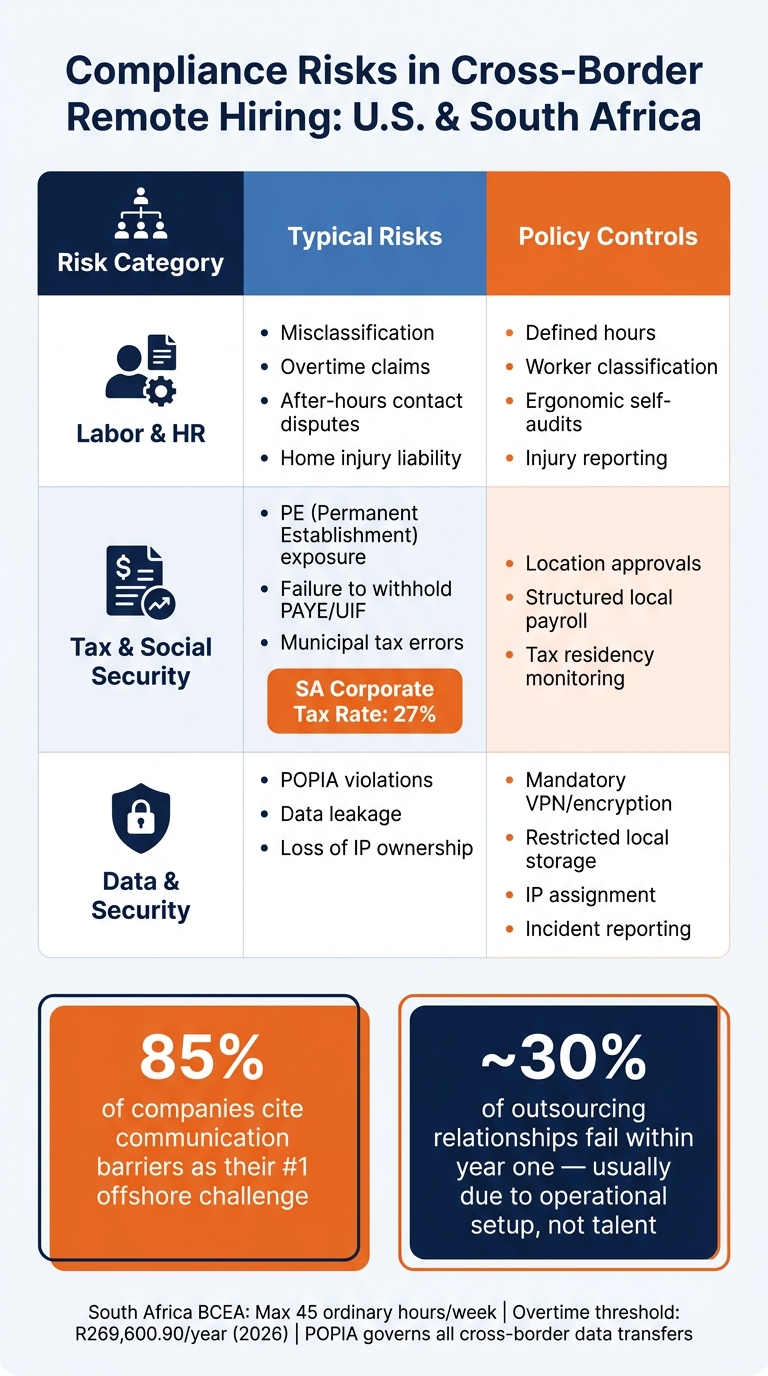
Remote Work Policy Compliance Risks for U.S.-South Africa Offshore Teams
Once ownership is clear, the policy also needs to deal with legal risk. If the rules aren’t written down, offshore hiring can expose U.S. businesses to labor, tax, and data problems.
Labor, payroll, and working-condition risks across borders
After ownership and reporting lines are set, labor compliance is usually the next trouble spot. In South Africa, the Basic Conditions of Employment Act (BCEA) sets a legal cap of 45 ordinary working hours per week. Employees earning below the 2026 threshold of R269,600.90 per year must also receive overtime pay and rest breaks, along with protections against unregulated after-hours contact.
Worker classification is another area where things can go sideways. If a company labels an offshore team member as a contractor but still controls their daily hours, tasks, and workflow, that person may be treated as an employee instead. That can lead to back taxes, benefit costs, and fines.
There’s also a tax angle many companies miss. When a U.S. business directs employees in South Africa without setting up a local entity, it may accidentally create a Permanent Establishment (PE). That means a taxable business presence in South Africa, with attributed profits subject to the country’s 27% corporate tax rate.
Data protection and security standards for remote access
Compliance doesn’t stop with payroll and hiring status. It also covers how remote staff access, store, and move company data.
South Africa’s Protection of Personal Information Act (POPIA) sets the rules for collecting, storing, and transferring personal data across borders. A remote work policy should spell out security steps like mandatory VPN use, multi-factor authentication (MFA), limits on local file storage, role-based access permissions, and a clear process for incident reporting.
That last part matters. These controls can’t just live in someone’s head or sit in an IT checklist. POPIA violations can bring serious legal penalties, so the policy needs to state these rules plainly and in writing.
How documented policies support cleaner offshore operations
When a policy is attached as a formal annexure to the employment contract, it becomes legally binding. That gives the employer a clear way to cover equipment, expense handling, and occupational health duties.
This tends to work best when the rules show up in both contracts and onboarding materials. In practice, the main compliance gaps usually fall into three buckets:
| Risk Category | Typical Risks | Policy Controls |
|---|---|---|
| Labor & HR | Misclassification; overtime claims; after-hours contact disputes; home injury liability | Defined hours; worker classification; ergonomic self-audits; injury reporting |
| Tax & Social Security | PE exposure; failure to withhold PAYE/UIF; municipal tax errors | Location approvals; structured local payroll; tax residency monitoring |
| Data & Security | POPIA violations; data leakage; loss of IP ownership | Mandatory VPN/encryption; restricted local storage; IP assignment; incident reporting |
Conclusion: Strong policies turn offshore hiring into a scalable system
A remote work policy is the framework that makes offshore hiring work. It deals with the same three risks across offshore teams: productivity, accountability, and compliance. That kind of clarity matters most when people need to stay on track across time zones.
The pattern is simple. Put structure in place early, and you avoid problems that cost far more to fix later. Good structure cuts down on communication gaps, ownership gaps, and compliance gaps that can throw offshore teams off course.
A clear policy turns offshore hiring from a coordination headache into a repeatable system. Without one, adding more hires just scales dysfunction. Policy is what makes offshore hiring repeatable, measurable, and compliant. It gives every new hire a clear starting point for communication, expectations, performance measurement, and legal guardrails. That’s what makes scaling possible. Following management best practices ensures these policies translate into daily operational success.
If you hire offshore talent in South Africa through Talently, finalize your policy before onboarding so new hires start with clear expectations on day one. If offshore hiring is going to scale, the policy needs to be in place before the first hire starts.
FAQs
What should a remote work policy include?
A remote work policy for offshore teams should spell out who can work remotely, which roles qualify, and the performance standards each person is expected to meet.
It should also set clear rules for day-to-day work, including communication norms, cybersecurity requirements, legal and tax compliance, equipment ownership, expense reimbursement, and productivity metrics based on measurable results, not just whether someone appears to be online.
How do remote work policies improve offshore team performance?
Remote work policies help offshore teams perform better because they replace guesswork with a clear framework built around measurable outcomes, not just attendance.
Instead of leaving people to figure things out on the fly, these policies set clear expectations through KPIs, service-level agreements, project timelines, and communication norms such as overlap hours. That gives teams a shared way to work, stay productive, take ownership, and stay aligned across time zones.
What legal risks can arise without a written policy?
Without a written remote work policy, companies can run into serious legal and financial problems. That can include permanent establishment, tax nexus, labor law violations, worker misclassification penalties, and data breach exposure.
For offshore teams, local rules on pay, leave, and termination can override contracts set by headquarters. That’s where things can get messy fast.
Talently helps lower these risks by handling offshore staffing, compliance, and employment contracts.
Related Blog Posts
Ready to build your dream team?
Book a free consultation and get your first candidate shortlist within 48 hours.
No upfront fee • Only pay if you hire