
Checklist for Cross-Cultural Hiring Success
 19 min read

Hiring South African professionals offers U.S. businesses several advantages: when you hire remote staff in South Africa, cost savings of up to 70%, high English proficiency (ranked #13 globally), and a favorable time zone overlap (6–8 hours with EST/PST). South African talent excels in fields like tech, finance, and engineering, with 53% of new offshore roles in tech. However, to succeed, companies must address differences in workplace norms, communication styles, and labor laws.
Key steps include:
- Prepare Your Team: Understand South African values like teamwork and relationship-building (Ubuntu) and train your team on cultural norms.
- Recruit Effectively: Use platforms like Talently for pre-screened candidates or implement structured hiring processes.
- Ensure Compliance: Follow South African labor laws, including contracts, taxes, and benefits like UIF and COIDA.
- Onboard Thoughtfully: Provide clear resources, assign mentors, and address infrastructure challenges like power outages.
- Fair Evaluations: Use objective metrics, regular feedback, and bias-reduction strategies to assess performance.
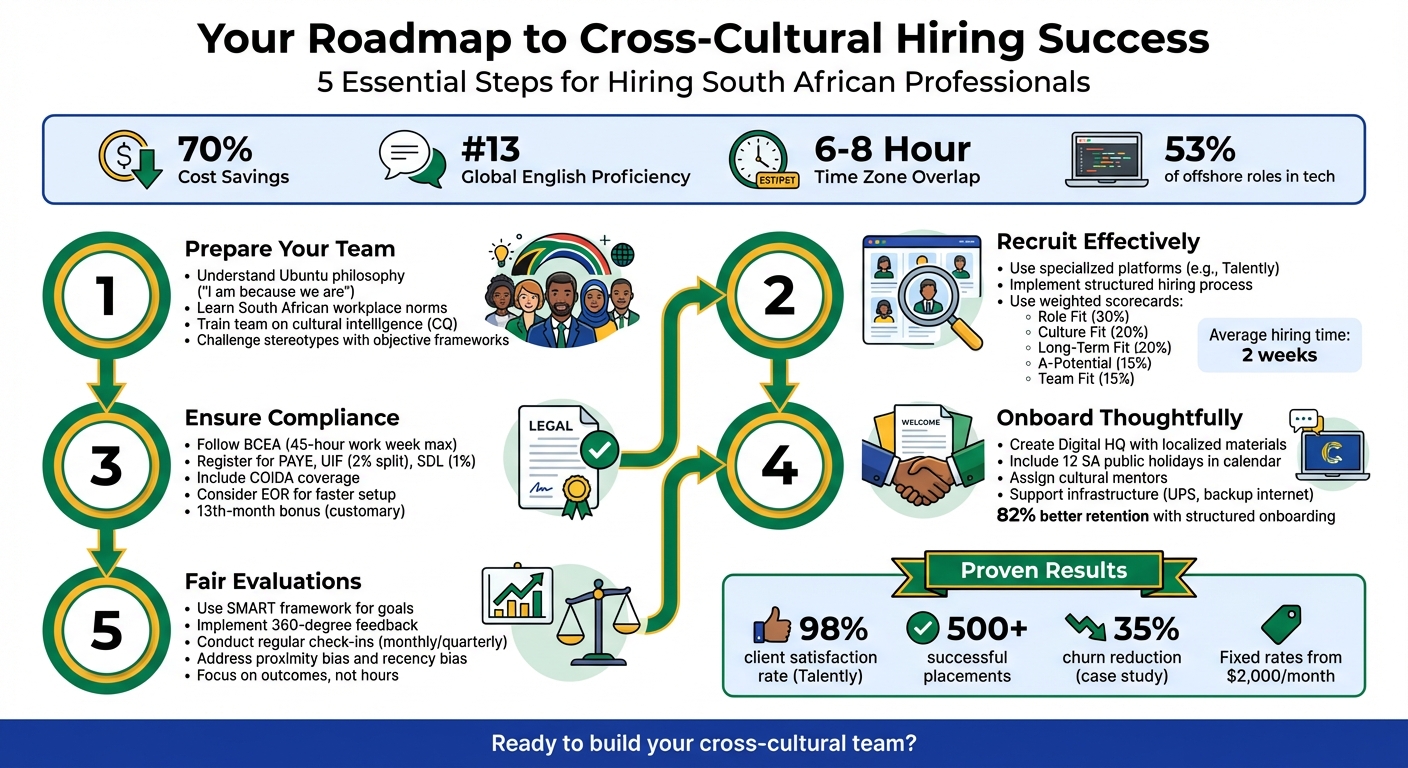
5-Step Cross-Cultural Hiring Process for South African Talent
Mastering Cross-Cultural Management: Strategies for Today’s Global Workplace
sbb-itb-7512dae
Prepare Your Team for Cross-Cultural Hiring
Before posting any job listings, it’s crucial to prepare your team to understand the unique aspects of South African workplace culture. This groundwork minimizes misunderstandings and helps create an environment where new hires can thrive from day one. By equipping your team with this knowledge, you’ll ensure a smoother integration process during recruitment and onboarding.
Learn About South African Workplace Norms
South African workplaces operate on distinct values that shape communication, collaboration, and relationships. A key concept to grasp is Ubuntu, which translates to “I am because we are.” This philosophy emphasizes community and teamwork, meaning employees often prioritize group harmony and shared decision-making over individual accomplishments.
Communication in South Africa is typically direct, but this can shift depending on hierarchical situations. For example, when delivering feedback – especially negative feedback – communication may become more indirect to preserve harmony and avoid embarrassment. It’s also important to recognize that building relationships comes first. Initial meetings often involve small talk about family or well-being before diving into business.
While respect for seniority remains strong, many workplaces are moving toward participatory decision-making. Employees increasingly expect their input to be considered before managers make final decisions. A practical note: always set specific deadlines. Phrases like “just now” can be vague, ranging from “immediately” to “later”, so clear timelines help avoid confusion.
Recognize and Challenge Common Stereotypes
Stereotypes can create blind spots, limiting your ability to see the true talent of South African professionals. One example stems from education statistics: only 7% of South African adults hold tertiary degrees, the lowest among OECD partner countries. However, this doesn’t paint the full picture. In fact, 77% of young adults have completed upper secondary or post-secondary education. Many professionals also bring exceptional skills gained through rigorous on-the-job training and certifications.
To tackle bias, use objective hiring frameworks that focus on measurable criteria rather than subjective impressions. Structured interview scorecards can evaluate Role Fit, Culture Fit, and Team Fit with predefined weightings, ensuring decisions are based on data. Additionally, challenge assumptions about infrastructure reliability. Professionals in major cities have adapted to challenges like load-shedding by using fiber internet and backup power solutions, such as DC-UPS units, to maintain connectivity. These frameworks pave the way for a fair recruitment and onboarding process. For a broader look at these strategies, consult our guide to offshore staffing.
Evaluate Your Team’s Cultural Intelligence
Your team’s ability to understand and adapt to cultural differences – known as cultural intelligence (CQ) – is essential for successful integration. Start by having team members complete self-assessments to identify gaps in their understanding of South African workplace norms and history.
“Cultural intelligence (CQ) refers to the ability to understand, respect, and adapt to cultural differences. It’s about recognizing that people from different backgrounds may have distinct values, communication styles, work preferences, and expectations.” – Africa HR Solutions
Invest in training that covers South African business etiquette, the Ubuntu philosophy, and relevant historical context. Collaborate with local experts who can provide guidance on social norms and labor laws before you begin hiring. Building this awareness ensures your team can navigate cultural differences effectively and respectfully.
Recruit and Vet South African Candidates
Once your team has a solid grasp of South African workplace norms, it’s time to move on to sourcing and evaluating candidates. This stage calls for a structured process that balances technical qualifications with cultural alignment, all while ensuring compliance with local labor laws.
Find Candidates Through Specialized Platforms
Skip generic job boards and focus on specialized platforms to access pre-screened professionals quickly. For example, Talently (https://hirewithtalently.com) connects North American companies with top-tier talent – professionals in the top 2% of their fields. These roles range from customer success management to marketing, executive assistance, and business development. Talently simplifies the hiring process by handling everything from initial screening to final interviews and even payroll compliance.
A great example of its impact? In 2025, Sarah Mitchell, VP of Customer Success at ScaleUp SaaS, hired two South African Customer Success Managers through Talently. Within six months, her team reduced churn by 35%, all at 50% of the cost of hiring locally in North America. This highlights how platforms like Talently can make hiring efficient without sacrificing quality.
If you’re hiring directly, consider a multi-step process to screen candidates effectively:
- Begin with a CV review to filter out early mismatches.
- Request a short self-recorded video (2–5 minutes) using tools like Loom to assess communication skills and energy.
- Conduct technical assessments tailored to the role.
- Wrap up with formal interviews, using a weighted scorecard for consistent evaluation.
Once you’ve identified qualified candidates, the next step is conducting culturally sensitive interviews.
Interview Candidates with Cultural Sensitivity
In South Africa, building relationships is a key part of business culture. Instead of diving straight into technical questions, start interviews with a personal touch. Ask about their family or general well-being to create a comfortable environment. This approach fosters trust and encourages candidates to showcase their true potential.
Schedule interviews with South Africa Standard Time (UTC +2) in mind, ensuring overlap with North American work hours. Also, confirm that candidates have stable internet connections for video calls.
To evaluate candidates objectively, use a weighted scorecard that includes:
- Role Fit: 30%
- Culture Fit: 20%
- Long-Term Fit: 20%
- A-Potential Fit: 15%
- Team Fit: 15%
Standardize your interview questions to ensure fairness. Ask every candidate the same core behavioral or situational questions, and avoid vague feedback like “lacked confidence.” Instead, provide specific, behavior-based examples. Prioritize practical skills and competencies over formal degrees.
Once you’ve assessed cultural fit, ensure your hiring process complies with South African labor laws.
Confirm Compliance with South African Labor Laws
South African labor laws are known for being protective, so compliance is critical even before extending an offer. The Basic Conditions of Employment Act (BCEA) sets minimum standards for working hours (maximum of 45 hours per week), leave, and pay. Meanwhile, the Labour Relations Act (LRA) handles issues like unfair dismissals, and the Employment Equity Act (EEA) prohibits discrimination based on race, gender, age, and other factors.
Your employment contracts should include mandatory clauses covering working hours, leave policies, termination processes, and compensation details. While a 13th-month bonus isn’t legally required, it’s a common practice in South Africa, often paid in December.
Choose the right hiring model based on your needs:
- Employer of Record (EOR): This option handles payroll, tax compliance (including PAYE income tax, UIF contributions, and the Skills Development Levy), and legal representation. It allows you to hire in about two weeks without setting up a local entity.
- Independent Contractors: For project-based work, ensure contractors maintain autonomy and provide their own tools to avoid misclassification penalties.
- Local Subsidiary: While this option offers full control, it comes with higher setup costs and administrative complexity.
“South Africa’s labour laws are regarded as some of the most protective and process-driven in the world, and this influences every stage of the employment relationship.” – HireJustNow
Finally, make sure your hiring practices account for statutory contributions. Employers must register for and remit:
- PAYE income tax
- UIF contributions (2% of gross salary, split equally between employer and employee)
- Skills Development Levy (1% of total payroll)
Remote workers should also be covered under COIDA for workplace injuries.
Onboard and Integrate New Hires
Getting onboarding right can make a huge difference. Studies reveal that a well-structured onboarding process can improve new hire retention by 82% and increase productivity by over 70%. Yet, only 12% of employees strongly feel their organization excels at onboarding. Without a strong start, companies risk losing talent and creating confusion.
Create Onboarding Materials That Match Local Practices
Centralize all important resources in a Digital HQ using platforms like Notion or Confluence. As GitLab‘s Remote Playbook wisely notes:
“If it isn’t documented, it doesn’t exist”
Tailor these materials to reflect local employment norms. For instance, include details about 12 South African public holidays in the shared team calendar to avoid scheduling conflicts. If a holiday falls on a Sunday, the following Monday becomes a paid day off .
Break down compensation specifics, such as the 13th-month bonus, which is common in South Africa. Be clear about deadline expectations too – South African professionals often have a more flexible approach to timelines compared to North American norms. Explain why certain deadlines are crucial and how they impact the team.
To build trust, which is especially valued in South African workplaces, include a “Personal Histories Session” during the first week. This allows leaders to share personal stories and challenges, fostering a sense of connection.
| Benefit Category | South African Standard |
|---|---|
| Annual Leave | 21 consecutive days per year |
| Sick Leave | 30 days per 3-year cycle |
| Public Holidays | 12 days (Monday off if holiday falls on Sunday) |
| Maternity Leave | 4 consecutive months (partially covered by UIF) |
| Family Responsibility | 3 days per year for birth, illness, or bereavement |
| 13th Month Bonus | Customary in December (not statutory) |
Pair New Hires with Cultural Mentors
Once onboarding materials are in place, take it a step further by assigning peer mentors to new employees. These mentors aren’t managers but colleagues who can answer informal questions about workplace norms and social customs . For example, a mentor can help navigate differences in feedback styles – North American directness might come across as too blunt to some South Africans.
Mentors also help new hires uncover unspoken workplace dynamics, sometimes referred to as “accidental values”, that aren’t captured in official policies .
Use the “Stop, Start, Continue” framework during 30-, 60-, and 90-day check-ins to refine the onboarding process and address any cultural misunderstandings early on. Encourage new hires to share feedback and adjust their onboarding experience to better align with both team goals and their local context. Incorporate tools like 16 Personalities or Working Genius assessments to help the team collaborate effectively with the new hire.
Establish Clear Remote Work Guidelines
For long-term success, set transparent expectations for remote work. South Africa has infrastructure challenges like “load shedding” (scheduled power outages) and unreliable internet. Offer financial support for solutions like UPS systems, generators, or mobile data plans to minimize disruptions . Ahmad Ramadan, General Manager of Human Resources at Bayobab, explains:
“Infrastructure challenges are realities we face across the continent. Our approach has been to embrace flexibility, provide support where needed – such as subsidised internet or alternative power solutions – and continuously collaborate with local teams to adapt to the realities of each market”
Focus on outcomes rather than micromanaging hours. This approach not only builds trust but also accommodates the flexibility remote work demands . Many South African professionals are open to working late to align with North American time zones, but rotating meeting times ensures fairness.
To avoid technical hiccups, ship hardware 3–5 days before the start date. Use a mix of communication tools tailored to South African preferences: WhatsApp for quick updates, Microsoft Teams or Zoom for meetings, and email for formal documentation. Set clear work-hour boundaries to prevent burnout, especially when working across time zones. Ramadan emphasizes:
“Leading remote teams requires managers to empower their people, focusing on outcomes rather than micromanaging processes. It’s about creating a balance between autonomy and accountability”
This integration is a critical part of navigating offshore staffing successfully. Next, focus on unbiased performance assessments to keep the team aligned and thriving.
Address Bias and Measure Performance Fairly
After new hires settle into their roles, the next hurdle is ensuring they’re evaluated on merit rather than misconceptions. Bias can easily overshadow actual performance, but there are practical ways to identify and address it, creating a fairer evaluation process.
Train Teams to Recognize and Reduce Bias
Start by digging into your hiring and evaluation data. Compare applicant pools and hire rates across different demographics – like race, gender, and age – to pinpoint where drop-offs might indicate bias. Also, review interview notes for vague or irrelevant language that could hint at subjective judgments.
In South Africa, some biases are particularly prominent. For example, the “Old School Tie” network, favoring candidates from elite schools, still lingers in certain circles, though it’s gradually fading. Gender bias also persists, with women often underrepresented in senior roles or subjected to patronizing behavior. To combat these issues, consider anonymized pre-screening – removing names, addresses, and university details from CVs before they reach reviewers. Standardizing interview questions ensures every candidate for the same role answers identical core questions, reducing room for bias.
Another key step is requiring interviewers to submit independent evaluations before group discussions. Diversify interview panels by including members with different genders, races, and backgrounds. Shift the focus from “culture fit” to “culture add”, emphasizing what unique value a candidate can bring rather than how closely they align with existing team members.
These measures help lay the groundwork for fairer performance evaluations.
Apply Objective Performance Standards
Once bias is addressed, the next step is to establish clear and objective performance standards. Use the SMART framework – Specific, Measurable, Achievable, Relevant, Time-bound – to create goals that leave no room for misinterpretation. Weighted scorecards can also be helpful, breaking down evaluations into categories like Role Fit, Culture Fit, and Team Fit, rather than relying on gut feelings.
Expand evaluations beyond the manager’s perspective by incorporating 360-degree feedback from peers, subordinates, and even customers. Calibration meetings between HR and managers ensure consistency in applying standards and challenge any subjective judgments before final ratings are finalized. As Maciej Kubiak, Head of People at PhotoAiD, notes:
“With calibration, [companies] ensure all performance terms and criteria are clearly explained so everyone uses the same method of judgment to determine employee ratings”.
Ditch the once-a-year review in favor of regular check-ins – monthly or quarterly. This approach allows for real-time feedback and helps maintain a running record of performance. Keeping detailed performance logs throughout the year can also counteract “Recency Bias”, where only recent events influence evaluations. Plus, this aligns with South African labor laws, ensuring employees have clear expectations and opportunities to improve.
| Common Bias | How It Affects Evaluations | How to Mitigate It |
|---|---|---|
| Proximity Bias | Favoring in-office employees over remote workers | Use objective output metrics and standardized rubrics for all |
| Recency Bias | Focusing on recent events only | Keep continuous performance logs throughout the year |
| Halo Effect | Letting one positive trait overshadow others | Evaluate independent competencies with specific criteria |
| Central Tendency | Rating everyone as “average” to avoid conflict | Use forced distribution or specific behavioral anchors |
Build Team Unity Through Common Goals
A fair evaluation system works best when individual and team goals align. Building on earlier onboarding efforts, create a sense of unity by connecting personal contributions to team-wide objectives. Embrace the South African concept of Ubuntu, which emphasizes collaboration and shared success over rigid, top-down management styles.
Encourage psychological safety by fostering an environment where employees feel safe discussing challenges and giving honest feedback to managers without fear of retaliation. Team-building exercises that focus on shared goals and effective communication can also help bridge any cultural divides. When everyone sees how their work fits into the bigger picture, performance evaluations shift from comparisons between individuals to a focus on collective progress.
Maintain Long-Term Cross-Cultural Success
Creating a thriving cross-cultural team is not a one-and-done effort – it’s an ongoing process that demands consistent attention and fine-tuning. Once you’ve established fair performance standards and built a sense of team unity, the next step is ensuring your South African hires stay motivated and productive for the long term.
Gather Regular Employee Feedback
Anonymous surveys and exit interviews are invaluable tools for understanding your team’s satisfaction levels. Metrics like eNPS (employee Net Promoter Score) can help you gauge whether team members across different groups would recommend your company as a great place to work. To get the most out of these surveys, include both demographic questions and open-ended ones that encourage honest feedback about your initiatives and areas that need improvement.
Transparency plays a huge role here. Sharing survey results with the team shows that you’re serious about improvement and builds trust by acknowledging both successes and areas where growth is needed. Departing employees, in particular, may feel more comfortable being candid about issues like inclusion and belonging. This feedback is more than just nice to have – it’s critical. Companies with inclusive cultures are 1.7× more likely to lead in innovation and see 2.3× higher cash flow compared to their peers. Use these insights to guide meaningful policy changes and stay competitive.
Revise Policies Based on Cultural Insights
Your South African team can offer valuable perspectives to shape HR policies. Adopting collaborative management styles aligned with Ubuntu – a South African philosophy centered on community and collective success – can make a big difference. While South Africans generally appreciate direct communication, it’s important to account for regional nuances, like the fast-paced culture in Johannesburg versus Cape Town’s more relaxed “just now” mindset.
Regularly review pay structures, promotion criteria, and hiring practices to identify and address cultural biases. Casper Geustyn, Labor Specialist at HireJustNow, highlights the importance of fairness in such systems:
“The goal of the system is to ensure minimum standards and fair treatment, particularly in a labour market where many employees earn lower wages or have limited bargaining power”.
Once your policies are refined, you’ll be better positioned to grow your team effectively.
Expand Your Team with Talently‘s Fixed-Rate Pricing
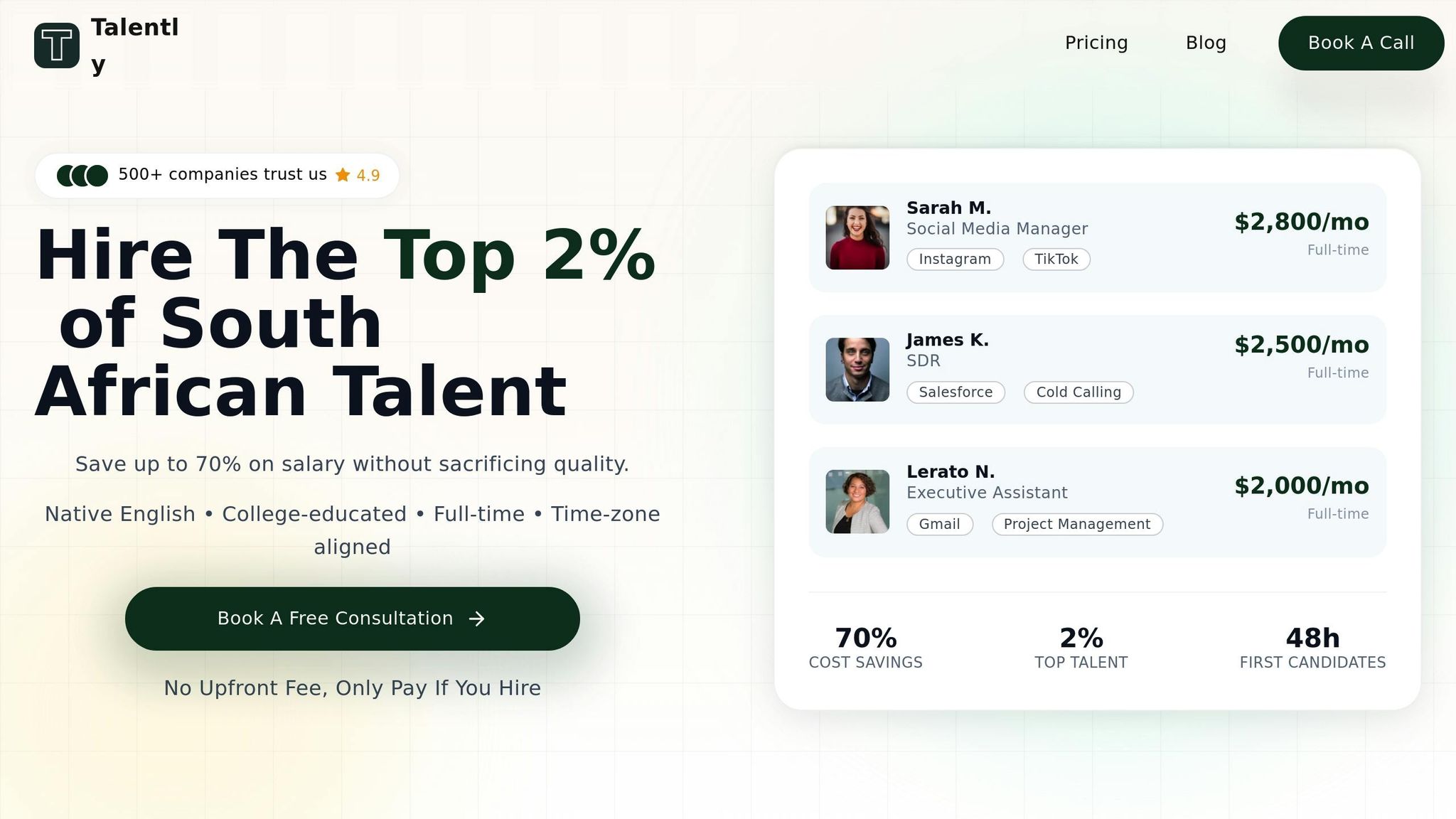
When it’s time to scale, Talently makes the process seamless. With a 98% client satisfaction rate and over 500 successful placements, Talently takes care of talent sourcing, vetting, and payroll, allowing you to focus on other priorities. Their fixed monthly rates – starting at $2,000 for Executive Assistants, $2,500 for Sales Development Representatives, and $2,800 for Social Media Managers – can save you up to 70%. Plus, the average hiring process takes just two weeks, all while ensuring compliance with South African labor laws.
“From consultation to onboarding, everything was seamless. They really understood our needs and found us the perfect executive assistant. Worth every penny”.
Conclusion
Creating a successful cross-cultural team with South African talent involves thoughtful planning, cultural understanding, and consistent teamwork. Start by familiarizing yourself with South African workplace norms, which often emphasize collective decision-making and relationship-focused business practices. Use structured vetting processes to evaluate candidates for role suitability, cultural alignment, and long-term potential. To ensure compliance with South African labor laws, consider working with an Employer of Record to manage payroll, tax obligations, and benefits seamlessly.
Once you’ve made your hires, integration becomes the focus. Develop onboarding materials tailored to cultural nuances, assign mentors to guide new hires, and establish clear communication practices that respect South Africa’s more formal business etiquette. Train your teams to identify and address biases, implement objective performance metrics, and foster unity by aligning everyone around shared goals. Keep communication open and adjust policies as needed based on cultural feedback to maintain team engagement over time.
South African professionals bring several advantages to the table, including native English proficiency, a 6–8 hour overlap with EST/PST time zones, and potential cost savings of up to 70%. With Talently, you can streamline the process – sourcing, vetting, payroll, and compliance are all handled, enabling you to hire skilled professionals in as little as two weeks. Fixed monthly rates starting at $2,000 make scaling both affordable and predictable.
FAQs
What are the biggest culture gaps to expect when hiring in South Africa?
When hiring in South Africa, it’s important to recognize some key differences in workplace communication and norms. South African workplaces often balance direct and indirect communication styles. Indirect communication is particularly common in hierarchical settings, where maintaining harmony and respect is a priority.
Adding to this complexity is the country’s rich diversity. With eleven official languages and a variety of ethnic groups, workplace interactions can vary significantly. This diversity requires a nuanced approach to communication and collaboration.
To ensure a smooth integration into North American teams, it’s crucial to approach these differences with patience, adaptability, and a strong sense of cultural awareness. These qualities can help bridge potential gaps and foster effective teamwork.
What legal and payroll requirements do I need to handle in South Africa?
To hire employees in South Africa, you must adhere to the Basic Conditions of Employment Act (BCEA). This law outlines key employment standards, including working hours, leave entitlements, and rules for termination. You’ll also need to handle contributions to the Unemployment Insurance Fund (UIF) and deduct Pay-As-You-Earn (PAYE) taxes from salaries.
It’s essential to provide written contracts that clearly define job roles and terms of employment. If you’re employing foreign workers, ensure you comply with immigration regulations and anti–money laundering requirements, particularly when paying individuals who don’t have South African bank accounts.
How can I prevent load shedding from disrupting a remote South African hire?
To reduce the impact of load shedding on work, think about offering backup power options such as inverters or UPS systems to keep crucial devices operational during outages. For internet access, a mobile Wi-Fi router or phone tethering can act as reliable alternatives. You might also consider portable power stations or rent-to-own UPS units to help maintain productivity. These steps can ensure your South African team member stays productive even during power cuts.
Related Blog Posts
Ready to build your dream team?
Book a free consultation and get your first candidate shortlist within 48 hours.
No upfront fee • Only pay if you hire