
How South African Talent Excels in Remote Communication
 13 min read

South African professionals have become a top choice for remote roles due to their strong communication skills and the many benefits they bring to global teams. Here’s why they stand out:
- High English Proficiency: Ranked #13 globally on the EF English Proficiency Index, South Africans excel in reading, writing, speaking, and listening, making them effective in roles requiring clear communication.
- Neutral Accent: Their accent, rooted in British English, is easy to understand and well-suited for international business.
- Time Zone Alignment: Operating in GMT+2, they overlap significantly with U.S. East Coast and U.K. working hours, enabling real-time collaboration.
- Multilingual Skills: Growing up in a country with 11 official languages enhances their ability to navigate diverse interactions and adapt communication styles.
- Tech Infrastructure: Reliable internet and strong cybersecurity support seamless remote work, ensuring consistent and secure communication.
South African professionals are particularly suited for roles like customer success, account management, and business development, where communication is key. Companies like Talently make it easier to connect with this talent, handling sourcing, payroll, and compliance.
Key takeaway: South African talent offers a blend of language skills, cultural alignment, and reliable technology infrastructure, making them a strong fit for remote teams.
Use our Communication test to find top communicators
sbb-itb-7512dae
Strong English Language Skills and Global Rankings
South Africa’s English Proficiency Rankings and Remote Work Statistics
South Africa’s EF English Proficiency Index Rankings
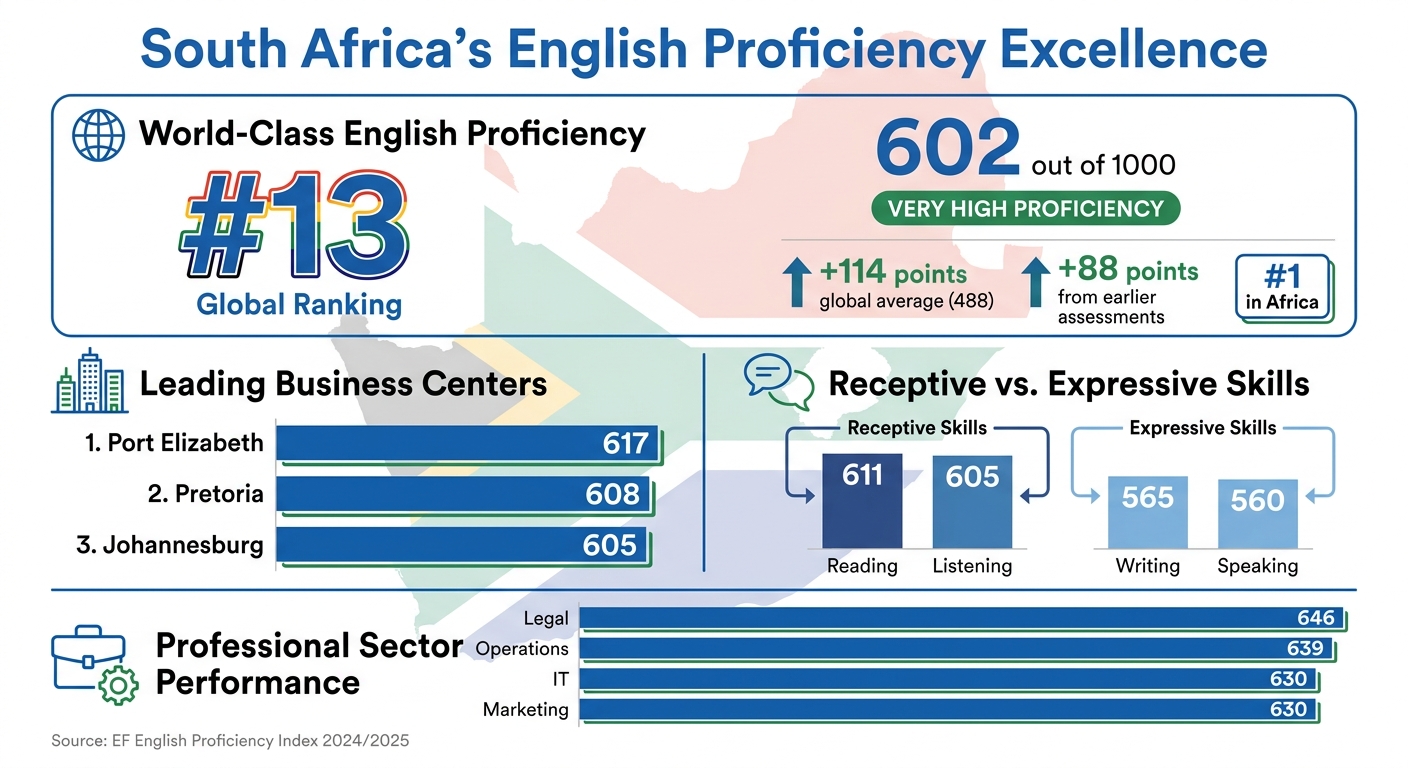
South Africa ranks #13 globally on the 2024/2025 EF English Proficiency Index with a score of 602, placing it in the “Very High Proficiency” category. This score surpasses the global average of 488 by an impressive 114 points. Within Africa, South Africa leads the continent in English proficiency, showing an 88-point increase from earlier assessments. Key business centers such as Port Elizabeth (617), Pretoria (608), and Johannesburg (605) contribute significantly to this high ranking. Additionally, job-specific scores highlight the country’s linguistic strength: Legal professionals score 646, Operations 639, and both IT and Marketing professionals achieve 630.
Why English Proficiency Matters in Remote Roles
Strong English skills are a cornerstone of effective remote work, and South African professionals excel in this area. Their receptive abilities are particularly notable, with reading and listening scores of 611 and 605, respectively. These skills are crucial for interpreting project briefs, technical documents, and client communications in a remote setting. On the expressive side, writing (565) and speaking (560) scores ensure clear communication in emails and virtual meetings, minimizing misunderstandings in roles like customer success, account management, and executive assistance. Combined with benefits like accent neutrality and shared values, these language abilities make South African professionals highly suited to hire remote staff in South Africa.
Neutral Accents and Western Cultural Compatibility
Origins of Accent Neutrality
South African English has its roots in British English, creating a version of the language that is widely understood around the world. Over time, it developed into three primary sub-varieties: Cultivated, General, and Broad. Among these, the General and Cultivated accents stand out for their clarity and neutrality, making them ideal for international business interactions.
A newer trend, known as the “Model-C” accent, is becoming increasingly common among young professionals. This accent further enhances clarity and neutrality. Additionally, most South African professional accents are non-rhotic, meaning the “r” at the end of words is not pronounced. This feature aligns closely with UK and European speech patterns, making South African English particularly easy for these audiences to understand. It’s also worth noting that many South African professionals of Indian and Asian heritage are native English speakers, adding to the linguistic diversity and proficiency within the workforce.
This linguistic clarity is more than just a convenience – it aligns perfectly with the straightforward and proactive communication style that remote work demands. The precision in their speech naturally complements the direct approach valued in Western business environments.
Shared Values with North American and UK Markets
Beyond their clear accents, South African professionals bring a communication style that resonates with Western business norms. According to the Cultural Atlas:
“Most South Africans have a direct style of communication. They generally speak confidently and straight to the point. Their intention and meaning is generally very self-evident”.
This directness helps reduce misunderstandings and speeds up decision-making – key advantages for remote teams.
“South African remote staff tend to integrate into company culture more naturally. They don’t feel like an external vendor. They feel like part of the team.” – Exclusively Remote
This seamless integration goes beyond just communication. South African professionals are known for their accountability and proactive problem-solving, meeting the high standards expected in Western markets. Many of them have experience with global business practices, enabling them to function as true team members rather than outsourced contractors.
Adding to this compatibility is South Africa’s favorable time zone (GMT+2), which allows for significant overlap with both UK and US East Coast working hours. This overlap facilitates real-time collaboration, removing many of the barriers typically associated with outsourcing. For a deeper look at these dynamics, see our guide to offshore staffing. Together, these factors create an environment where South African professionals can thrive as integral parts of international teams.
Multilingual Workforce and Emotional Intelligence
Benefits of Multilingualism
South Africa is home to 11 official languages, creating a vibrant mix of linguistic and cultural communication. This environment allows many professionals to grow up fluent in multiple languages, sharpening their ability to navigate diverse interactions.
Living in a multilingual society builds a strong awareness of language. South African professionals often switch between languages and adjust their communication styles based on their audience. This constant adaptation fosters a natural sensitivity to tone and nuance – an invaluable skill, especially in customer-facing roles where the right choice of words and tone can make all the difference.
Beyond language skills, this exposure to diverse cultures nurtures what researchers term “cultural intelligence.” This is the ability to interpret situations, adapt communication styles, and connect across different perspectives. Such skills are especially useful in remote teams, where the lack of face-to-face interaction can sometimes lead to misunderstandings. South African professionals’ linguistic adaptability often translates into the emotional insight needed to navigate high-pressure communication scenarios effectively.
Emotional Intelligence in Communication Roles
Being multilingual doesn’t just enhance language skills – it also strengthens emotional intelligence. Growing up in a diverse society helps individuals learn to read subtle cues and adjust their communication style to fit the situation.
This adaptability is particularly evident in how South African professionals manage complex or high-stress situations. Workplace consultant Therese Otten highlights this strength:
South African professionals succeed globally because they’ve learned to operate calmly in complexity. When challenges arise, they respond effectively.
In roles like customer success, sales, and account management, this ability to remain calm and solution-focused has a noticeable impact. These advanced language and emotional skills are crucial for addressing the unique challenges of remote communication and maintaining strong professional relationships. This is just one of the many benefits of offshore staffing that help streamline global operations.
Technology Infrastructure Supporting Remote Work
South Africa’s robust technology infrastructure plays a key role in enabling seamless and reliable remote communication.
Internet Quality and Network Readiness
South Africa has made significant strides in providing high-speed internet crucial for remote work. The country is ranked 28th globally for Fiber to the Home (FTTH) and internet subscription services, with a score of 46.27 out of 100. This broad adoption of fiber ensures the stability required for video calls, large file sharing, and real-time collaboration. It’s this solid foundation that helps South African professionals excel in remote roles by maintaining clear and uninterrupted communication.
Additionally, mobile network coverage reaches an impressive 99.2% of the population with at least 3G connectivity. This ensures professionals remain connected, even in rural or less developed areas. South Africa also ranks 42nd in international bandwidth and 38th in secure server infrastructure, both of which are critical for handling sensitive data securely. With a cybersecurity score of 83.48, the country demonstrates strong measures to safeguard remote communication.
This tech maturity has fueled remarkable industry growth. Since 2015, South Africa’s Global Business Services sector has grown by approximately 41%, creating over 112,000 jobs. This growth reflects the confidence international organizations have in the country’s technical capabilities. Nick Durrant, Managing Director at Bluegrass Digital, highlights this sentiment:
What global teams are really looking for now is not just additional capacity, but confidence. Confidence that the people joining their teams will integrate quickly, communicate clearly and take shared ownership of outcomes.
Co-Working Spaces and Remote Work Facilities
South Africa’s co-working spaces provide essential resources like high-speed fiber, modern meeting facilities, and advanced technology to support remote professionals. These hubs are vital for location-independent workers needing reliable connectivity and professional environments, enabling them to meet the communication standards required by global teams.
Cities like George in the Western Cape have emerged as prime destinations for remote work. By investing in municipal fiber and smart city technologies, George has attracted digital professionals and positioned itself as a hub for remote workers. Facilities such as kanwerk in George illustrate this trend, offering community-focused spaces that connect remote workers with local businesses.
However, power reliability remains a challenge, prompting many professionals to adopt backup solutions like solar panels and UPS systems to ensure uninterrupted connectivity. In a bold move, Webafrica, a leading South African internet service provider, transitioned to a 100% remote workforce in April 2022. CEO Sean Nourse described the shift as “life-changing” for the team after the company closed all physical office locations.
Through investments in internet infrastructure, co-working spaces, and adaptive solutions, South Africa has built a strong foundation for remote professionals. This infrastructure, paired with the remote hiring strategies of organizations like Talently, ensures U.S. businesses can confidently collaborate with top South African talent. To find the right fit, you can use a remote talent skill matcher to identify professionals with the specific expertise your team requires.
How Talently Connects Businesses with South African Professionals
Strong communication skills are essential, but finding the right talent to match those skills can be challenging. Talently steps in to make this process seamless by handling everything from sourcing to payroll. This allows North American companies to easily onboard South African professionals known for their outstanding communication abilities – without the usual complications of offshore hiring.
Talent Sourcing and Screening Process
Talently focuses on identifying and vetting the top 2% of South African talent, prioritizing native English speakers who are college-educated and equipped for business roles. Their multi-step screening process ensures candidates excel in communication-heavy positions like customer success management, sales development, and marketing. After a 30-minute consultation to understand your team culture and ideal candidate profile, Talently provides a tailored shortlist – often within just 48 hours, and never more than two weeks.
Michael Chen, Head of Sales at TechFlow Inc, shared his experience hiring South African Business Development Representatives through Talently in 2024:
The quality of talent is exceptional. Our South African BDRs are outperforming our US-based reps, booking 40% more meetings.
In addition to their expertise, South African professionals benefit from a six- to eight-hour overlap with Eastern and Pacific time zones, enabling real-time collaboration and boosting productivity.
This streamlined and efficient process ensures companies can quickly and confidently build high-performing offshore teams. This approach highlights why offshore staffing is a smart strategy for modern companies.
Complete Offshore Staffing Services
Talently takes South Africa’s communication strengths a step further by offering a full-service offshore staffing solution. Beyond sourcing talent, they handle contracts, payroll, benefits, and compliance, acting as the employer of record. This eliminates the administrative burden for businesses, allowing them to focus entirely on integrating their new hires.
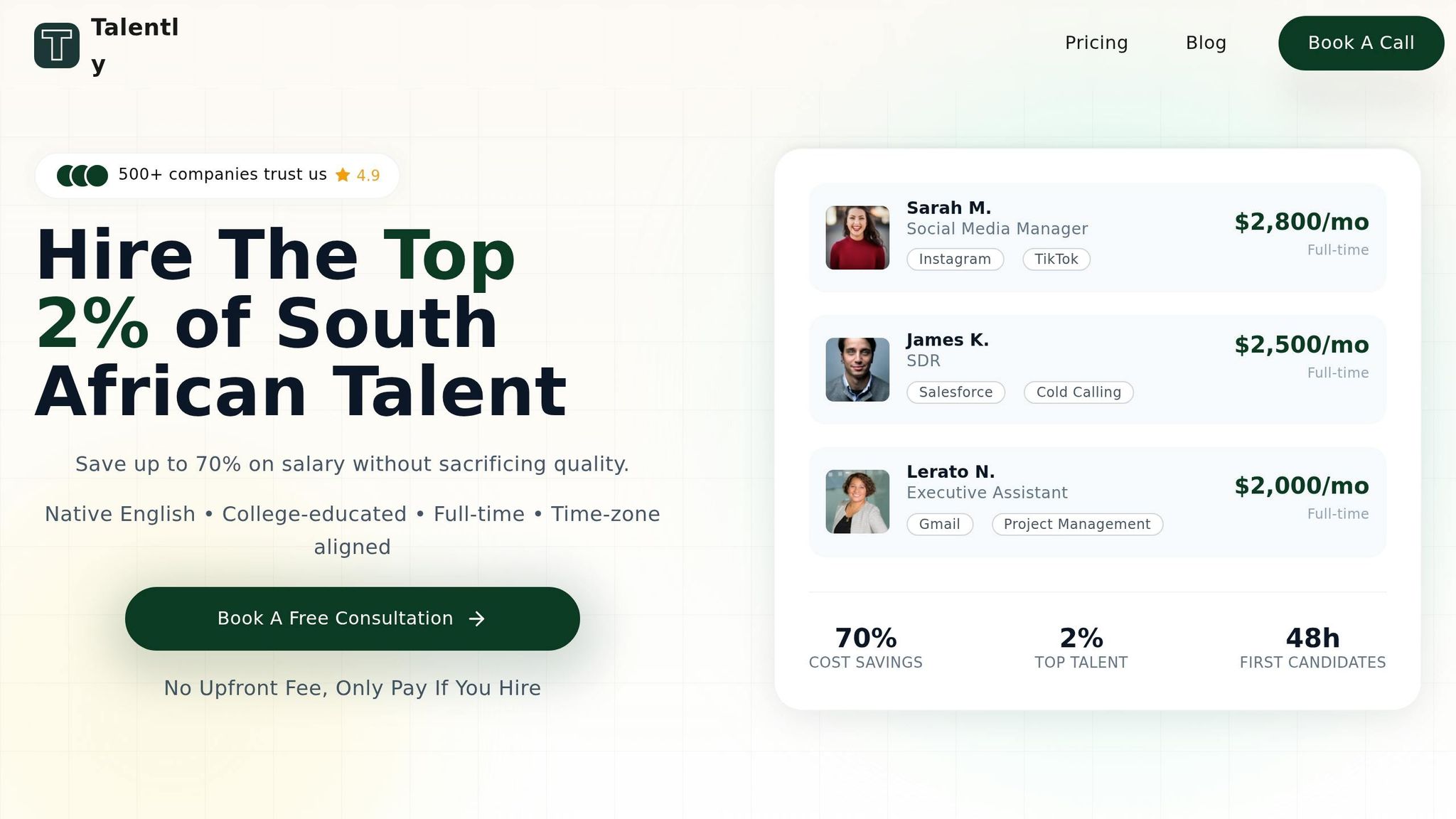
Talently operates with a transparent, fixed-rate monthly pricing model, requiring no upfront fees and adhering to a pay-for-success approach. Starting rates include $2,000/month for Executive Assistants, $2,500/month for Sales Development Representatives, and $2,800/month for Social Media Managers. These rates can save businesses up to 70% compared to hiring locally in North America – potentially cutting costs by over $50,000 annually per hire.
Sarah Mitchell, VP of Customer Success at ScaleUp SaaS, highlighted the impact Talently had on her team in 2024:
Talently transformed our customer success team. We hired two amazing CSMs at half the cost of local hires, and they’ve reduced our churn by 35% in just 6 months.
With a 98% client satisfaction rate across more than 500 placements, Talently continues to prove how effective offshore staffing can be when done right.
Conclusion
South African professionals bring a strong edge to remote communication, thanks to their high English proficiency, neutral accents, and ability to connect well with global teams. Ranked “Very High Proficiency” on the EF English Proficiency Index, they ensure smooth customer interactions and seamless internal communication. These qualities – language skills, a neutral accent, and adaptability – make them valuable contributors to any team. This communication strength also supports effective real-time collaboration.
The GMT+2 time zone is another advantage, allowing South African professionals to collaborate easily with North American teams, fostering trust and efficiency.
A study from Gauteng highlights that remote work thrives when employees have reliable technology, feel supported by management, motivated, and are empowered within their roles.
Together, these strengths – communication skills, cultural alignment, and technology readiness – enhance efficiency while keeping operational costs in check. By minimizing miscommunications and reducing hidden staffing expenses, South African professionals give businesses a clear advantage when building integrated offshore teams.
FAQs
What roles are South African professionals best suited for on remote teams?
South African professionals shine in roles that rely heavily on strong communication skills and remote teamwork. Fields like customer success management, marketing, and business development are where they truly stand out, especially in positions that involve frequent client interaction. Their knack for effective engagement makes them a great fit for these kinds of responsibilities.
How much working-hour overlap will I get with South Africa from the U.S.?
South Africa operates 6 to 8 hours ahead of U.S. time zones, depending on where you are in the United States. This time difference creates a 6 to 8-hour overlap in working hours, making it easier for U.S.-based businesses to collaborate with professionals in South Africa.
How do South African remote workers stay online during power outages?
South African remote workers rely on backup power solutions like inverters, UPS systems, and portable power stations to stay connected during power outages. These devices help keep essential equipment like routers and laptops running, ensuring they can continue working without interruptions.
Related Blog Posts
Ready to build your dream team?
Book a free consultation and get your first candidate shortlist within 48 hours.
No upfront fee • Only pay if you hire