
Best Practices for Managing Offshore E-Commerce Teams
 21 min read

Managing offshore e-commerce teams can help businesses scale efficiently while reducing costs by 50–70% compared to local hiring. This is a core benefit of an offshore staffing model. These teams handle tasks like customer support, marketing, and website maintenance, offering access to global talent and around-the-clock operations. However, challenges like communication barriers, time zone differences, and quality control require careful planning.
Key takeaways for success:
- Define clear roles: Offshore teams excel in process-driven tasks like customer support, SEO, and Shopify development.
- Use SOPs and tools: Standard Operating Procedures, platforms like Slack, Asana, and Shopify, and time-tracking tools ensure smooth workflows.
- Onboard effectively: Provide clear training, security protocols, and regular check-ins.
- Track performance: Focus on measurable results like CSAT or ROAS, not just hours worked.
- Secure data: Use VPNs, password managers, and role-based access controls to protect sensitive information.
Platforms like Talently simplify hiring by sourcing pre-vetted professionals and managing payroll and compliance, making it easier for businesses to scale without administrative headaches.
Francesca Moi | BBTS E214: How to Build a Rockstar Offshore Team That Runs Without You
How to Structure an Offshore E-Commerce Team
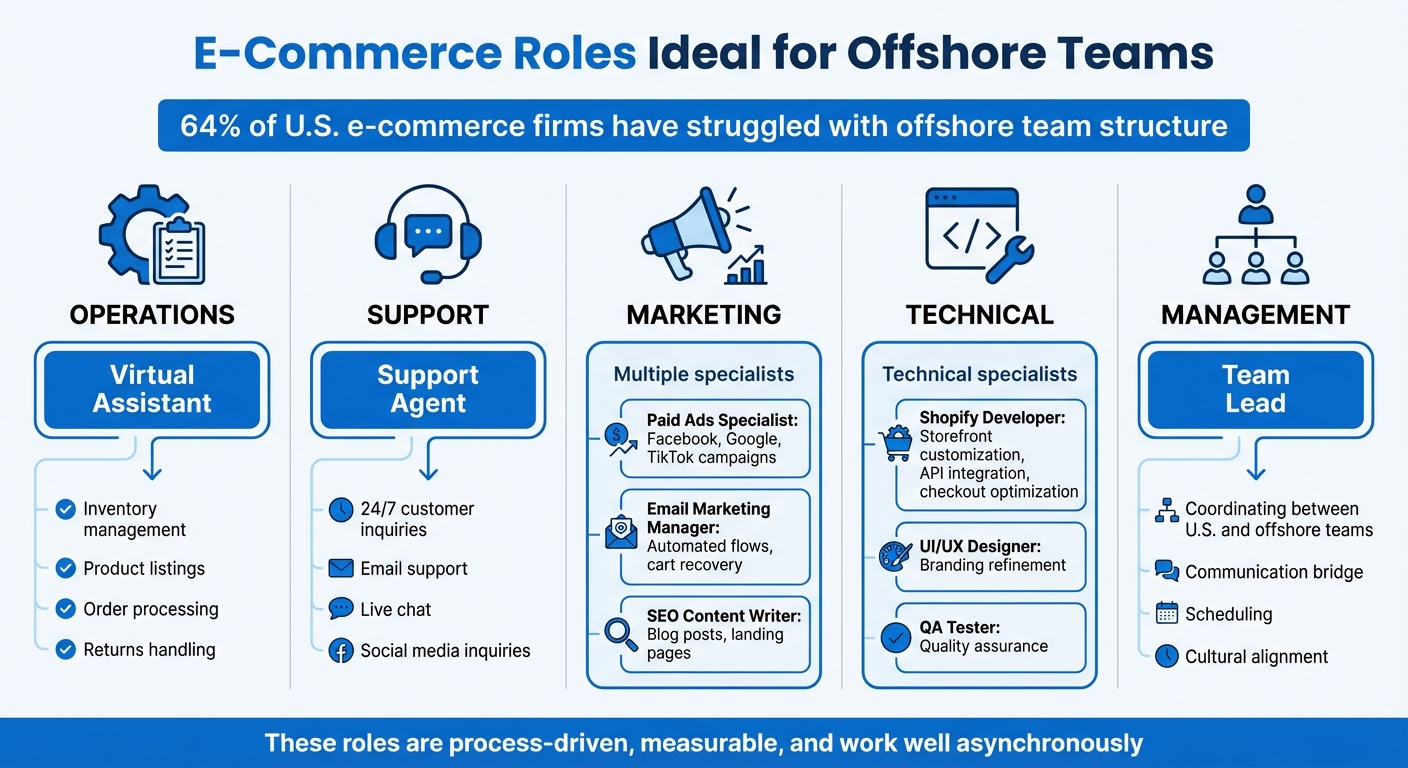
E-Commerce Offshore Team Roles and Responsibilities Guide
Creating an offshore team requires careful planning. The way you structure this team can determine whether they become a seamless part of your business or a recurring headache – something 64% of U.S. e-commerce firms have struggled with.
E-Commerce Roles Ideal for Offshore Teams
Certain e-commerce tasks are particularly well-suited for offshore staffing. For example, customer support agents can manage email, live chat, and social media inquiries around the clock, offering true 24/7 support. Virtual e-commerce assistants can handle product listings, order processing, inventory updates, and returns, allowing your local team to focus on higher-level strategies.
On the marketing side, offshore paid ads specialists can manage campaigns on platforms like Facebook, Google, and TikTok. Email marketing managers can design automated flows to recover abandoned carts and retain customers. SEO content writers can create blog posts and landing pages to boost organic traffic. For technical tasks, Shopify developers can customize storefronts and optimize checkout processes, while UI/UX designers refine branding and QA testers ensure everything runs smoothly. These roles tend to be process-driven, measurable, and work well asynchronously.
| Function | Key Offshore Roles | Primary Responsibility |
|---|---|---|
| Operations | Virtual Assistant | Inventory management, listings, and orders |
| Support | Support Agent | 24/7 customer inquiries |
| Marketing | Ads Specialist | Managing ad campaigns on social platforms |
| Technical | Shopify Developer | Storefront customization and API integration |
| Management | Team Lead | Coordinating between U.S. and offshore teams |
Steps to Build Your Team Structure
Start with documentation. Before hiring, create detailed Standard Operating Procedures (SOPs) for every task you plan to delegate. Whether it’s processing returns, adding products, or handling customer support, these guides take the guesswork out of the job and set clear expectations from day one.
Establish clear reporting lines. Assign a team leader within your offshore hub to act as a bridge between your U.S.-based team and the offshore staff. This person will handle communication, scheduling, and any cultural nuances, ensuring smooth collaboration and alignment with your business goals.
Manage time zones effectively. Aim for at least 2–3 hours of overlapping work time during U.S. morning hours, which typically aligns with the afternoon for South African teams. Use this overlap for live meetings, instant feedback, and joint problem-solving. Outside of this window, your offshore team can work independently using your SOPs and clearly defined roles.
Implement a 30-60-90 day plan. For new hires, set specific goals for their first week (like gaining access to systems and tools), their first month (completing supervised tasks), and their first three months (working independently). This structure helps new team members ramp up quickly and understand what success looks like in their role.
Once your structure is in place, the next step is finding and onboarding the right talent.
How Talently Eases Offshore Hiring
Building and managing an offshore team can feel overwhelming. Sourcing candidates, verifying their skills, navigating South African employment laws, and handling international payroll are just a few of the challenges. That’s where Talently steps in.
Talently simplifies the hiring process by offering access to pre-vetted South African professionals. They also handle employment contracts, benefits, and payroll, so you don’t have to. Instead of spending weeks posting job ads and conducting interviews, you can quickly hire skilled professionals for your e-commerce roles.
With pricing starting at $2,500 per month for full-time hires, Talently provides a cost-effective alternative to U.S.-based staffing. Their fixed monthly rates eliminate surprise expenses, letting you focus on managing your team rather than worrying about compliance.
This approach is especially valuable as 73% of American e-commerce companies already depend on offshore teams to close talent gaps. Talently takes care of the heavy lifting, helping you move from “we need help” to “we have a fully functioning team” in just a few weeks.
Hiring and Onboarding Offshore Talent
Once you’ve outlined your team structure, the next step is bringing the right offshore talent on board. This process goes beyond just reviewing resumes. You need individuals who not only excel in technical skills but can also communicate effectively across time zones and mesh with your company’s values. A thoughtful hiring and onboarding strategy sets the foundation for long-term success.
How to Select the Right Offshore Talent
Start with a paid trial project to see candidates in action before committing to a full-time hire. This hands-on approach lets you assess how they perform under real-world conditions – how they meet deadlines, solve problems, and communicate. Sometimes, a trial project reveals more than even the most thorough interview.
When evaluating technical skills, focus on their expertise with the platforms your business relies on. For instance, if your e-commerce operations run on Shopify, look for developers who have experience with Shopify’s API, payment gateways, and checkout customization. For customer support roles, prioritize live simulations to test English proficiency and communication skills instead of relying solely on written tests.
Practical assessments are also key. Recent data highlights that 76% of hiring managers use coding challenges or task-specific tests to evaluate candidates in technical roles. Tailor these tests to the specific position – ask a marketing candidate to critique an ad campaign or have a virtual assistant complete a sample order process.
Set clear expectations for responsiveness and quality right from the start. Additionally, ensure candidates are familiar with data protection practices and comfortable using tools like password managers and VPNs to securely access sensitive systems.
Once you’ve chosen the right people, a solid onboarding process will help them integrate seamlessly into your operations.
Onboarding Process for Offshore Employees
A successful onboarding process should focus on three key areas: access, training, and setting clear expectations. Start by providing essential tools and accounts, such as email, Shopify, Google Workspace, and Slack. Supplement this with concise video SOPs (standard operating procedures) to guide them through your workflows.
Tools like Loom are great for creating these video SOPs, covering everything from navigating your Shopify backend to generating key reports. These videos become a handy resource for new hires to revisit whenever needed.
Consider implementing a buddy system. Pair each offshore employee with an onshore team member who can mentor them during their first few weeks. This mentor can provide real-time feedback, answer questions, and help the new hire adjust to your company’s communication and decision-making style.
Security should be a priority from day one. Use role-based access control and set up VPNs for employees handling sensitive data. Regular check-ins – daily at first, then transitioning to twice-weekly – help address any concerns quickly and ensure a smooth transition into the team.
With onboarding complete, the next step is fostering a sense of connection and shared purpose.
Building Cultural Alignment
Introduce your company’s mission and values early in the onboarding process so offshore employees understand your brand’s goals and vision. Recognizing both U.S. and local holidays – like Heritage Day for South African teams alongside Thanksgiving – helps avoid scheduling conflicts and demonstrates respect for diverse backgrounds.
Some companies go further by hosting annual retreats or team-building activities to bring onshore and offshore staff together.
“The best offshore teams are made of people who care about your brand because you cared about them first.” – Talent Hackers
Create opportunities for casual interaction by setting up a virtual water cooler on platforms like Slack or Microsoft Teams. Encourage team members to share non-work topics, whether it’s weekend plans or favorite recipes. Treat offshore employees as an integral part of the team – invite them to brainstorming sessions, include them in early product launches, and celebrate their achievements during company-wide meetings. This sense of belonging not only boosts morale but also leads to better performance and retention over time.
Communication, Tools, and Time Zone Management
Once your team is onboarded and aligned, the next hurdle is ensuring seamless communication and productivity across different time zones. By combining thoughtful communication strategies and the right tools, you can minimize delays and misunderstandings, helping your team work effectively no matter where they are.
Setting Up a Communication Framework
With your team now integrated, it’s crucial to establish a clear and systematic communication process. Start by implementing a structured meeting schedule. Daily 15-minute standups can help team members share their priorities and address any challenges. Weekly team reviews and monthly strategic sessions provide broader context and keep everyone aligned.
To tackle the challenges of time zones, asynchronous communication is your best friend. Tools like recorded video updates and detailed documentation allow work to progress without waiting for live interactions. At the same time, ensure your standard operating procedures outline clear escalation paths for issues that arise outside regular working hours.
“The best remote managers empower their employees to do their jobs and meet their deadlines rather than requiring them to log on during specific hours.” – Slack
Set clear expectations for response times, such as replying to Slack messages within one business day. Agree on which tools to use for different purposes – Slack for quick questions, email for formal decisions, and video calls for brainstorming sessions. A structured approach isn’t just helpful; it’s necessary. Research shows that project managers who lack a structured methodology are 15% less likely to meet their goals and 16% less likely to complete projects on time.
Tools for Offshore E-Commerce Teams
The right tools can make your e-commerce team more efficient and connected. For real-time communication, platforms like Slack and Microsoft Teams are essential, with Microsoft Teams available for as little as $4 per user per month. For project management, Asana helps teams stay on top of tasks, deadlines, and roadmaps.
| Tool Category | Recommended Software | Primary Use Case |
|---|---|---|
| Communication | Slack, Microsoft Teams | Real-time messaging, huddles, and updates |
| Project Management | Asana, Trello, ClickUp | Task tracking, deadlines, and project roadmaps |
| E-commerce Operations | Shopify, Zendesk | Store management, order processing, and support |
| Async Video | Loom, Slack Clips | Tutorials, walkthroughs, and status updates |
| Documentation | Notion, Confluence | Centralized SOPs, meeting notes, and standards |
| Time Tracking | Time Doctor, Hubstaff | Tracking hours and monitoring productivity |
For e-commerce-specific needs, Shopify is a reliable choice for managing storefronts, while Zendesk excels at handling customer support. To monitor productivity, tools like Time Doctor (starting at $7 per user per month) can track billable hours and output.
Centralizing documentation on platforms like Notion or Confluence ensures offshore team members can access key information without waiting for onshore support. To enhance security, use password managers like LastPass or 1Password and enforce multi-factor authentication for shared accounts.
Working Across Time Zones
Managing time zones effectively is just as important as communication. Aim for 3–4 hours of overlap where teams can collaborate live. For example, U.S. East Coast teams often overlap with South African colleagues during early morning hours.
Shared calendars are a must. They should include global holidays, local work hours, and scheduled time off to avoid conflicts. When live meetings aren’t possible, focus on deliverables and outcomes rather than logging hours. Recording key meetings and sharing transcripts ensures everyone stays informed, no matter their time zone.
Automating routine tasks, such as using Slack’s Workflow Builder, helps maintain momentum even when teams aren’t online at the same time. This approach aligns with findings that 83% of employees report higher productivity when working from home, contributing to a 27% boost in overall company performance.
sbb-itb-7512dae
Performance Tracking, Quality Control, and Security
Once communication channels and tools are in place, the next step is ensuring your offshore team delivers results. This involves tracking performance, maintaining quality, and safeguarding sensitive data – all crucial for long-term success.
Performance Metrics for E-Commerce Roles
Each role in your e-commerce team requires tailored performance metrics. For instance, customer support teams should be evaluated on Customer Satisfaction (CSAT), Net Promoter Score (NPS), and First Call Resolution rates. Meanwhile, marketing professionals should focus on metrics like Cost Per Acquisition (CPA) and Return on Ad Spend (ROAS). For development teams, sprint velocity, bug fix rates, and meeting deadlines are strong indicators of performance.
The focus should always be on outcomes rather than activity. As Hubstaff puts it, “Results should always matter more than mouse movements”. A lack of clear performance indicators is a common pitfall – 63% of companies that fail in outsourcing efforts cite this as a key reason.
| E-Commerce Role | Key Performance Indicators (KPIs) | Tracking Tools |
|---|---|---|
| Customer Support | CSAT, NPS, First Call Resolution, Abandonment Rate | Zendesk, SurveyMonkey, Hubstaff |
| Marketing | Cost Per Lead (CPL), CPA, ROAS, Retention Rate | Google Analytics, Ads Manager |
| Operations | Backlog Volume, Resolution Rate, Average Handling Time, Inventory Accuracy | Jira, Trello, Asana |
| Development | Sprint Velocity, Code Churn, Bug Fix Rate, Deadlines Hit | GitHub, Jira, Time Doctor |
| Sales | Conversion Rate, Sales Cycle Length, Win/Loss Ratio, Average Order Value | CRM (Salesforce/HubSpot) |
Automating performance tracking can save time and improve accuracy. Tools like Hubstaff (starting at $4.99 per user per month) and Time Doctor ($7 per user per month) simplify this process. Centralizing performance data in a single dashboard can cut reporting time by 22%. For development teams, consistent sprint velocity with less than 15% variation is a sign of stability.
Once metrics are in place, the next step is ensuring quality through systematic checks.
Quality Control Methods
Maintaining high standards requires consistent oversight. For development teams, peer reviews of code before release help catch issues early. In customer support, managers can conduct weekly ticket audits by reviewing random samples to ensure accuracy and consistency.
Creating detailed Standard Operating Procedures (SOPs) is essential for repetitive tasks like product listings, order fulfillment, and returns management. Embedding checklists directly into tools like Asana or Trello ensures tasks are completed correctly without constant supervision.
For e-commerce operations, spot-checking product listings can prevent errors from reaching customers. Set clear targets for each role: customer support teams should aim for error rates below 2%, while operations teams should maintain inventory accuracy above 99%. Reducing backlogs can also lower client frustrations related to delays by 35%.
To help offshore employees succeed, establish a 30-60-90 day plan outlining expectations and goals for their first three months.
Data Protection and Security Practices
Securing sensitive data is just as important as tracking performance and maintaining quality. Start with Role-Based Access Control (RBAC), ensuring team members only access the data they need. For example, a customer support agent shouldn’t have access to financial records, and a marketing coordinator shouldn’t view customer payment details.
Use password managers like LastPass or 1Password and require multi-factor authentication for shared accounts. Secure remote access by mandating the use of VPNs.
Technology alone isn’t enough – training plays a critical role. Regular cybersecurity training and signed Non-Disclosure Agreements (NDAs) are vital before granting access to sensitive information. Rotate passwords regularly and monitor system usage with tools like Teramind to ensure compliance with security protocols.
Failure to comply with regulations like GDPR and CCPA can lead to fines of up to €20 million or 4% of annual global revenue, whichever is higher. To mitigate risks, implement data encryption, anonymization, and secure disposal processes. Using unified privacy dashboards can reduce audit times by 50% and speed up deal closures by 40%.
“Managing an outsourced team without indicators is like navigating without a compass.” – Talenteum
Finally, encourage feedback from offshore staff. They should feel comfortable reporting blockers or unclear instructions that hinder their work. Poor communication between project managers and stakeholders is a leading cause of project failure, affecting one in five projects. By combining clear metrics, quality control, and security practices, you set the stage for your offshore team to thrive while keeping your business protected.
Scaling and Improving Your Offshore Team
Once you’ve established performance tracking and security measures, the next step is growth. Navigating offshore staffing effectively requires thoughtful planning to maintain quality and avoid operational strain.
How to Scale Offshore Teams for Growth
Avoid the temptation to scale too quickly. Instead, bring on 2–3 new hires per function at a time. This measured approach lets you assess how well new team members integrate before expanding further. As Scale Army points out, “Scaling too fast introduces delivery risk that’s hard to correct later”.
Focus on capacity-based planning – only expand when your current team consistently operates at 80–90% capacity over multiple cycles. Rather than zeroing in on headcount, track performance metrics like tickets resolved or articles completed to gauge readiness for growth.
Start by filling high-impact operational roles, such as Virtual Assistants and Customer Support, before moving on to specialized positions like SEO writers, Paid Ads specialists, and CRO experts. A great example of this approach is LoanTech, which grew its offshore team from 9 to 46 agents while boosting operational efficiency by 230%. Similarly, Warby Parker connected its offshore development teams with customer insights through immersion programs, leading to a 28% increase in conversion rates.
This phased approach not only supports sustainable growth but also prepares your team to handle seasonal demand.
Managing Seasonal Demand
Structured scaling lays the groundwork for managing predictable seasonal surges. For instance, e-commerce businesses often experience traffic spikes during Black Friday, Cyber Monday, and the holiday shopping season. Offshore teams can provide 24/7 support during these times, helping to ease the burden on your core staff.
To handle these surges, consider creating dedicated offshore pods for high-volume tasks like catalog updates and seasonal promotions. Cross-train your team members across multiple functions so they can pivot to high-priority areas during demand spikes. Additionally, maintaining relationships with standby contractors or secondary vendors can help manage overflow during peak periods. Updating your Standard Operating Procedures (SOPs) in advance ensures offshore teams can handle seasonal tasks efficiently without constant oversight.
Improving Processes Over Time
Sustained success requires continuous process improvement. Go beyond annual reviews by implementing weekly checkpoints, monthly scorecards, and quarterly evaluations. Regular retrospectives give offshore staff the opportunity to highlight blockers or unclear instructions, which can improve both productivity and team retention. In fact, companies with strong onboarding and feedback systems see an 82% increase in employee retention.
Maintain up-to-date video tutorials, SOPs, and internal playbooks that evolve alongside your operations. Use peer reviews and automated validation tools to catch errors early. Adopting a unified project management framework, such as Agile or Scrum, across both onshore and offshore teams can minimize fragmentation and reduce rework. Finally, monitor metrics like “monthly cost per output unit” to ensure scaling remains cost-effective as your workload grows.
Conclusion
Successfully managing offshore e-commerce teams requires a solid structure, clear SOPs, and a focus on measurable results rather than simply tracking hours worked. Metrics like tickets resolved or campaigns launched help foster trust and ensure remote teams stay results-oriented. This approach also helps motivate offshore teams effectively by providing clear objectives.
To maintain seamless communication across time zones, a combination of daily 15-minute standups, weekly reviews, and monthly strategic sessions is key. Centralized documentation further ensures that offshore team members can access critical information without unnecessary delays.
Security is another essential pillar. Tools like multi-factor authentication, VPNs, and password managers (e.g., LastPass) safeguard both your business data and customer information.
The financial benefits are hard to ignore. Offshore hiring can reduce costs by 50% to 70% compared to onshore recruitment in the U.S.. However, as Zac Carman, CEO of ConsumerAffairs, points out:
“Affordability is only part of the equation – and often not the most important”.
What matters most is finding vetted professionals who align with your company culture and have the skills to excel in e-commerce workflows from the start. That’s where an efficient staffing solution becomes indispensable.
Talently simplifies the recruitment process with AI-powered candidate matching, virtual onboarding, and compliance monitoring – all for a fixed monthly rate starting at $2,500. From employment contracts to offshore staff payroll, the platform handles the administrative details, freeing you to focus on scaling your business.
FAQs
What are the best ways to improve communication with my offshore e-commerce team?
Clear and effective communication with your offshore team begins with a solid framework. Combining real-time tools like Slack or Zoom with asynchronous platforms such as email or project management software ensures your team stays connected, no matter the time zone. Create a clear communication plan that outlines preferred tools, expected response times, and escalation procedures. Regular check-ins during overlapping work hours – like a 1–2 hour window that works for both U.S. and offshore teams – can help align goals and tackle any ongoing challenges.
Keep your language simple and free of jargon to avoid confusion, and always confirm key points in writing. Providing detailed written summaries or recorded updates can help bridge any language barriers and ensure everyone is on the same page. Building trust is equally important – try hosting informal virtual meetups or cultural exchange sessions to strengthen team bonds and encourage better collaboration.
For an even smoother process, consider working with a platform like Talently, which connects you with pre-vetted offshore talent who are already experienced with professional communication tools and practices. By combining structured communication, clear documentation, and relationship-building efforts, you can create a more productive and cohesive team.
What are the best tools to manage an offshore e-commerce team effectively?
Managing an offshore e-commerce team can be challenging, but the right tools can make a world of difference in communication, task management, and productivity. For tracking work hours and ensuring accountability, Hubstaff and Toggl are excellent choices. These tools not only monitor time but also provide useful insights into how your team is performing.
When it comes to organizing tasks and managing projects, platforms like Trello and Asana shine. Their intuitive interfaces make it easy to set up workflows, assign deadlines, and keep everything on track.
To bridge communication gaps across different time zones, Slack and Microsoft Teams are go-to options. They combine messaging, file sharing, and collaboration features to ensure your team stays in sync. For added productivity insights, RescueTime offers a non-intrusive way to help team members maintain focus and efficiency.
By integrating these tools into your workflow, you can ensure your offshore team stays connected, organized, and productive – ready to tackle the fast-moving e-commerce world.
What are the best ways to ensure data security when managing offshore e-commerce teams?
To safeguard sensitive data when collaborating with offshore e-commerce teams, it’s essential to establish a solid security policy right from the start. This should include requiring multi-factor authentication (MFA) for all accounts, enforcing encrypted VPN connections, and adopting a least-privilege access model to restrict system access to only what’s necessary. Keeping a detailed log of access requests, system changes, and incidents in a secure repository ensures you have a clear audit trail at all times.
For file sharing, rely on trusted cloud-based tools that offer end-to-end encryption. Additionally, regularly back up critical data to a secure location that’s geographically separate to mitigate risks. Conduct frequent security assessments, such as penetration tests, and provide your team with ongoing training on topics like phishing prevention, secure data handling practices, and how to report suspicious activities.
If you’re looking for additional support, partnering with a platform like Talently can strengthen your security efforts. Talently pre-screens candidates, securely manages payroll, and ensures compliance during onboarding. This minimizes the risk of exposing sensitive information and helps you implement strong security measures from the very beginning of your collaboration.
Related Blog Posts
Ready to build your dream team?
Book a free consultation and get your first candidate shortlist within 48 hours.
No upfront fee • Only pay if you hire