
How to Calculate ROI for Offshore Teams
 14 min read

Calculating ROI for offshore teams boils down to understanding the cost differences and savings between domestic and offshore staffing. Offshore teams can save businesses 40% to 70% on labor costs, but it’s not just about salaries. To calculate ROI, you need to factor in all costs – like onboarding, management overhead, and tools – while also considering potential savings and efficiency gains.
Key Steps to Calculate ROI:
- Domestic Employee Costs: Total costs include salary, taxes, benefits, and overhead. For example, a $70,000 base salary can cost $92,675 annually after adding benefits and other expenses.
- Offshore Team Costs: Offshore costs include salaries, onboarding, tools, and coordination. For example, a $2,500/month offshore hire costs $36,300 annually, including additional expenses.
- Net Savings: Subtract offshore costs from domestic costs. Example: $92,675 – $36,300 = $56,375 in annual savings.
- ROI Formula: Use ROI = (Net Savings / Offshore Costs) × 100. Example: 155% ROI, meaning every $1 spent on offshore staffing saves $1.55.
Quick Example:
| Metric | Domestic Employee | Offshore Team | Savings |
|---|---|---|---|
| Annual Cost | $92,675 | $36,300 | $56,375 |
| ROI Percentage | – | – | 155% |
Offshore staffing also offers additional benefits, like faster project timelines with 24/7 work cycles and access to global talent. However, accurate ROI calculations require considering hidden costs, such as training and management. Proper management and motivation are essential to maintaining these ROI gains over time.
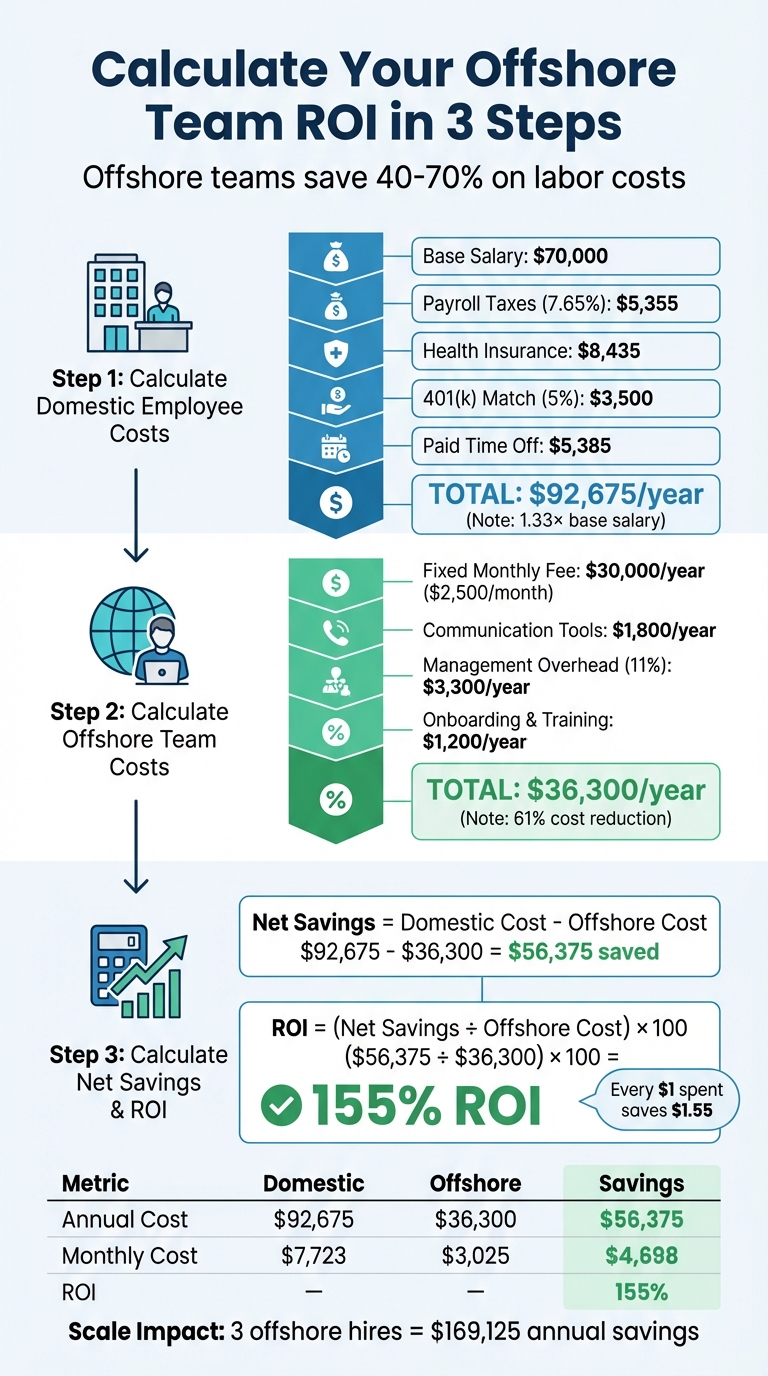
3-Step ROI Calculator for Offshore Teams with Cost Breakdown
How to Calculate the ROI of Engineering Teams
sbb-itb-7512dae
Step 1: Calculate Total Domestic Employee Costs
To measure offshore ROI effectively, you first need a clear picture of what you’re spending on domestic employees compared to offshore vs onshore staffing costs. Many businesses tend to underestimate these expenses, often focusing only on salaries. This is a common pitfall when evaluating an offshore staffing model. However, the actual costs typically range from 1.25 to 1.4 times the base pay. Below is a detailed breakdown of all the components that contribute to these costs.
Domestic Employee Cost Components
The full cost of an employee goes beyond their paycheck and includes several key elements:
- Direct Compensation: This includes the base salary, overtime pay, bonuses, and commissions – essentially the core of an employee’s earnings.
- Payroll Taxes: Employers are responsible for contributing 6.2% for Social Security and 1.45% for Medicare. Additionally, they pay Federal Unemployment Tax (FUTA), which averages around $42 per employee, and State Unemployment Tax (SUTA), which varies depending on the state.
- Benefits: On average, benefits add about 33% to an employee’s base pay. This includes health insurance (costing employers an average of $8,435 annually for single coverage in 2023), dental and vision plans, 401(k) matching contributions, and paid time off.
- Additional Costs: These can include overhead expenses like office rent, utilities, and supplies, as well as equipment or software licenses. For example, some companies provide up to $2,000 for home office setups. Recruitment and onboarding also add to the bill, with hiring costs averaging $4,700 per employee and recruiter fees ranging from 15% to 30% of the base salary.
“In most companies, people are one of the biggest things we spend money on, so not working with our [HR] experts on that side … is a missed opportunity.”
- Melissa Howatson, CFO at Vena
Example: Domestic Employee Cost Calculation
Let’s look at an example to understand how these costs add up. Consider the case of a customer success manager with a base salary of $70,000.
| Cost Component | Annual Amount | Calculation Method |
|---|---|---|
| Base Salary | $70,000 | Offered compensation |
| Payroll Taxes (FICA) | $5,355 | 7.65% of salary |
| Health Insurance | $8,435 | Average employer contribution |
| 401(k) Match | $3,500 | 5% of base salary |
| Paid Time Off | $5,385 | 20 days at daily rate |
| Total Annual Cost | $92,675 | ≈1.33× base salary |
In this example, a $70,000 base salary translates to about $92,675 in annual recurring costs. And when you factor in non-recurring expenses like recruitment, training, and office overhead, the total cost can climb even higher.
Step 2: Calculate Total Offshore Team Costs
Once you’ve figured out your domestic costs, the next step is to break down your offshore expenses. Getting this right is crucial for an accurate ROI assessment. Offshore staffing typically offers savings of 40% to 70% compared to U.S. salaries. But keep in mind, it’s not just about the base salary – there are other factors to consider.
Offshore Team Cost Components
When calculating offshore costs, you need to look beyond the monthly payment. Here’s a breakdown of the key cost components:
- Direct Compensation: This is the base salary or fixed fee. For example, Talently offers a fixed monthly rate of $2,500, which covers contracts, benefits, payroll, and equipment management.
- Management Overhead: Add about 11% of the base fee to account for the time your domestic team spends on tasks like coordination, approvals, and oversight.
- Communication Tools: Collaboration tools such as Slack, Zoom, and project management software typically cost around $150 per month per team member.
- Setup and Onboarding Costs: Expect to spend 2–3 weeks on onboarding, including training and ensuring compliance with legal requirements.
- Time Zone Coordination: If overlapping work hours or extended coverage is necessary, plan for an additional $400 per month.
- Quality Assurance and Compliance: Ensuring data security, regulatory compliance, and conducting code reviews adds another $250 to $550 per month.
These hidden costs can increase the base salary of an offshore worker by 30%–50%. For instance, while a developer might have a base rate of $15 per hour, the actual cost to your company could rise to $30 per hour once all overhead is included. Using a Total Cost of Employment (TCE) approach – factoring in every expense – gives you a more accurate picture of your investment. Here’s how these components come together in an example.
Example: Offshore Team Cost Calculation
Let’s break down the costs for a customer success manager role using Talently’s fixed-rate model. This example compares the offshore cost to the domestic employee cost from Step 1.
| Cost Component | Annual Amount | Calculation Method |
|---|---|---|
| Talently Fixed Monthly Fee | $30,000 | $2,500 × 12 months (includes salary, benefits, payroll) |
| Communication Tools | $1,800 | $150/month for Slack, Zoom, and project management |
| Management Overhead | $3,300 | 11% of base fee for coordination time |
| Onboarding & Training | $1,200 | One-time setup and knowledge transfer |
| Total Annual Cost | $36,300 | ≈$3,025/month average |
Now, compare this to the $92,675 annual cost for the domestic employee from Step 1. The offshore option saves $56,375 annually – a 61% reduction in cost. Even after factoring in management, tools, and setup expenses, you’re spending less than 40% of what a domestic hire would cost.
If you scale this up, the savings become even more substantial. For instance, hiring three offshore customer success managers would cost about $108,900 annually, compared to $278,025 for three domestic hires. That’s a difference of $169,125 – money you could redirect toward growing your business.
Step 3: Calculate Net Savings and ROI Percentage
Once you’ve figured out the costs for domestic and offshore employment, it’s time to assess the financial benefits. This step breaks down exactly how much you’re saving and the return you’re getting from your offshore investment.
How to Calculate Net Savings
Net savings represent the difference between the cost of domestic and offshore employment. The formula is simple: Net Savings = Domestic Total – Offshore Total.
Let’s revisit the earlier example of a customer success manager. If the domestic annual cost is $92,675 and the offshore annual cost is $36,300, the calculation looks like this: $92,675 – $36,300 = $56,375. That’s $56,375 in net savings per year, which could be reinvested into other areas to drive growth. To get the full picture, convert these savings into an ROI percentage.
How to Calculate ROI Percentage
Using the same example, you can calculate the ROI percentage with this formula: ROI = (Net Savings / Offshore Total) × 100.
Here’s how it works: divide $56,375 by $36,300, then multiply by 100. The result? A 155% ROI, meaning for every dollar spent on offshore staffing, you’re saving $1.55.
ROI Comparison Table
Here’s a quick summary of the calculations:
| Metric | Domestic Employee | Offshore Team | Difference |
|---|---|---|---|
| Annual Total Cost | $92,675 | $36,300 | $56,375 savings |
| Monthly Average Cost | $7,723 | $3,025 | $4,698 savings |
| Net Savings | – | – | $56,375 |
| ROI Percentage | – | – | 155% |
Now, imagine scaling this to three offshore hires. Your annual savings would soar to $169,125 – a significant amount that could fuel growth or help you explore new markets. This often involves exploring popular offshoring destinations to find the best balance of cost and skill.
Other Factors That Affect Offshore ROI
When evaluating offshore ROI, it’s essential to look beyond direct costs and consider other influential factors, including potential drawbacks of offshore staffing, that can significantly impact returns.
Common ROI Calculation Mistakes
One of the biggest mistakes in calculating offshore ROI is making a simple comparison of hourly rates between offshore and domestic workers. For instance, comparing a $25/hour offshore developer to a $75/hour domestic one might seem like a no-brainer, but this often ignores hidden costs like onboarding and training. These additional expenses can add 30–50% to the base salary.
Another oversight is failing to include management overhead in the total cost equation. Management-related expenses can increase overall costs by another 30–50%. Additionally, it’s crucial to account for the adjustment period when an offshore team is getting up to speed. Instead of focusing on the first month, assess ROI over quarterly trends for a more accurate picture.
Non-Financial Benefits of Offshore Teams
Offshore staffing isn’t just about saving money – it also brings valuable non-financial benefits. One standout advantage is the ability to implement “follow-the-sun” workflows, where a 24/7 development cycle significantly speeds up project timelines. This approach can cut development cycles by 30–50%. While your U.S. team wraps up for the day, your offshore team continues the work, keeping progress moving around the clock.
Beyond time savings, offshore teams provide access to specialized expertise that may not be readily available locally. This allows your in-house team to focus on strategic innovation rather than routine tasks. Companies that effectively integrate offshore teams with advanced technology adoption have reported up to a 75% reduction in financial errors. These benefits highlight how offshore staffing can enhance overall ROI in ways that go beyond just dollars and cents.
Break-Even Analysis for Offshore Staffing
Calculating the break-even point is key to understanding how quickly offshore staffing starts paying off. To find this, divide your total initial investment (including sourcing, legal fees, training, and technology) by your monthly net savings. For example, if your setup costs total $6,000 and you’re saving $4,698 per month (as shown in the earlier customer success manager example), you’ll break even in about 1.3 months – less than six weeks.
Offshore staffing often hits the break-even mark faster than domestic hiring due to lower upfront costs and substantial monthly savings. For instance, hiring a junior developer in Eastern Europe might cost $5,536 per month compared to around $11,000 for a U.S.-based hire, resulting in monthly savings of approximately $5,464. However, don’t forget to account for transitional costs, such as expenses incurred during the knowledge transfer phase when both internal and offshore teams are active simultaneously. Depending on the industry, strategic outsourcing can deliver an ROI as high as 231%.
Conclusion: Maximizing ROI with Offshore Teams
Calculating ROI for offshore teams boils down to three main steps: first, understanding your total domestic employee costs, which include salaries, benefits, and hidden expenses like management overhead; second, identifying your complete offshore team costs, such as base salaries, onboarding, compliance, and communication tools; and finally, computing your net savings and ROI percentage. The formula – (Returns – Costs) / Costs – is simple, but its accuracy depends on capturing both direct and indirect expenses. This data-driven approach helps guide smarter decisions for resource allocation and growth.
One common mistake is focusing solely on hourly rates while overlooking hidden costs, which can add anywhere from 14% to 60% to your total expenditure. To ensure your analysis is realistic, include all these hidden costs and consider tracking ROI over quarterly trends rather than reacting to short-term fluctuations.
Beyond the financial metrics, offshore staffing offers additional advantages that traditional ROI calculations often overlook. These include strategic benefits like operational resilience and team engagement. Factors such as cultural alignment and collaboration satisfaction not only enhance productivity but also improve retention and knowledge continuity.
Talently simplifies the ROI equation with its fixed monthly pricing model. Starting at $2,500 per month for full-time South African talent, the platform provides budget predictability, eliminating concerns about fluctuating costs or hidden fees. Talently takes care of talent sourcing, vetting, payroll, benefits, and compliance, which helps you avoid the $4,129 average cost per hire that U.S. companies typically encounter. By stabilizing the “Costs” variable in the ROI formula, this model makes financial planning and break-even analysis much easier.
Considering that offshore recruitment can reduce labor costs by 40% to 70% compared to U.S.-based roles, the path to achieving a positive ROI becomes evident. With Talently managing administrative tasks, you can focus on building a high-performing team that delivers tangible business results while keeping financial efficiency in check. This streamlined approach positions offshore teams as a strategic asset for driving sustainable growth.
FAQs
What hidden costs should I consider when hiring offshore teams?
While offshore staffing might initially appear to be a budget-friendly solution, there are a number of hidden costs that can quickly add up. For starters, setup and legal fees – covering contracts, payroll compliance, and entity registration – can take a significant bite out of your savings. On top of that, management overhead, which typically hovers around 15% of the talent cost, reflects the time and resources spent on task coordination, performance tracking, and problem-solving.
You’ll also need to factor in the cost of communication tools, such as video conferencing software, and the challenges of time-zone coordination to ensure scheduling overlaps. Then there’s the investment in training and onboarding remote staff to get them up to speed. Don’t overlook indirect expenses like equipment, IT support, and quality assurance efforts – whether it’s fixing bugs or staying compliant with regulations. These hidden costs can have a substantial impact on your overall budget, so it’s crucial to include them when calculating your ROI.
How can offshore teams help speed up project timelines?
Offshore teams can help speed up project timelines by taking advantage of different time zones. For instance, U.S.-based companies working with professionals in South Africa can keep tasks moving forward overnight, creating a near-continuous workflow. This “follow-the-sun” strategy ensures quicker handoffs for essential activities like coding, testing, and feedback, cutting down on delays.
Another advantage is the ability to scale rapidly. Partnering with an offshore staffing provider makes it easy to bring on skilled professionals without the added costs of expanding local office space. This flexibility is especially helpful during high-demand periods, such as sprints or major project milestones, keeping projects on track and moving faster toward completion.
Platforms like Talently make this process even smoother by sourcing, vetting, and onboarding top talent from South Africa for U.S. businesses. With fixed monthly pricing and a streamlined hiring process, companies can focus on delivering projects faster without getting bogged down by administrative hurdles.
What mistakes should I avoid when calculating ROI for offshore teams?
When evaluating the ROI of offshore teams, it’s easy to fall into traps that lead to misleading conclusions. Here are some common pitfalls to watch out for:
1. Overlooking hidden expenses
Comparing offshore salaries to U.S. wages might seem straightforward, but it often misses the bigger picture. Costs like setup fees, management overhead, compliance requirements, and communication tools can quickly add up. These additional expenses can increase the base salary by 30-50% or more, significantly impacting your ROI.
2. Neglecting quality and productivity factors
Focusing solely on lower hourly rates can be deceptive. Offshore staffing often involves longer coordination times, potential quality challenges, and higher maintenance costs. Ignoring these factors can paint an overly optimistic picture of your ROI.
3. Leaving out strategic and non-financial benefits
ROI isn’t just about cutting costs. Offshore teams can offer advantages like faster time-to-market, scalability, and opportunities for innovation. Assigning a monetary value to these benefits ensures a more complete assessment of your return.
By considering all costs, potential productivity changes, and broader benefits, you’ll be able to calculate a more accurate and practical ROI for your offshore team.
Related Blog Posts
Ready to build your dream team?
Book a free consultation and get your first candidate shortlist within 48 hours.
No upfront fee • Only pay if you hire