
Remote Hiring Best Practices for Growing Companies: Build High-Performing Global Teams That Scale
 6 min read
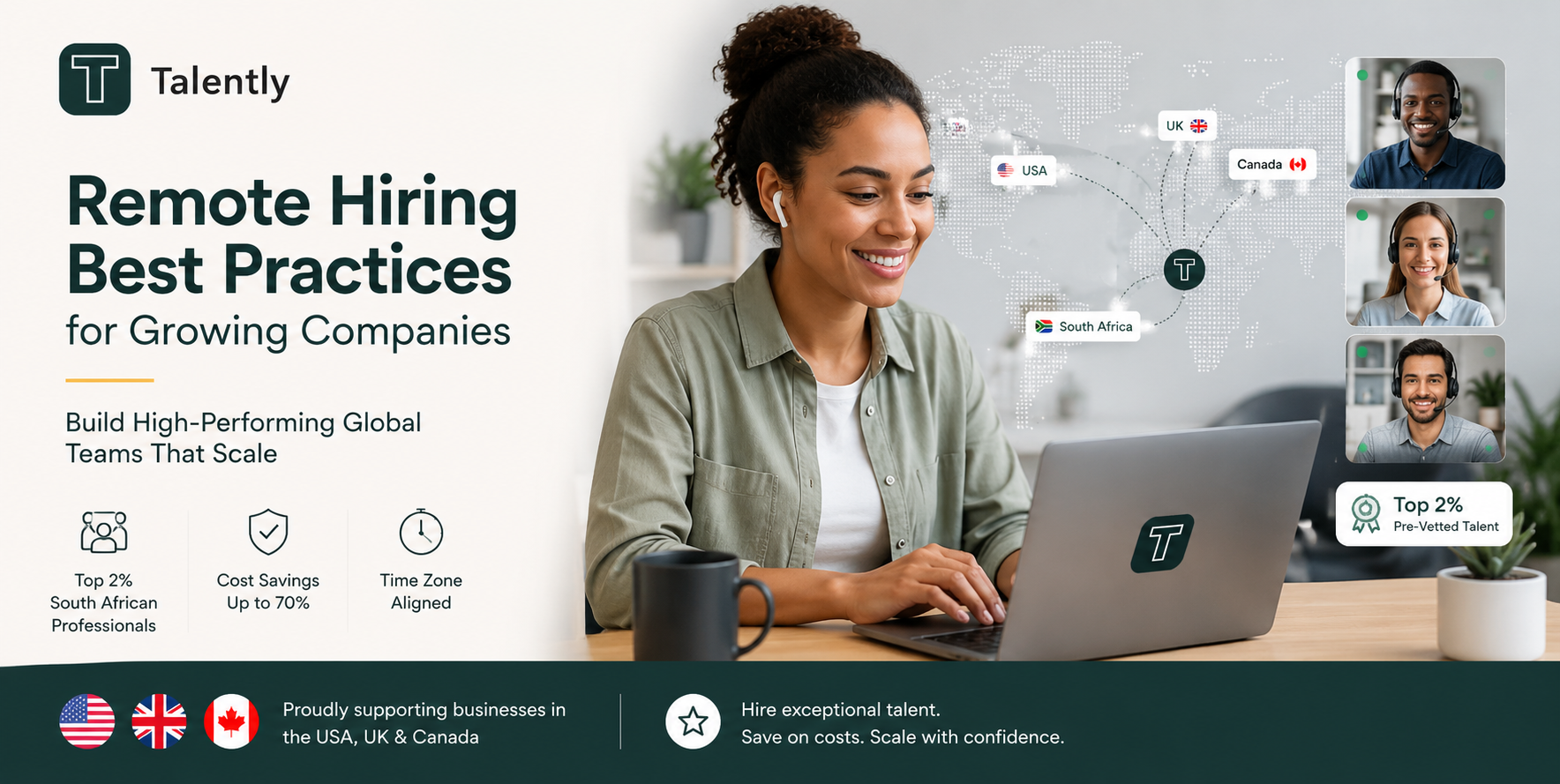
Growing companies often reach a point where local hiring becomes expensive, slow, and highly competitive. Finding qualified professionals can delay expansion, increase recruitment costs, and place unnecessary pressure on existing teams.
This is why more businesses across the United States, Canada, and the United Kingdom are adopting remote hiring best practices to access skilled professionals worldwide while maintaining productivity and controlling costs.
For organizations looking to build a reliable distributed workforce, South Africa has become one of the most attractive talent markets. With highly educated, native English-speaking professionals and strong cultural alignment with Western businesses, companies can hire exceptional remote employees without compromising quality.
If your goal is to scale efficiently, the strategies below provide a proven roadmap.
Quick Answer: What Are Remote Hiring Best Practices?
Remote hiring best practices are proven methods for sourcing, evaluating, hiring, onboarding, and managing remote employees to build productive virtual teams while reducing hiring risks and operational costs.
Successful remote hiring focuses on:
- Hiring for skills and communication
- Creating a structured remote recruitment strategy
- Using standardized interview processes
- Providing effective employee onboarding
- Building accountability through workforce management
- Supporting long-term employee engagement
In short: Great remote hiring is about building systems – not just filling vacancies.
Why Growing Companies Are Prioritizing Remote Hiring
The global workforce has changed permanently.
Instead of limiting recruitment to one city or country, companies now compete for talent worldwide. This approach offers significant advantages:
| Traditional Hiring | Remote Hiring |
| Limited talent pool | Global talent access |
| Higher salary costs | More cost-efficient hiring |
| Longer recruitment cycles | Faster recruitment |
| Office overhead | Lower operating expenses |
| Geographic restrictions | Flexible distributed workforce |
| Difficult scaling | Easier workforce expansion |
Businesses that embrace remote hiring can often scale faster while improving employee satisfaction and operational flexibility.
The 7 Remote Hiring Best Practices Every Growing Company Should Follow
1. Build a Clear Remote Recruitment Strategy
Before advertising any position, define exactly what success looks like.
Your remote recruitment strategy should answer:
- What outcomes will this role deliver?
- Which skills are essential?
- Which tools will employees use daily?
- What communication style fits your company culture?
Hiring without a structured plan often leads to mismatched expectations and unnecessary turnover.
2. Hire for Communication Before Technical Skills
Technical knowledge can be developed.
Strong communication cannot always be taught.
Remote employees spend most of their day collaborating through:
- Video meetings
- Slack or Microsoft Teams
- Project management platforms
Professionals who communicate clearly help reduce misunderstandings and improve productivity across virtual teams.
This is one reason South African professionals are increasingly sought after by businesses in North America and the UK, where fluent English and cultural compatibility are essential.
3. Standardize Your Hiring Process
A consistent interview process leads to better hiring decisions.
Consider evaluating candidates through multiple stages:
- Resume screening
- Skills assessment
- Behavioural interview
- Practical work sample
- Culture-fit discussion
- Reference verification
Using the same evaluation criteria for every candidate reduces hiring bias while improving recruitment quality.
Expert Insight
“The highest-performing remote companies don’t simply hire globally – they build repeatable hiring systems that consistently identify professionals who excel independently, communicate effectively, and align with company values.”
This approach creates sustainable growth rather than short-term hiring success.
4. Prioritize Employee Onboarding
Hiring doesn’t end with the signed contract.
Successful employee onboarding determines how quickly new hires become productive.
A strong onboarding process includes:
- Equipment and software access before Day One
- Clear documentation
- Team introductions
- Defined performance expectations
- Regular check-ins during the first 90 days
Companies with structured onboarding often experience stronger employee retention and faster productivity.
5. Invest in Workforce Management
Managing remote employees requires transparency – not micromanagement.
Effective workforce management includes:
- Weekly performance reviews
- Clearly defined KPIs
- Goal tracking
- Documentation
- Collaborative planning
Focus on measurable outcomes instead of monitoring every working hour.
Trust encourages ownership.
Ownership drives performance.
6. Build Culture Across Virtual Teams
Remote employees should never feel isolated.
Successful organizations intentionally create connection through:
- Virtual coffee chats
- Team celebrations
- Recognition programs
- Cross-functional collaboration
- Knowledge-sharing sessions
A connected team collaborates better, innovates faster, and remains engaged longer.
7. Partner with a Specialized Remote Hiring Provider
Many growing businesses lack the time to source, screen, interview, onboard, and manage international hiring.
Working with an experienced hiring partner streamlines the entire process.
Talently helps businesses across the US, UK, and Canada hire exceptional remote South African professionals by handling:
- Talent sourcing
- Candidate screening
- Skills assessment
- Payroll support
- Compliance guidance
- HR assistance
This enables leadership teams to focus on growth instead of recruitment administration.
Common Mistakes That Slow Remote Hiring
Many organizations struggle because they overlook simple fundamentals.
Avoid these common mistakes:
❌ Hiring too quickly without structured interviews
❌ Prioritizing resumes over practical skills
❌ Poor onboarding documentation
❌ Unclear performance expectations
❌ Weak communication processes
❌ Micromanaging remote employees
❌ Ignoring cultural alignment
Correcting these issues significantly improves long-term hiring success.
Why South African Professionals Stand Out
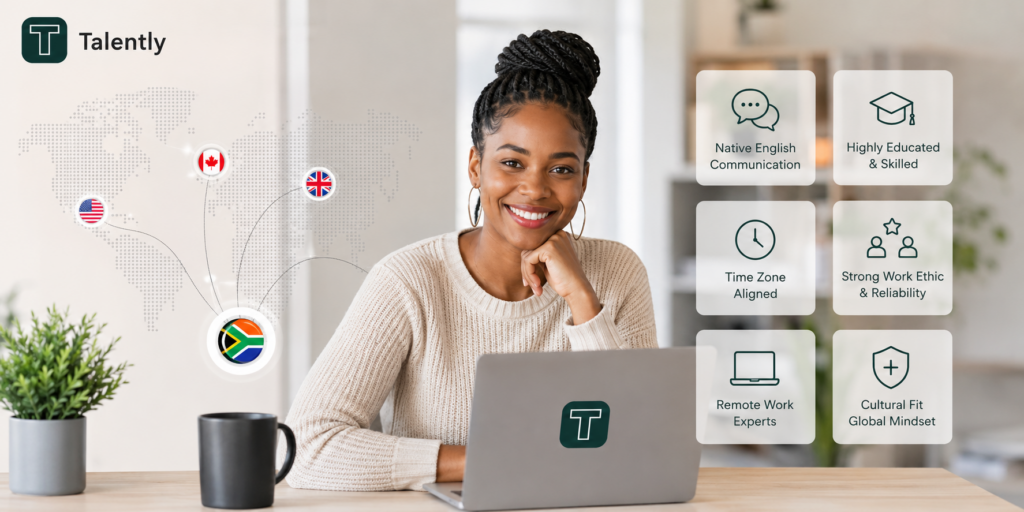
Businesses hiring internationally increasingly choose South African professionals because they offer:
- Native or near-native English proficiency
- Strong customer service experience
- Sales and business support expertise
- Time zone overlap with Europe and partial overlap with North America
- Competitive hiring costs
- High educational standards
These advantages make South Africa one of today’s fastest-growing global talent destinations.
Key Takeaways
- Create a documented remote recruitment strategy.
- Hire for communication as much as technical ability.
- Use structured interviews and consistent evaluations.
- Invest in employee onboarding.
- Focus on measurable workforce management.
- Build strong virtual teams through intentional culture.
- Partner with specialists to simplify international hiring.
Remote hiring succeeds when supported by repeatable systems rather than one-off recruitment efforts.
Frequently Asked Questions
1. What are the most important remote hiring best practices?
The most effective practices include structured recruitment, skills-based interviews, clear communication expectations, comprehensive onboarding, and measurable performance management.
2. How can growing companies hire remote employees successfully?
Define hiring goals, standardize interviews, assess communication skills, onboard thoroughly, and maintain regular performance reviews to build successful remote teams.
3. Why is South Africa becoming a popular remote hiring destination?
South Africa offers highly skilled, English-speaking professionals with strong business experience, competitive salaries, and excellent cultural compatibility with companies in the US, UK, and Canada.
4. How do you manage a distributed workforce effectively?
Use collaborative tools, establish measurable KPIs, schedule regular check-ins, document processes, and encourage transparent communication across teams.
5. What should employee onboarding include for remote workers?
Remote onboarding should provide technology setup, company documentation, role expectations, team introductions, training plans, and scheduled feedback sessions.
6. How long does remote recruitment usually take?
With a structured hiring process and experienced recruitment partner, many companies can identify qualified candidates within days and complete hiring in a few weeks.
7. Should growing companies use remote hiring agencies?
Yes. Specialized hiring partners reduce recruitment time, improve candidate quality, manage compliance requirements, and simplify international hiring, allowing businesses to scale faster.
Final Thoughts
Remote hiring is no longer an alternative hiring model – it has become a competitive advantage for companies that want to scale efficiently.
By implementing proven remote hiring best practices, businesses can access global expertise, strengthen their distributed workforce, and build resilient virtual teams that support long-term growth.
For organizations hiring across the US, UK, and Canada, partnering with Talently provides access to carefully vetted South African professionals supported by end-to-end recruitment, onboarding, payroll, and workforce management solutions.
Ready to build your dream team?
Book a free consultation and get your first candidate shortlist within 48 hours.
No upfront fee • Only pay if you hire