
Why Ongoing Training Matters for Offshore Teams
 11 min read
If training stops after onboarding, offshore team performance starts to slip. Skills get dated, work quality becomes uneven, and managers spend more time fixing issues instead of moving work forward.
Here’s the short version:
- Skill gaps hurt output: nearly 60% of employers say skill gaps are already reducing productivity.
- Learning affects retention: 94% of employees say they would stay longer if their company invested in their growth.
- Structured training helps teams get up to speed sooner: many offshore hires reach full productivity in 30–45 days with a training program, versus 60–90 days without one.
- Standards drift without updates: KPIs, brand voice, communication rules, and security habits all get out of date if no one reviews them.
- The fix is simple: use role-based learning paths, mix live and self-paced training, refresh process and security lessons often, and assign clear ownership.
Bottom line: I’d treat training as part of team performance, not just onboarding. When people keep learning, you get better output, lower turnover, and less manager rework.
This article explains the risks of stopping training too early, what a steady training system should include, and how to set it up for offshore teams.
The Problem: What Businesses Risk When Training Stops After Onboarding
Skill Gaps Grow Quickly in Remote Roles
When training ends at onboarding, offshore staff often keep using the same methods they learned on day one, even after the business has changed. Those habits can be months out of date. In remote roles, that gap grows fast.
Almost 60% of employers say skill gaps are already hurting productivity. And remote work makes that issue worse. If no one is nearby to spot an old process, it can stick around far longer than it should. One workaround turns into another. Then suddenly you’re dealing with uneven QA scores, deliverables that need several rounds of edits, and offshore staff solving problems based on old rules instead of current ones.
Engagement and Retention Drop When Development Feels Unequal
Remote offshore employees often miss the small coaching moments that happen naturally in an office. They don’t overhear advice. They don’t get pulled into casual career chats. So when onshore teammates get mentoring or growth paths that don’t reach them, that gap starts to wear people down. Quietly, they begin to see themselves as people who complete tasks, not people who belong to the team.
The retention data is hard to ignore: 94% of employees say they would stay longer at a company that invests in their career development and learning. Offshore teams with structured training programs see annual retention above 80%. Once development stops after onboarding, that edge starts to fade. And when that happens, the problem isn’t just morale. It shows up in the work.
Performance Standards Drift Across Teams
Without continued training, remote teams can drift out of sync on the basics that matter most:
- KPIs
- Brand voice
- Communication norms
- Security practices
In an office, a manager might catch a small mistake in passing and fix it on the spot. Remote teams don’t get that luxury. A small miss in one time zone can keep moving until it starts affecting output.
That’s what makes performance drift so costly for offshore teams. Onshore managers get stuck in correction mode, answering the same questions again and again and filling gaps that a clear training system could have stopped early. Teams without structured training programs usually need 60–90 days to reach full productivity, while properly trained offshore employees often get there in 30–45 days. And every time the business changes, that gap can grow.
That is why training has to continue after onboarding.
sbb-itb-7512dae
How to Build an Offshore Team That Actually Works with Greg Fischer of Well Oiled Machine
The Solution: How Ongoing Training Improves Productivity and Retention
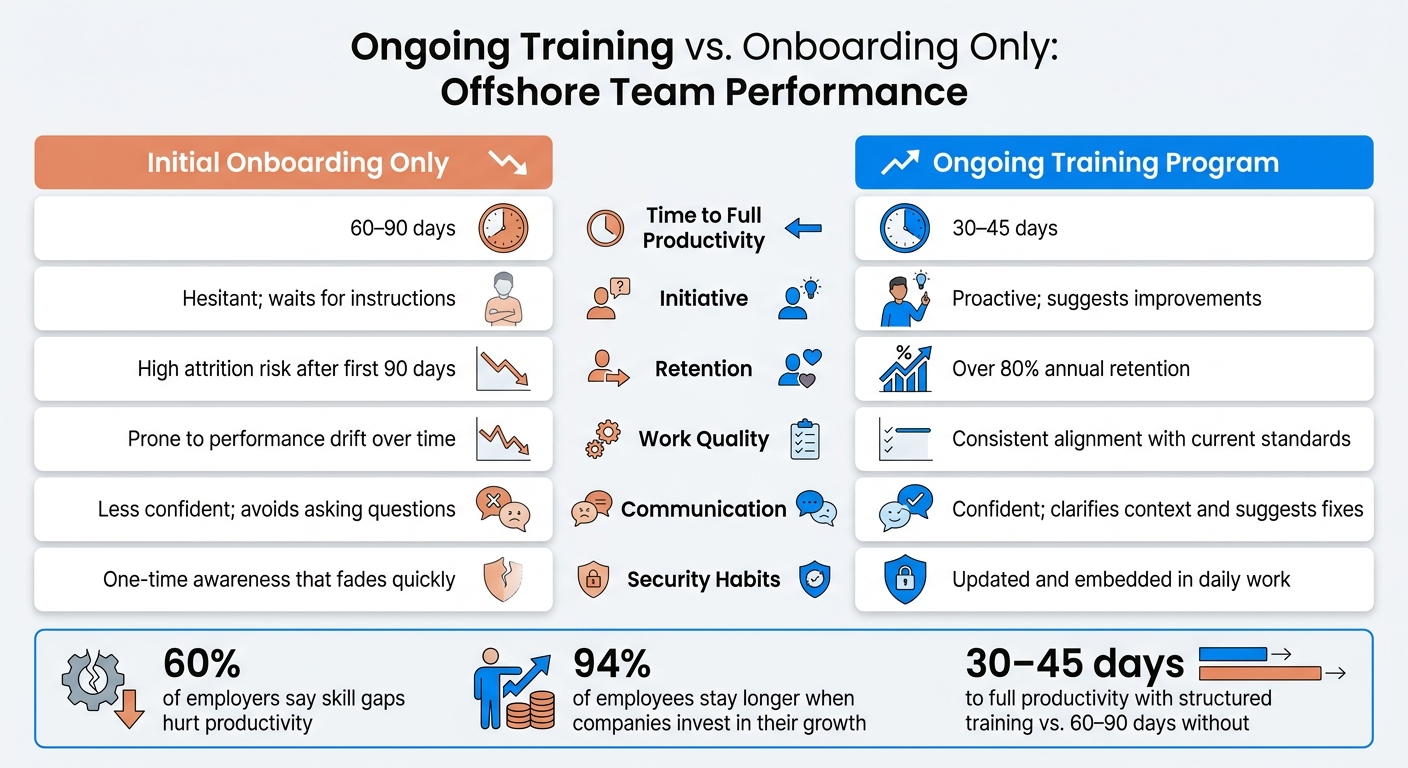
Ongoing Training vs. Onboarding Only: Offshore Team Performance Compared
Ongoing training fixes knowledge drift. It keeps skills sharp, standards current, and day-to-day context clear.
| Factor | Initial Onboarding Only | Ongoing Training Program |
|---|---|---|
| Time to Full Productivity | 60–90 days | 30–45 days |
| Initiative | Hesitant; waits for instructions | Proactive; suggests improvements |
| Retention | High attrition risk after the first 90 days | Over 80% annual retention |
| Work Quality | Prone to performance drift over time | Consistent alignment with current standards |
| Communication | Less confident; avoids asking questions | Confident; clarifies context and suggests fixes |
| Security Habits | One-time awareness that fades quickly | Updated and embedded in daily work |
Better Output Through Role-Specific Upskilling
Training works best when it connects directly to the job someone does every day. A customer success manager who gets steady coaching on CRM workflows, an executive assistant who improves reporting accuracy, or a developer who practices AI-assisted coding and debugging is much more likely to stay on top of the tools and standards that matter.
That kind of role-based upskilling does more than improve task execution. It helps offshore staff think through problems, spot gaps, and act with more confidence.
Stronger Retention Through Visible Career Growth
People stay when they can see a path ahead. If new skills connect to clear career milestones, instead of loose promises about growth, offshore staff have a concrete reason to stick around. That cuts turnover.
The numbers make the case. 94% of employees say they’d stay longer at a company that invests in their career development. Offshore teams with structured training programs consistently achieve over 80% annual retention. That isn’t random. It happens when growth is made visible and intentional.
More Consistent Collaboration in Distributed Teams
Training also improves how distributed teams work together. Teaching people when to ask clarifying questions, which channel to use, and how to give context-rich updates across time zones can reduce rework and bottlenecks. When offshore staff know the norms, they speak up sooner, send issues to the right place, and help keep projects moving.
"Offshore teams are not ‘plug-and-play’ – they need context, clarity and capability." – Access Offshoring
That context and clarity don’t appear on their own. They come from training that becomes part of the team’s regular operating rhythm. The next step is turning that into a system the team can repeat.
How to Build a Continuous Training Program for Offshore Teams
If training ends after onboarding, people start to drift. Processes change, habits slip, and small gaps turn into bigger ones over time. A continuous training program helps you keep skills up to date without dumping extra work on managers. The core idea is simple: build role-based learning paths, use more than one training format, and stick to a steady refresh schedule.
Start With Role-Based Learning Paths and Skill Assessments
Generic training burns time and usually misses the mark. A better move is to map out what each role needs to do well day to day. Look at KPIs, QA scores, and manager feedback to spot skill gaps, then build a simple learning path for each role around those gaps.
A customer success manager needs different training than a graphic designer or a business development rep. When each path is tied to the actual job, the training stays relevant. And when training feels relevant, people are far more likely to use it. It also helps to connect each learning milestone to a measurable result, like lower error rates or less time to productivity. That makes progress easier to track and sets up the next step: picking the right delivery format.
Use a Mix of Live and Self-Paced Formats
Not every lesson should be taught the same way. Live workshops are a good fit for soft skills and harder problem-solving, but time zones can make them hard to schedule. Self-paced modules and recorded sessions give offshore staff room to learn on their own time instead of waiting for onshore hours.
A simple split often works best:
- Use live sessions for high-context discussions and Q&A
- Record those sessions so anyone who missed them can catch up later
- Add a searchable knowledge base so staff can find answers without waiting for someone onshore to reply
That mix gives people structure without slowing them down.
Include Soft Skills, Process Updates, and Security Habits
Offshore staff also need clear guidance on communication. That includes which channel to use, how to write a status update, and when to flag an issue instead of handling it alone. These working norms have a measurable effect on how smoothly distributed teams run.
Process updates and cybersecurity habits should also stay in the training cycle instead of showing up once during onboarding and then disappearing. Refresh core training every year, run quarterly micro-lessons, and send immediate updates when tools or workflows change. That rhythm helps keep standards, security, and processes current across time zones.
Next, assign clear ownership so training stays consistent as the team grows.
Making Training Work With the Right Offshore Staffing Structure
Training works best when the staffing setup is steady. If offshore team members report into a messy system with no clear owner, even a solid training plan starts to slip.
Assign Clear Ownership for Learning Across the Business
Training tends to work better when responsibility is split in a simple way. HR or L&D owns the structure – the tools, tracking, and completion metrics. Functional leaders own the content – role-based coaching, SOPs, and performance standards. That kind of clarity helps teams keep materials up to date before standards start to drift.
A peer mentor or "buddy" helps connect those two layers. They answer day-to-day questions and help new hires get comfortable with company culture as things happen, not weeks later.
| Stakeholder | Primary Responsibility | Key Outcome |
|---|---|---|
| HR / L&D | LMS management and completion tracking | Consistent training structure |
| Functional Leaders | Role-specific coaching and SOP creation | High-quality work output |
| Peer Mentors | Day-to-day Q&A and cultural integration | Faster process and social integration |
Once ownership is clear, the next move is to build a development rhythm teams can repeat.
Use Onboarding as the Start of a Longer Development Plan
Onboarding should set the starting point, not mark the end of learning. After roles and ownership are defined, training should move into a 30-60-90-day plan that helps new offshore hires go from basic tool use to handling more complex work on their own. When that period ends, learning shouldn’t stop. It should continue through quarterly skill goals and annual core refreshers.
Companies with strong onboarding processes increase new hire retention by 82% and improve productivity by as much as 70%. Those gains grow when onboarding ties straight into a longer development path instead of sitting on its own.
Talently supports this setup by handling hiring, payroll, and contracts. That gives offshore teams the steadiness they need for training that continues over time.
Conclusion: Ongoing Training Protects Performance and Retention
Continuous training helps keep output steady, closes skill gaps before they turn into bigger problems, and gives people a reason to stay. With clear ownership, role-based learning paths, and a steady staffing structure, ongoing development becomes a business edge instead of one more thing to manage.
FAQs
How often should offshore teams be retrained?
Offshore teams need continuous training. A one-time session won’t cut it.
Initial onboarding can follow a structured 30- to 90-day plan. But that’s just the start. After that, people need steady updates as industry trends, internal processes, and tech keep changing.
To keep performance on track, build in a simple rhythm:
- Consistent feedback loops
- Quarterly skill development goals
- Routine performance reviews
That kind of steady support helps teams stay sharp and aligned as the work shifts.
What training topics matter most after onboarding?
After onboarding, training should shift toward steady skill growth and role-specific development.
The main areas to focus on are:
- technical skills and current industry trends
- critical thinking and proactive problem-solving
- cross-cultural communication with onshore teams
Teams also need shared context around business goals, compliance updates, and decision-making frameworks. That way, offshore talent can stay in sync with company objectives instead of working in a vacuum.
Who should own training for offshore teams?
Ownership needs to be clear, so training stays structured and consistent. In most companies, teams like human resources, learning and development, or operations manage the overall curriculum and track completion.
At the same time, functional leaders should handle role-specific training and keep documentation and processes up to date. That split keeps training tied to both employee growth and day-to-day job needs.
Related Blog Posts
Ready to build your dream team?
Book a free consultation and get your first candidate shortlist within 48 hours.
No upfront fee • Only pay if you hire