
Remote Team Structure: How Successful Companies Organize Global Employees
 16 min read
Hiring talented people across borders is often easier than figuring out how everyone should work together.
A company in New York hires a customer support specialist in South Africa. A London-based startup brings in a remote operations assistant. A Canadian business expands its marketing department with international professionals. The new employees have the skills, the motivation, and the tools. Yet three months later, projects are delayed, managers are answering the same questions repeatedly, and nobody is quite sure who owns the final decision.
The problem isn’t necessarily the people. It’s the remote team structure.
Successful global companies don’t simply add employees to an existing organizational chart and hope everything falls into place. They design reporting relationships, communication routines, responsibilities, and workflows around the realities of distributed work.
The good news? You don’t need a complicated corporate hierarchy to make it work.
In this guide, we’ll explain how to choose the right organizational model, structure international departments, manage employees across time zones, and build a remote workforce that can grow without creating unnecessary management headaches.
What Is a Remote Team Structure?
A remote team structure is the organizational framework that defines how employees working from different locations report to managers, collaborate, make decisions, and remain accountable for business outcomes.
It covers more than job titles and reporting lines. A well-designed structure establishes who manages each employee, who approves work, how information moves between departments, and how teams coordinate across time zones.
For example, a US company might have its sales director based in Chicago, two sales development representatives in South Africa, and a marketing manager in London.
Instead of managing these employees as separate regional units, the company could organize them under one revenue department with shared performance targets and clearly assigned responsibilities.
That’s the difference between hiring remotely and building an effective distributed organization.
Why Does Organizational Structure Matter More for Global Remote Teams?
In a traditional office, employees often resolve small problems through informal conversations. They ask a colleague for clarification, walk over to their manager, or discuss priorities between meetings.
Remote teams don’t always have that luxury.
When responsibilities are unclear, a simple question can turn into a 24-hour delay. When multiple managers assign conflicting priorities, employees struggle to decide what deserves attention first.
Research from Gallup reinforces the importance of management quality. Its workplace research attributes 70% of the variance in team-level employee engagement to managers.
That finding matters for businesses expanding internationally. Hiring strong professionals is important, but their performance also depends on how effectively they are managed.
A good remote organizational structure helps businesses:
- Establish clear reporting relationships and decision-making authority.
- Reduce duplicated work and unnecessary meetings.
- Improve accountability without constant employee monitoring.
- Coordinate responsibilities across countries and time zones.
- Integrate international employees into existing departments.
- Expand staffing capacity without creating unnecessary management layers.
The goal isn’t to control every activity. It’s to create enough clarity that employees can make progress independently.
The 5 Most Effective Remote Team Structures for Global Companies
There is no universal organizational model that works for every distributed company.
The best choice depends on your business size, management capacity, employee responsibilities, and how closely different departments need to collaborate.
Here’s how the most common structures compare.
| Structure | Best suited for | Main consideration |
| Functional | Growing businesses with specialist departments | Cross-department coordination |
| Flat | Startups and small teams | Leadership bottlenecks |
| Hierarchical | Larger, established companies | Slow approval processes |
| Matrix | Cross-functional organizations | Conflicting priorities |
| Hybrid distributed | Companies combining local and international employees | Consistent management standards |
1. Functional Structure: Best for Growing Remote Businesses
A functional structure organizes employees by department, such as sales, marketing, finance, operations, and customer support.
Each department has a designated manager responsible for assigning work, monitoring performance, and supporting employees.
Consider a Canadian e-commerce company with a local operations director and remote professionals in South Africa.
Its structure might look like this:
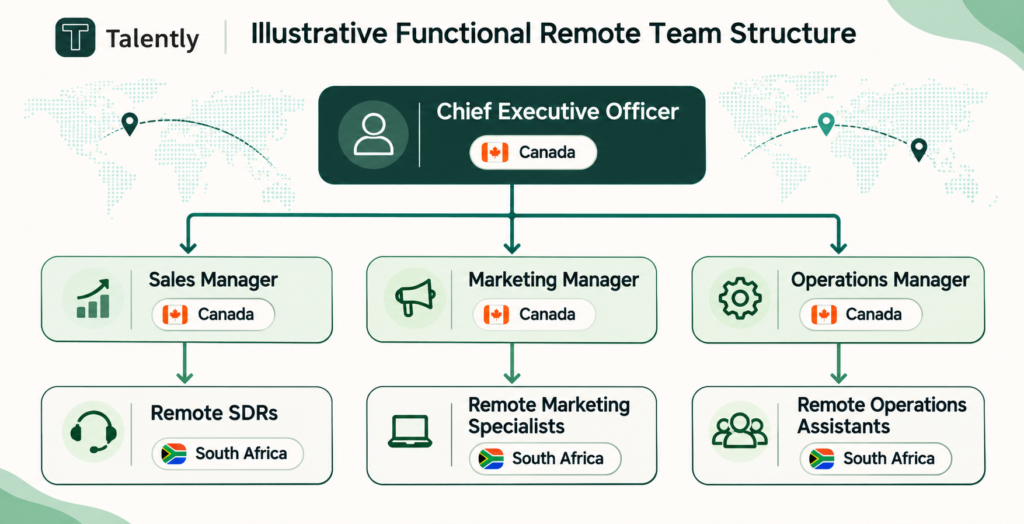
Every employee belongs to a department, reports to a defined manager, and contributes to shared business goals.
Our recommendation: For companies adding their first few international employees, a functional model is often the most manageable starting point.
2. Flat Structure: Best for Early-Stage Startups
A flat structure minimizes management layers. Employees communicate directly with founders or senior leaders.
This can work particularly well when a startup has fewer employees, responsibilities change frequently, and decisions need to happen quickly.
Imagine a UK founder working directly with a South African virtual assistant, social media manager, and sales assistant.
There may be no need for three separate department heads.
However, flat structures become harder to maintain as hiring accelerates. If every employee depends on the founder for approvals, the founder eventually becomes the bottleneck.
Our recommendation: Start with a flat structure when the team is small, but introduce team leads when coordination demands begin slowing execution.
3. Hierarchical Structure: Best for Larger Organizations
A hierarchical structure establishes multiple management levels.
Employees report to supervisors, supervisors report to department managers, and department managers report to senior leadership.
This model supports organizations that need formal approval procedures, specialized supervision, and clearly defined accountability.
Its main disadvantage is the possibility of slower decision-making.
For international teams, excessive approval layers can make time-zone differences more disruptive.
Our recommendation: Keep approval authority as close to the work as practical while retaining appropriate financial, legal, and operational controls.
4. Matrix Structure: Best for Cross-Functional Projects
In a matrix structure, employees may have a primary functional manager while also receiving project direction from another leader.
For example, a South African graphic designer could report to the marketing manager while contributing to campaigns led by different regional teams.
This arrangement makes specialist skills available across departments.
The challenge arises when managers disagree about priorities.
To prevent confusion, every employee should know which manager handles performance reviews, who assigns project deadlines, and who resolves conflicting requests.
5. Hybrid Distributed Structure: Best for International Expansion
A hybrid distributed structure combines locally based leadership with international professionals working inside the same functional departments.
Rather than treating offshore employees as an isolated support unit, companies integrate them into existing workflows.
For instance, a US business might retain its strategy, client relationships, and senior leadership domestically while employing South African professionals across sales support, marketing, customer service, and administration.
This arrangement can help companies expand operational capacity while maintaining centralized business direction.
For many businesses exploring international staffing, it offers a practical balance between oversight and flexibility.
How to Choose the Best Org Structure for Your Remote Team
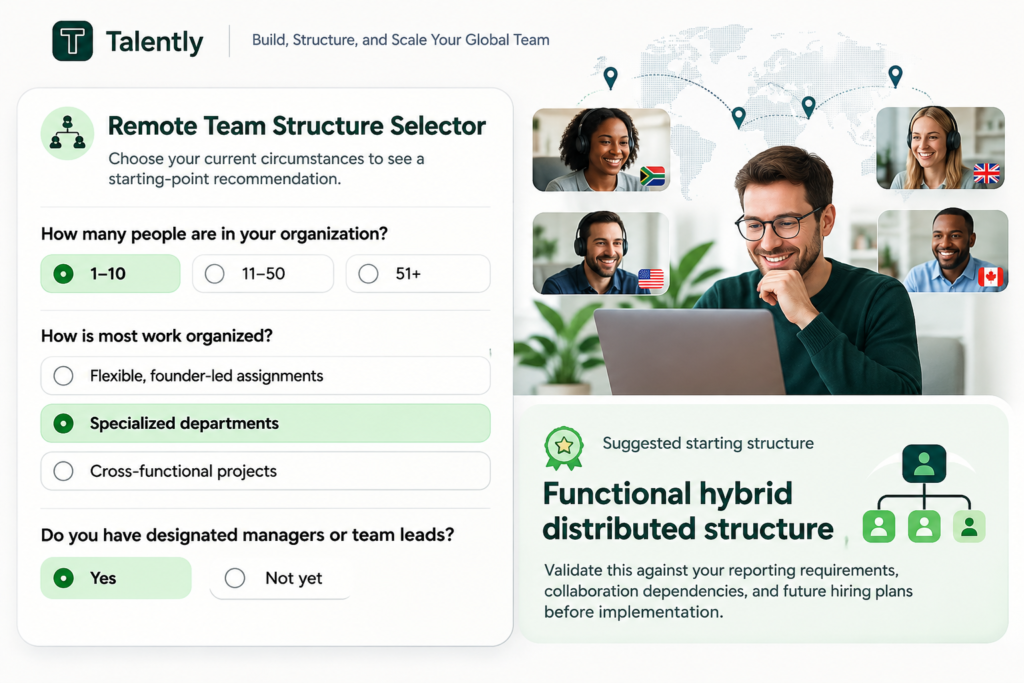
The best org structure for your remote team depends on how work is delivered, who makes decisions, and how much management support employees need.
Instead of choosing a model because another successful company uses it, evaluate your operational requirements.
How Successful Companies Organize Remote Employees Across Countries
Choosing an organizational model is only the first step. The real work begins when employees start collaborating.
We recommend designing the operating structure around five principles.
1. Give Every Employee One Primary Manager
Even when employees work with several departments, one person should remain responsible for their performance, development, and workload management.
Without a primary manager, international employees can receive competing instructions from different leaders.
2. Define Responsibilities Before Hiring
A job title rarely explains everything an employee is expected to do.
Before adding a remote professional, document the role’s main responsibilities, expected deliverables, required skills, reporting relationship, and decision-making limits.
For example, a remote sales development representative might own prospect research, initial outreach, CRM updates, and meeting scheduling.
The sales manager would retain responsibility for sales strategy, pipeline forecasting, and performance coaching.
3. Build Communication Around Time-Zone Overlap
Global businesses should not assume that every employee can attend meetings during headquarters’ business hours.
South Africa operates on South Africa Standard Time (UTC+2), which provides useful working-hour overlap with the UK and portions of the North American workday, depending on schedules and daylight saving time.
For businesses evaluating this advantage, our guide to South Africa’s remote talent time-zone overlap explores the scheduling considerations.
The objective is to reserve overlapping hours for decisions, coaching, and collaboration while allowing independent work to continue asynchronously.
4. Measure Results Instead of Online Activity
A remote employee’s performance should not be judged primarily by how often their status indicator appears green.
Instead, establish measurable outcomes.
For a customer support representative, these might include response quality, customer satisfaction, resolution time, and adherence to agreed service levels.
For a marketing specialist, they might include completed campaigns, qualified leads, content quality, and delivery against deadlines.
5. Document Decisions and Processes
Important decisions should not exist only in meeting recordings or private conversations.
Use shared documentation for standard operating procedures, project ownership, escalation paths, and recurring workflows.
A written decision record helps employees understand not just what was decided, but why.
This is particularly valuable when a colleague begins work several hours after the decision was made.
A Practical Remote Team Structure Blueprint for Growing Companies
Consider a hypothetical US professional services company expanding from 12 to 20 employees.
The business wants to increase sales activity, improve customer support, and reduce administrative pressure on its leadership team.
Instead of hiring eight employees without a coordinated plan, the company could build the following structure.
| Department | Primary manager | Potential South African roles | Core performance measure |
| Sales | US Sales Director | 2 SDRs | Qualified meetings and pipeline contribution |
| Customer Support | US Support Manager | 2 Support Specialists | Resolution quality and service levels |
| Marketing | US Marketing Manager | 1 Marketing Assistant | Campaign delivery and quality |
| Operations | US Operations Director | 2 Operations Assistants | Process accuracy and turnaround |
| Finance | US Finance Manager | 1 Bookkeeper | Reconciliation accuracy and deadlines |
Illustrative staffing scenario, not a Talently customer case study.
Notice that the international employees are not placed under a separate offshore manager by default.
They belong to the departments that use their skills.
This approach reduces the risk of creating two disconnected organizations: one responsible for strategy and another responsible for execution.
It also makes performance evaluation more meaningful because remote professionals contribute to the same departmental objectives as their local colleagues.
How to Structure Communication and Accountability in Remote Teams
A successful remote organizational chart must be supported by a predictable operating rhythm.
Here’s a practical starting point.
| Frequency | Activity | Purpose |
| Daily or as needed | Written progress updates | Surface blockers and priorities |
| Weekly | Manager check-ins | Review outcomes and workload |
| Weekly | Department planning | Align deliverables and dependencies |
| Monthly | Performance reviews | Evaluate KPIs and development |
| Quarterly | Structure review | Assess staffing and management needs |
These are suggested routines, not mandatory meeting requirements.
A team performing independent, well-documented tasks may need fewer synchronous meetings than a team handling complex customer escalations.
The important principle is to make communication purposeful.
In fact, Gallup reports that employees whose hybrid teams establish clear collaboration norms are more likely to be engaged and less likely to experience burnout.
Why South African Professionals Fit Into Global Remote Team Structures
For businesses in the US, UK, and Canada, South Africa is one option worth evaluating when expanding internationally.
The decision should be based on role requirements, employee capabilities, operating hours, hiring arrangements, and the level of collaboration needed.
Access to Professionals Across Business Functions
Companies can explore South African talent for roles spanning administration, customer support, sales, marketing, finance, and operations.
At Talently, we focus on helping businesses connect with remote South African professionals.
Our approach is particularly relevant for companies that want to strengthen existing departments rather than build an entirely separate international office.
Businesses evaluating the available options can explore our remote staffing services in South Africa.
Opportunities for More Flexible Staffing Budgets
International recruitment can provide different compensation and operating-cost options.
However, salary comparisons alone rarely tell the full story.
Employers should evaluate compensation, recruitment fees, employment arrangements, payroll, benefits, equipment, training, management time, and applicable compliance requirements.
Our resource on South African remote employee costs provides a starting point for understanding the cost considerations.
Better Integration Through Deliberate Onboarding
Remote professionals need more than software access and a list of assignments.
They need to understand the business, its customers, the standards expected of their work, and how to seek help when something goes wrong.
A structured onboarding plan should include introductions to relevant colleagues, clear role expectations, process documentation, initial deliverables, and scheduled feedback.
For additional guidance, see our article on onboarding South African remote employees.
Common Mistakes Companies Make When Structuring Remote Teams
Even experienced leaders can struggle when their workforce expands across borders.
Mistake 1: Treating Remote Employees as an Outsourced Task Queue
When international professionals receive only isolated assignments, they may never develop the context needed to contribute independently.
Better approach: Include remote employees in relevant department planning, performance discussions, and knowledge-sharing activities.
Mistake 2: Hiring Before Defining Management Ownership
A company may identify an urgent staffing gap without deciding who will supervise the new employee.
The result is often unclear priorities and inconsistent feedback.
Better approach: Assign a primary manager and document responsibilities before recruitment begins.
Mistake 3: Creating Too Many Meetings
Some managers compensate for physical distance by scheduling constant video calls.
This can reduce the time employees have to complete meaningful work.
Better approach: Use asynchronous updates for routine information and reserve meetings for collaboration, coaching, and decisions.
Mistake 4: Ignoring Cross-Border Employment Requirements
Hiring someone in another country can involve different legal, payroll, tax, data protection, and worker-classification considerations.
Better approach: Review the intended employment arrangement with qualified local advisers before finalizing the hire.
Mistake 5: Keeping an Outdated Organizational Chart
As departments expand, informal changes in responsibility can leave employees unsure about reporting relationships.
Better approach: Review the organizational chart whenever roles, managers, or departmental responsibilities change.
How Much Does It Cost to Build a Remote Team?
The cost of building a remote team depends on the roles being hired, their seniority, location, employment model, and operational requirements.
A useful budgeting framework includes five components.
| Cost category | What to consider |
| Compensation | Role, experience, working hours, market expectations |
| Recruitment | Candidate sourcing, screening, placement fees |
| Employment administration | Payroll, statutory obligations, benefits |
| Technology | Devices, software, security, connectivity |
| Management | Onboarding, training, supervision, quality assurance |
There is no reliable universal per-employee cost for every global remote team.
A senior finance professional, an entry-level administrative assistant, and an experienced sales representative will have very different compensation expectations.
Businesses should compare the total cost of productive employment, not simply the advertised monthly salary.
How to Build Your Remote Team Structure in 30 Days
A practical organizational redesign doesn’t need to become a six-month consulting project.
For a small or midsize business, the following 30-day framework provides a starting point.
Week 1: Audit Responsibilities
Identify recurring work, current bottlenecks, departmental ownership, and tasks that could be delegated.
Document where decisions are delayed and which managers are overloaded.
Week 2: Design the Organizational Model
Choose a functional, flat, matrix, hierarchical, or hybrid distributed structure.
Assign primary managers, define role outcomes, and establish approval limits.
Week 3: Prepare Hiring and Onboarding
Finalize job descriptions, interview criteria, onboarding documents, and communication standards.
If hiring internationally, review the relevant contractual and compliance arrangements.
Week 4: Launch and Test the Structure
Introduce reporting routines, establish initial performance measures, and check whether employees understand their responsibilities.
Review bottlenecks after the first month and refine the structure as needed.
This process is a starting framework. Larger or more regulated organizations may require additional planning and approval time.
When Should You Work With a Remote Talent Partner?
Building an international team independently is possible, but recruitment can become time-consuming when managers are unfamiliar with another country’s talent market.
A remote talent partner may be worth considering when your company needs additional sourcing capacity, role-specific candidate screening, or guidance through an unfamiliar recruitment process.
Before selecting a provider, ask how candidates are assessed, what the recruitment fees cover, which responsibilities remain with your business, and what support is available after selection.
At Talently, our focus is helping businesses access South African remote professionals who can contribute to their existing teams.
If your organization is ready to expand, explore our South African talent recruitment services and consider which positions would make the greatest difference to your current operations.
Key Takeaways: What Makes a Remote Team Structure Successful?
The strongest remote organizations are not necessarily those with the most sophisticated management hierarchies.
They are the ones where employees understand their responsibilities, managers know how to support them, and important decisions don’t depend on everyone being online simultaneously.
For most growing businesses, a functional or hybrid distributed structure provides a practical foundation. Smaller startups may benefit from a flatter model, while more complex organizations may require matrix relationships or additional management layers.
Whatever model you choose, prioritize accountability, documented processes, measurable outcomes, and consistent communication.
International hiring works best when the people you recruit become part of your organization, not an isolated group operating outside it.
Frequently Asked Questions About Remote Team Structure
1. What is the best organizational structure for a remote team?
The best organizational structure for a remote team depends on company size, departmental responsibilities, and management needs. Functional structures work well for growing businesses, while flat structures suit smaller startups. Companies managing international employees often benefit from hybrid distributed models that combine centralized leadership with remote departmental specialists.
2. How do successful companies manage global remote employees?
Successful companies manage global remote employees through clear reporting relationships, documented workflows, measurable performance expectations, and regular communication. They establish decision-making authority and coordinate working hours across time zones. Managers focus on completed work, employee development, and accountability rather than monitoring online activity throughout the day.
3. What is the difference between a remote team and a distributed team?
A remote team consists of employees working away from a central office, while a distributed team operates across multiple locations, often without a single shared workplace. The terms overlap, but distributed organizations typically require more deliberate coordination across regions, departments, and time zones to maintain consistent operations.
4. How many managers does a remote team need?
The number of managers a remote team needs depends on employee experience, task complexity, and the amount of supervision required. Small teams may operate under one manager, while larger departments benefit from designated leads. Companies should add management capacity when coaching, decision-making, or workload coordination becomes difficult.
5. How do you organize remote employees across different time zones?
Organize remote employees across time zones by identifying overlapping working hours, defining response-time expectations, and documenting important decisions. Schedule collaborative activities during reasonable shared hours and allow independent tasks to progress asynchronously. Establish clear escalation procedures for urgent issues that arise outside normal working schedules.
6. Can South African remote employees work for US, UK, and Canadian companies?
Yes. Businesses in the US, UK, and Canada can engage South African professionals remotely, subject to applicable employment, contractual, tax, and regulatory requirements. The appropriate arrangement depends on the worker’s classification and responsibilities. Companies should also evaluate time-zone overlap, communication expectations, and role-specific operational requirements before hiring.
7. How can a company scale its remote team without losing productivity?
Companies can scale remote teams by defining responsibilities before recruitment, assigning managers, standardizing onboarding, and monitoring measurable outcomes. As headcount increases, leaders should review reporting relationships and collaboration processes. Hiring additional employees without updating management capacity or documentation can create bottlenecks that undermine productivity.
Ready to build your dream team?
Book a free consultation and get your first candidate shortlist within 48 hours.
No upfront fee • Only pay if you hire