
Offshore Staffing vs Outsourcing: Understanding the Difference for Businesses
 16 min read
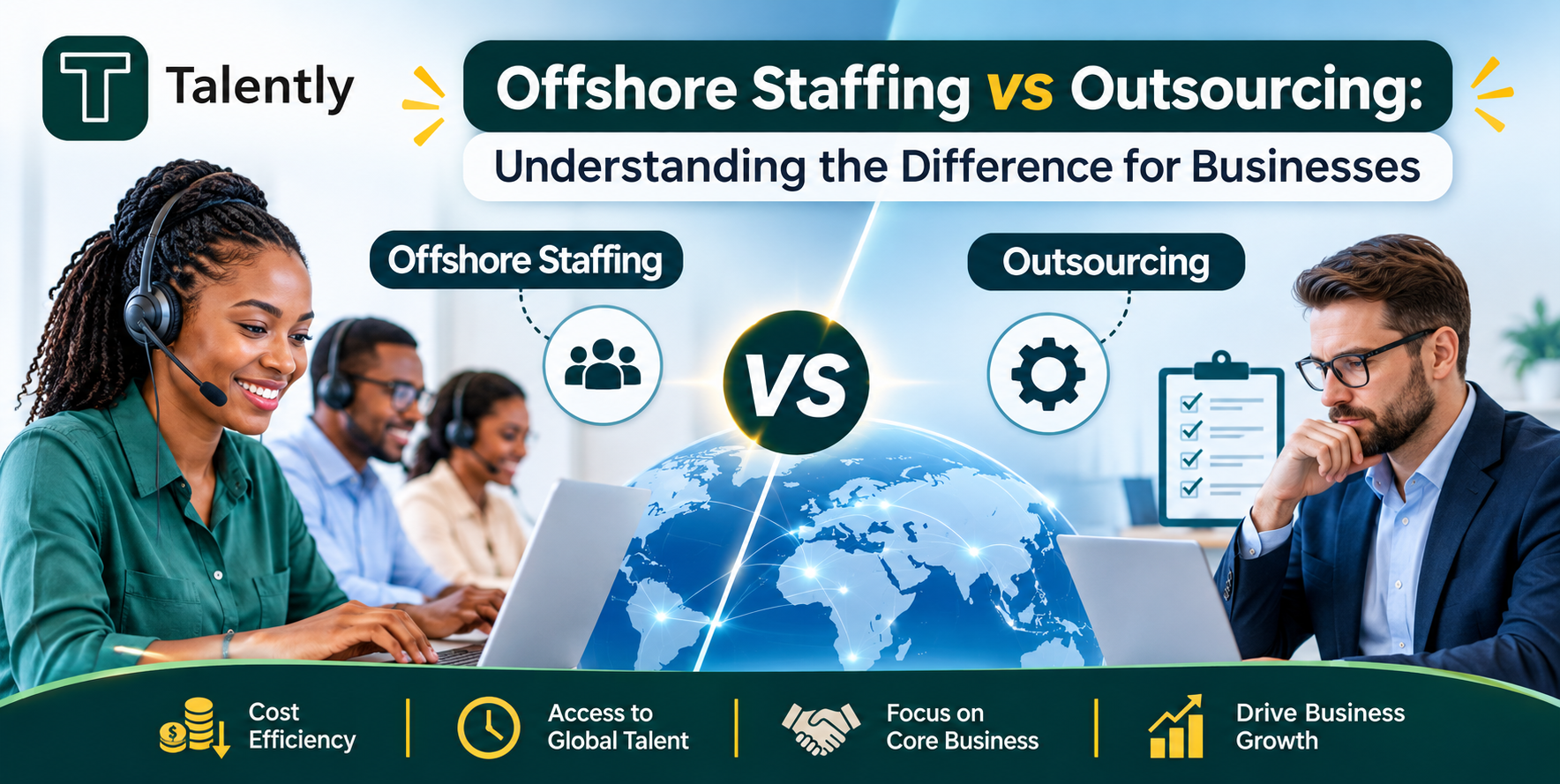
Hiring is becoming a difficult balancing act for growing businesses. You need capable people to handle increasing workloads, but every new employee adds recruitment expenses, salary commitments, training responsibilities, and management overhead.
For companies in the US, UK, and Canada, the challenge is particularly noticeable when local hiring budgets cannot keep pace with operational demands.
That is why many employers begin comparing offshore staffing vs outsourcing. Both approaches can provide access to international talent, but they solve different business problems.
One gives you dedicated professionals who become part of your team. The other allows an external provider to take responsibility for delivering specific services.
Confusing the two can lead to unexpected costs, communication problems, limited operational control, or hiring arrangements that do not support long-term growth.
The important decision is not simply where you can find cheaper labour. It is whether your business needs additional people, an external service provider, or a combination of both.
This guide explains the differences in management, salary, pricing, accountability, and flexibility, including why South African professionals are worth considering when building an international team.
What Is the Difference Between Offshore Staffing and Outsourcing?
Offshore staffing involves hiring dedicated professionals in another country who work within your business operations, while outsourcing involves paying an external provider to manage and deliver specific tasks, projects, or business functions.
The main distinction is who controls the work.
With offshore staffing, your business generally manages the professional’s responsibilities, daily priorities, performance expectations, and collaboration with existing employees.
With outsourcing, the service provider typically decides how to allocate resources and complete the agreed work.
For example, imagine a US-based company needs help managing customer enquiries.
Under an offshore staffing arrangement, the company could hire a dedicated South African customer support professional who uses its internal systems and reports directly to its customer service manager.
Under an outsourcing arrangement, the company could contract a customer support provider to manage incoming enquiries according to agreed service standards.
Both approaches can work. However, the level of involvement, cost structure, and relationship with the people doing the work will differ.
Offshore Staffing vs Outsourcing: Key Differences at a Glance
| Comparison factor | Offshore staffing | Outsourcing |
| Primary purpose | Build or extend your team | Delegate a service or function |
| Workforce | Usually dedicated professionals | Dedicated or shared provider resources |
| Daily management | Primarily your business | Primarily the provider |
| Hiring involvement | Often direct candidate selection | Usually provider-led |
| Pricing | Salary plus recruitment or service costs | Project, hourly, seat-based, or service fees |
| Workflow control | High | Defined by the service agreement |
| Team integration | Usually close | Varies by arrangement |
| Training | Business-specific onboarding | Often provider-managed |
| Knowledge retention | Builds within your team | May remain with the provider |
| Scalability | Add professionals as needed | Expand or reduce contracted services |
| Best suited for | Ongoing roles and team development | Defined deliverables or managed processes |
These are typical characteristics, not fixed rules. Some outsourcing providers supply dedicated teams, while some offshore staffing companies offer additional management services.
The practical question is whether you want to manage people directly or pay someone else to manage the delivery of work.
How Does Offshore Staffing Work?
Offshore staffing allows businesses to recruit professionals based in another country without requiring those professionals to work at the company’s physical office.
Depending on the arrangement, the employer may hire directly or work with a recruitment, staffing, or employment services partner.
A typical offshore staffing process involves four stages.
1. Identify the role your business needs
Start by defining the responsibilities, required experience, working hours, reporting structure, and expected outcomes.
For example, a Canadian business might need a full-time administrative assistant who can manage scheduling, customer communication, and CRM updates.
2. Recruit and evaluate candidates
The business or its hiring partner sources suitable professionals and evaluates their qualifications, communication abilities, and relevant experience.
The employer should have the opportunity to assess candidates before making a hiring decision.
3. Establish the employment arrangement
The parties determine how contracts, compensation, payroll, benefits, taxes, and local employment obligations will be handled.
These responsibilities depend on whether the worker is directly employed, engaged as an independent contractor, or employed through a third party.
4. Integrate the professional into the team
The offshore professional begins working within the company’s systems and processes.
They may attend team meetings, use company software, report to an internal manager, and follow the same performance expectations as local colleagues.
For employers considering this approach, our guide to hiring South African talent provides additional context on recruiting remote professionals.
How Does Traditional Outsourcing Work?
Outsourcing begins with a business identifying a task, project, or function that an external provider can deliver.
Instead of recruiting an individual employee, the company contracts with a service provider.
For example, a UK e-commerce company might outsource its after-hours customer support operation.
The provider may recruit support agents, establish schedules, train employees, monitor performance, and manage day-to-day delivery.
The client typically evaluates performance through agreed metrics such as response times, service quality, resolution rates, or completed transactions.
This arrangement can reduce internal management requirements.
However, it may also mean the client has less influence over individual staffing decisions and how the work is performed.
Outsourcing is particularly useful when responsibilities are clearly defined and the company does not need direct supervision of every person involved.
Offshore Staffing vs Outsourcing Cost: Which Is More Affordable?
Neither offshore staffing nor outsourcing is automatically cheaper.
Offshore staffing can offer better cost visibility for ongoing roles, while outsourcing can be more economical for temporary projects, fluctuating workloads, or functions that require specialised management.
The real cost depends on what the company receives and how much internal support it must provide.
Offshore staffing costs
Typical expenses may include:
- Employee salary or contractor compensation
- Recruitment or placement fees
- Payroll and employment administration
- Statutory benefits and employer contributions, where applicable
- Software, equipment, and onboarding
- Internal management and training
Some staffing providers bundle several of these expenses into a recurring service fee.
The employer should request an itemised quotation rather than assuming the quoted monthly rate represents the professional’s entire compensation.
Outsourcing costs
Outsourcing providers may charge based on:
- Fixed project fees
- Monthly retainers
- Hours worked
- Number of service agents
- Transactions completed
- Performance or output-based pricing
These charges can include the provider’s management, staffing, infrastructure, technology, and profit margin.
Additional charges may apply when the project scope changes or the business requires services outside the original agreement.
Example: Comparing the annual cost
Consider a hypothetical company that needs ongoing administrative support.
| Annual cost component | Offshore staffing | Outsourcing |
| Core staffing or service fee | $24,000 | $30,000 |
| Recruitment and setup | $1,500 | $1,000 |
| Software and onboarding | $1,000 | Included |
| Internal management time | $3,000 | $1,500 |
| Estimated annual total | $29,500 | $32,500 |
Illustrative example only, in USD. These are not Talently prices, verified market averages, or guaranteed savings. Actual costs vary by role, experience, working hours, contract structure, and service requirements.
In this scenario, offshore staffing costs $3,000 less over a year.
However, the financial difference alone does not determine which model is better.
If the company lacks the time or expertise to manage an employee, outsourcing could still provide greater operational value.
Employers should compare the total cost of delivering the same work at the same quality standard.
Our article on local versus offshore hiring costs explores additional expenses to consider.
Offshore Staffing vs Outsourcing Salary: What Do Businesses Actually Pay?
Salary is one of the most misunderstood aspects of international hiring.
When comparing offshore staffing vs outsourcing salary arrangements, employers must distinguish between the worker’s compensation and the total amount charged by a staffing or outsourcing provider.

Offshore staffing salary structure
Under a typical dedicated staffing arrangement, the professional receives agreed compensation based on their role, experience, and employment terms.
The employer may also pay a recruitment fee, ongoing staffing fee, or employment administration charge.
For example, a company hiring a South African virtual assistant should examine the professional’s compensation separately from any recruitment or service fees.
Understanding this distinction makes it easier to evaluate whether the arrangement is sustainable for both the employer and the professional.
Our South African virtual assistant salary guide provides further role-specific information.
Outsourcing pay structure
With traditional outsourcing, the business generally pays the service provider rather than negotiating directly with each worker.
The provider then compensates its employees or contractors according to its own arrangements.
Consequently, the amount paid by the client may not reveal the individual worker’s salary.
Why pay transparency matters
When comparing offshore staffing vs outsourcing pay, employers should ask whether the arrangement provides adequate visibility into compensation, fees, benefits, and contractual obligations.
Lower prices do not necessarily indicate better value.
A sustainable hiring arrangement should support competitive compensation, clear responsibilities, consistent performance, and reasonable employee retention.
Why South Africa Is Worth Considering for Offshore Staffing
For employers in the US, UK, and Canada, South Africa offers an international recruitment option worth evaluating.
It can be particularly relevant for businesses seeking English-speaking professionals in administrative, sales, customer service, marketing, and operational roles.
English-language communication
English is widely used in South African business and professional environments.
This can be helpful for roles involving customer conversations, internal coordination, written communication, and client relationship management.
However, communication ability should still be evaluated individually during recruitment.
Working-hour compatibility
South Africa operates on South African Standard Time, UTC+2, throughout the year.
For UK businesses, this can provide substantial working-day overlap, particularly for roles requiring regular meetings and collaboration.
For North American employers, the overlap is smaller. Businesses may need to arrange agreed shifts or use asynchronous workflows, depending on the role.
Access to a broader talent pool
International recruitment allows companies to consider qualified candidates beyond their immediate geographical area.
This can be valuable when local hiring is slow, recruitment budgets are limited, or the business needs skills that are difficult to source nearby.
Potential hiring cost advantages
Compensation expectations differ across countries, but the actual savings depend on experience, responsibilities, currency movements, benefits, and service fees.
Employers should compare equivalent roles and qualifications rather than relying on broad country-level salary assumptions.
For a wider geographical comparison, explore our article on South Africa versus the Philippines for outsourcing.
When Should a Business Choose Offshore Staffing?
Offshore staffing is often the stronger option when the company needs a consistent person who can learn its operations and contribute over time.
Consider a growing software company that needs someone to manage CRM records, support sales representatives, and coordinate customer onboarding.
These responsibilities may change as the company grows.
A dedicated offshore professional can become familiar with its software, customers, reporting requirements, and internal processes.
The company also retains direct control over priorities and performance.
Offshore staffing is particularly suitable when:
- The workload is consistent and ongoing.
- The role requires familiarity with internal systems.
- The company wants direct involvement in candidate selection.
- A manager is available to provide direction and feedback.
- Long-term knowledge retention matters.
- The business expects responsibilities to evolve.
For companies planning multiple hires, our guide on building a remote team without increasing business costs discusses how to approach workforce expansion.
When Is Outsourcing the Better Choice?
Outsourcing may be more appropriate when a business needs a defined service delivered without managing the people involved.
Imagine a Canadian retailer that experiences a sharp increase in customer enquiries during the holiday season.
Hiring permanent employees for a short-term increase in demand may not make financial sense.
An outsourcing provider could potentially offer temporary support capacity, established processes, and management oversight.
Outsourcing can also be useful for specialist projects where the business does not have the necessary internal expertise.
It is worth considering when:
- Workloads fluctuate significantly.
- The project has a clearly defined scope.
- Internal management capacity is limited.
- The company needs a complete managed service.
- The requirement is temporary.
- Service-level agreements can define acceptable performance.
Businesses should still review contract flexibility, data security, quality assurance, and the provider’s ability to handle unexpected changes.
Expert Insight: The Real Difference Is Operational Ownership
The most useful way to compare offshore staffing and outsourcing is to ask three questions.
Who chooses the people? Who directs their work? Who is accountable when something goes wrong?
These questions reveal more than the advertised hourly rate.
For example, a company that regularly changes sales priorities may benefit from a dedicated offshore sales development representative who joins internal meetings and receives direct coaching.
A company that needs a fixed number of routine transactions processed each month may prefer a managed outsourcing arrangement.
The distinction becomes especially important when employees handle sensitive customer information, represent the brand, or make decisions that affect revenue.
Our recommendation is to define operational ownership before comparing provider quotations.
If a role requires frequent direction, company-specific judgement, and ongoing collaboration, dedicated staffing deserves serious consideration.
If the work is repeatable, measurable, and suitable for external management, outsourcing may be more efficient.
Common Mistakes Businesses Make When Choosing Offshore Staffing or Outsourcing
Choosing the lowest advertised rate
A low hourly rate can look attractive until recruitment fees, management time, training, software, and rework are included.
Better approach: Compare the total annual cost against the expected quality and volume of work.
Assuming every offshore worker is a dedicated employee
Some arrangements provide exclusive professionals. Others use shared resources across multiple clients.
Better approach: Confirm exclusivity, reporting relationships, and working-hour commitments in writing.
Ignoring time-zone requirements
An employee can be highly qualified but still struggle to collaborate if the required working hours are unclear.
Better approach: Establish the necessary overlap and shift expectations before recruitment.
Failing to define performance expectations
Without clear objectives, employers may struggle to evaluate productivity or determine whether the arrangement is successful.
Better approach: Set measurable role-specific indicators and establish a regular feedback process.
Overlooking legal and data responsibilities
Cross-border hiring may involve employment classification, payroll, tax, confidentiality, intellectual property, and data protection considerations.
Better approach: Confirm the contractual arrangement and obtain appropriate legal or employment advice for the relevant jurisdictions.
How to Choose Between Offshore Staffing and Outsourcing
Use the following questions to evaluate your business requirements.
| Business question | Consider offshore staffing if… | Consider outsourcing if… |
| Do you need support every working day? | The role is ongoing | The work is seasonal or variable |
| Do you want to select the individual? | Candidate choice is important | The provider can allocate resources |
| Can you manage the work internally? | You have a suitable manager | You need provider-led supervision |
| Will responsibilities change frequently? | The role needs flexibility | The scope is relatively stable |
| Is company-specific knowledge important? | Long-term familiarity adds value | Work is standardised |
| Do you need a complete service? | You mainly need additional capacity | You want delivery managed externally |
A hybrid approach is also possible.
For example, a company could hire a dedicated South African operations coordinator while outsourcing a separate, specialised IT project.
The two models do not have to compete. They can support different parts of the same business.
How We Help Businesses Explore South African Remote Hiring
At Talently, our focus is helping companies consider remote South African professionals as part of their workforce strategy.
We understand that employers are not simply searching for lower hiring costs.
They need people with the right skills, communication abilities, working-hour availability, and capacity to support existing operations.
Whether you are looking for administrative support, customer service professionals, sales talent, or other remote capabilities, the starting point should be a clear understanding of the role and the business outcomes you expect.
Before committing to an offshore hiring arrangement, we encourage employers to clarify their responsibilities, evaluate candidate suitability, and understand the complete commercial terms.
Our remote employment solutions page is a useful starting point for businesses exploring international hiring options.
Final Verdict: Offshore Staffing or Outsourcing?
The right choice depends on what your business needs to accomplish.
Offshore staffing is often better suited to companies that want dedicated professionals, direct management, stronger team integration, and ongoing workforce capacity.
Outsourcing is often more appropriate when a business wants to delegate a defined service and reduce the responsibility of managing delivery internally.
For US, UK, and Canadian employers interested in expanding their teams, South African professionals may offer a practical option worth exploring.
The objective should not be to find the cheapest arrangement. It should be to establish a hiring model that delivers reliable performance, manageable costs, and sustainable growth.
Looking to expand your team with remote South African professionals?
Explore Talently’s hiring solutions and discuss the roles, skills, and working arrangements your business needs before making your next hiring decision.
Frequently Asked Questions
1. What is the main difference between offshore staffing and outsourcing?
Offshore staffing typically gives businesses dedicated professionals who work under their direction, while outsourcing transfers responsibility for delivering a service or project to an external provider. The biggest difference is management control. Offshore staffing is generally better for ongoing roles, while outsourcing suits clearly defined services and deliverables.
2. Is offshore staffing cheaper than outsourcing?
Offshore staffing can be more economical for ongoing positions because businesses pay for dedicated workforce capacity. Outsourcing may cost less for temporary projects or fluctuating workloads. Actual costs depend on salaries, provider fees, management requirements, training, and service scope. Employers should compare total annual expenses rather than advertised hourly rates.
3. How does offshore staffing vs outsourcing salary differ?
With offshore staffing, a professional’s salary or compensation may be identifiable separately from recruitment and administration fees. With outsourcing, the client generally pays a service charge that includes multiple operating expenses. The worker’s individual salary may not be disclosed. Compensation transparency depends on the provider and contractual arrangement.
4. Why do US and UK companies hire offshore staff from South Africa?
South Africa offers access to English-speaking professionals across several business functions. UK employers may benefit from substantial working-hour overlap, while US companies can arrange suitable shifts for certain roles. Employers also consider international talent availability and potential cost differences, although individual qualifications, schedules, and employment costs require careful evaluation.
5. Can offshore employees work directly with an existing in-house team?
Yes. Offshore professionals can participate in internal meetings, use company software, collaborate with local employees, and report to designated managers. Successful integration requires clear communication, appropriate onboarding, defined responsibilities, and agreed working hours. The precise arrangement depends on the worker’s contract and the offshore staffing model selected.
6. Is offshore staffing better for small businesses and startups?
Offshore staffing can suit small businesses and startups that need consistent support without expanding their local workforce. It is particularly useful when recurring tasks justify a dedicated role and someone can manage the employee. Outsourcing may be preferable when workloads are unpredictable or the business lacks management capacity.
7. What should businesses check before choosing an offshore staffing provider?
Businesses should evaluate candidate screening, compensation transparency, recruitment fees, contractual obligations, payroll arrangements, data security, and replacement policies. They should also confirm who manages performance and how working hours are established. A suitable provider should explain responsibilities clearly and help employers assess whether the arrangement matches their operational requirements.
Ready to build your dream team?
Book a free consultation and get your first candidate shortlist within 48 hours.
No upfront fee • Only pay if you hire