
Hire South African Talent: The Complete Guide to Costs, Roles and Smarter Remote Hiring
 21 min read

Hiring another employee should help your business move forward. Yet for many US and Canadian companies, recruitment has become a difficult balancing act. You need someone experienced enough to take ownership of the work, available during the right hours and affordable enough to justify the investment.
That combination can be hard to find locally.
It explains why more employers are exploring how to hire South African talent for sales, marketing, customer support, administration, finance and operations.
But international hiring raises questions that ordinary recruitment advice rarely answers properly.
- How much will you actually spend once payroll and service fees are included?
- Can employees work your business hours?
- What happens if a candidate has excellent qualifications but struggles with remote communication?
- Who takes responsibility for employment compliance?
Choosing the cheapest candidate is not necessarily the smartest decision.
This guide explains how South African remote hiring works, which roles are suitable, how to evaluate total costs and what to check before making an offer. You’ll also learn how we help businesses find and manage qualified professionals without turning international recruitment into another operational burden.
Key Takeaways
- South Africa offers a hiring market for English-speaking, remote-capable professionals across business functions.
- Employers should compare total employment costs, not salaries alone.
- South African Standard Time is UTC+2, so US working-hour overlap requires deliberate scheduling.
- Recruitment-only and full-service staffing models have different costs and responsibilities.
- Practical skills assessments and structured interviews are more useful than relying solely on qualifications.
- Payroll, worker classification, benefits and data protection should be reviewed before onboarding.
- A well-defined role and clear performance expectations make international hiring more effective.
What Does It Mean to Hire South African Talent?
Hiring South African talent means recruiting professionals based in South Africa to perform work for a business, either remotely or through an international employment arrangement.
A US startup might recruit a sales development representative to manage outbound prospecting. A Canadian ecommerce company might hire a customer support specialist. A marketing agency could bring in an SEO specialist or graphic designer.
The employee remains based in South Africa while collaborating with the overseas company.
There are several ways to arrange this relationship, including direct employment through an established local entity, independent contracting where legally appropriate, or employment through a staffing provider or Employer of Record.
A South African talent agency can help with sourcing and screening, while some providers also manage contracts, payroll and ongoing HR responsibilities.
The right arrangement depends on how much control and administrative responsibility your business wants to retain.
Why Hire South African Talent Instead of Recruiting Locally?
The most compelling reason is not simply that salaries may be lower. It is the opportunity to build additional capacity while maintaining the experience, communication and accountability your business needs.
1. Access a wider professional talent pool
A local recruitment search is limited by geography, salary expectations and candidate availability.
International recruitment opens the door to professionals who may have relevant experience but live outside your immediate hiring market.
South Africa has professionals working across customer service, finance, business development, digital marketing, technology and administrative functions.
That makes it a viable option for companies that want to recruit remote employees without restricting their search to a single city or country.
Our approach is to understand the responsibilities of the position before identifying candidates with the relevant experience.
For employers considering top South African talent, a rigorous selection process matters more than a broad claim about candidate quality.
2. Control costs without automatically sacrificing capability
US companies often face substantial salary, recruitment and employee benefit costs.
Hiring in South Africa can offer savings because compensation levels and labour-market conditions differ between countries.
However, the real question is whether the candidate can perform the required work at a sustainable total cost.
For example, an experienced remote customer support professional may be more valuable than a cheaper candidate who needs extensive supervision.
Businesses researching South African talent cost savings should consider compensation, recruitment fees, benefits, equipment, management time and retention together.
3. Work with English-speaking professionals
English is widely used in South African business environments.
This can be particularly useful for roles involving customer communication, internal reporting, meetings and written correspondence.
However, the phrase South African English accent for remote work should not be treated as a guarantee that every candidate communicates identically.
South Africa has diverse accents, languages and professional backgrounds.
What matters is whether the individual can communicate clearly with your team and customers.
Our recommendation is to evaluate communication through realistic exercises, such as a customer call simulation, written response or presentation.
You can explore the topic further in our guide to South African remote communication skills.
4. Build teams that can work across borders
Businesses increasingly need people who can collaborate through Slack, Microsoft Teams, Google Workspace, Zoom, CRM platforms and project management software.
These tools make cross-border collaboration possible, but software familiarity alone is insufficient.
A strong remote employee must know how to document work, communicate delays, ask useful questions and manage priorities without constant supervision.
These qualities are especially important when building South African talent for remote teams.
Which South African Professionals Can You Hire?
Not every position is equally suitable for offshore recruitment.
Roles with clearly defined responsibilities, measurable outcomes and digital workflows are generally easier to manage remotely.
The following table identifies common hiring opportunities and what employers should evaluate.
| Department | Roles to consider | Essential hiring criteria |
| Sales | SDRs, sales assistants, appointment setters | Prospecting, CRM accuracy, objection handling |
| Administration | Executive assistants, virtual assistants | Organisation, discretion, calendar management |
| Customer experience | Support agents, customer success managers | Communication, empathy, problem resolution |
| Marketing | Social media managers, SEO specialists, paid media specialists | Campaign execution, reporting, platform expertise |
| Finance | Bookkeepers, accounting assistants | Reconciliation, accuracy, accounting software |
| Operations | Operations assistants, managers, project coordinators | Process ownership, reporting, coordination |
| Creative | Graphic designers | Portfolio quality, design execution, feedback handling |
| Specialist support | Data analysts, recruiters, legal assistants | Relevant technical knowledge and confidentiality |
Sales and business development
Businesses looking to hire SDRs in South Africa should assess prospect research, cold outreach, lead qualification and CRM discipline.
For organisations that need help maintaining their pipeline, appointment setters can support meeting scheduling and prospect follow-up.
Meanwhile, sales assistants may handle proposal preparation, pipeline updates and sales administration.
A candidate who can demonstrate accurate CRM management and effective prospect communication is often more useful than someone with a polished CV but limited practical experience.
Executive and administrative assistance
Founders frequently spend too much time managing their inboxes, scheduling meetings and coordinating routine activities.
That makes it worthwhile to hire virtual assistants in South Africa when recurring administrative work is consuming valuable management time.
Companies can also hire executive assistants in South Africa for more complex responsibilities, such as executive scheduling, travel coordination, stakeholder communication and confidential documentation.
The distinction matters. An executive assistant should be evaluated on judgement and discretion, not merely task completion.
Marketing and creative support
A growing marketing department may need execution capacity without hiring a full local team.
Businesses can hire social media managers in South Africa to manage content calendars, publishing, community responses and campaign reporting.
They may also hire paid media specialists in South Africa to support advertising campaigns, or hire SEO specialists in South Africa for search optimisation work.
For design requirements, graphic designers can support campaign assets, presentations and digital content.
When evaluating marketing candidates, request examples of completed work and ask them to explain their decisions.
Customer support and customer success
Businesses that hire customer support in South Africa should prioritise response quality, issue resolution and familiarity with support platforms.
Customer success is different.
When you hire customer success managers in South Africa, the responsibilities may include onboarding customers, monitoring account health, managing renewals and identifying retention risks.
Support teams generally respond to customer problems. Customer success professionals take a more proactive role in helping customers achieve their intended outcomes.
Finance, operations and specialist roles
Companies can hire bookkeepers in South Africa for transaction recording, reconciliations and routine reporting.
They may also hire accounting assistants in South Africa for accounts payable, receivables and financial administration.
Other possibilities include hiring data analysts in South Africa for dashboards and reporting, or hiring recruiters in South Africa for candidate sourcing and interview coordination.
Growing ecommerce businesses may need ecommerce assistants for catalogue management, order administration and customer queries.
Similarly, companies can hire marketing assistants, operations assistants, project coordinators and operations managers in South Africa as responsibilities become more complex.
Specialist roles such as legal assistants should be scoped carefully, particularly when work involves jurisdiction-specific advice or regulated activities.
Expert insight: Before choosing a job title, identify the five recurring outcomes the employee must own. A clear responsibility list makes screening more accurate and helps prevent hiring someone whose experience sounds relevant but does not match the work.
How Much Does It Cost to Hire South African Talent?
The South Africa remote employee cost depends on the position, seniority, working hours, employment arrangement and service provider.
A junior administrative professional and an experienced operations manager will not have the same compensation requirements.
Similarly, recruiting an employee directly differs financially from using a staffing provider that manages payroll and HR administration.
Salary versus total employment cost
Consider a hypothetical business evaluating two hiring options.
| Cost component | US-based employee | South African remote employee |
| Base salary | $65,000/year | $30,000/year |
| Recruitment fees | Varies | Varies |
| Employer obligations | Additional | Additional |
| Equipment and software | Additional | Additional |
| Staffing provider fees | If applicable | If applicable |
| Total cost | Must be calculated | Must be calculated |
Illustrative comparison only. These are hypothetical salaries, not verified market averages or quotes.
The salary difference in this example is $35,000 annually before accounting for additional costs.
That does not mean every employer will achieve the same saving.
A proper South Africa vs US salary comparison should match candidates by role, experience, working hours and responsibilities.
Our guide to US versus South Africa hiring costs provides a more focused comparison.
How our pricing models work
We publish two service models for employers considering South African recruitment.
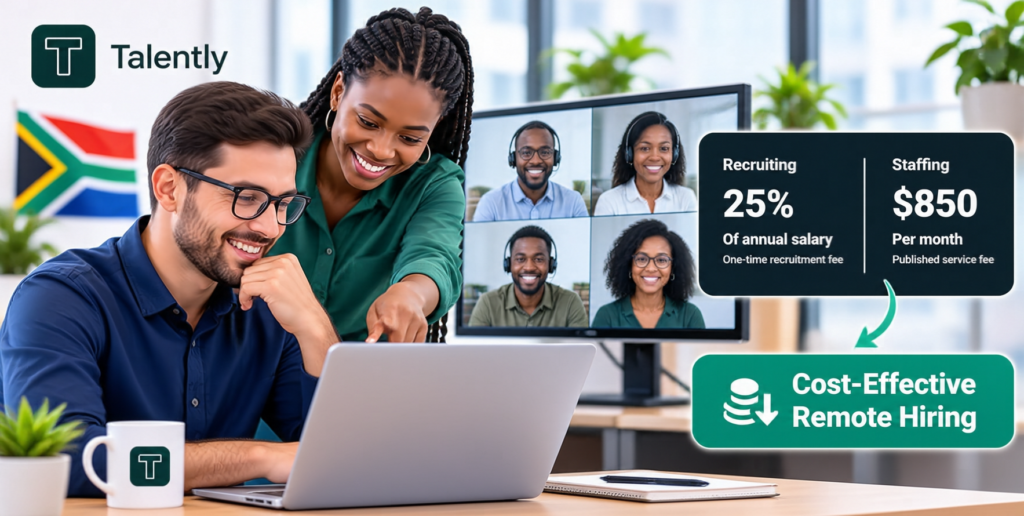
Under recruiting, the client handles contracts, payroll and HR. Under staffing, we provide those administrative services. Candidate compensation and the full commercial scope should be confirmed separately.
The staffing fee should not be mistaken for an employee’s complete monthly compensation.
If you’re evaluating offshore staffing with no upfront fee, review the agreement carefully to understand when payments begin and what services are included.
South African Hiring Models: Which One Should You Choose?
There are three common approaches to international remote hiring.
| Hiring model | Main advantage | Main consideration |
| Direct recruitment | More direct control of the employment relationship | Employer must establish an appropriate legal arrangement |
| Independent contractor | Flexibility for genuinely independent work | Worker misclassification risk |
| Full-service staffing | Recruitment and employment administration support | Ongoing provider fees and contractual terms |
Direct recruitment
This works well for companies with established international employment capabilities.
You can hire directly, provided you have a lawful employment structure and the resources to manage local obligations.
Independent contracting
Contracting may be appropriate for project-based services delivered by a genuinely independent professional.
However, describing someone as a contractor does not automatically make the relationship legally valid.
Actual working conditions, control, economic dependence and the nature of the arrangement matter.
Review our South Africa contractor versus employee resource before selecting this model.
Full-service staffing
A full service offshore staffing South Africa arrangement can reduce the operational work associated with international hiring.
Under our staffing model, we manage employment administration such as contracts, payroll and HR support, while the client directs the employee’s day-to-day responsibilities.
For a growing company without an established South African HR function, this can be a practical alternative to building local infrastructure.
Explore full-service offshore staffing in South Africa for further information.
South Africa Time Zone for US Companies: Will Your Teams Actually Overlap?
Time-zone compatibility is one of the most important operational questions in offshore recruitment.
South Africa operates on South African Standard Time (SAST), which is UTC+2 throughout the year.
Unlike much of the United States and Canada, South Africa does not observe daylight saving time.
That means the time difference changes when North American clocks move forward or backward.
| North American time zone | South Africa ahead by |
| Eastern Time | 6–7 hours |
| Central Time | 7–8 hours |
| Mountain Time | 8–9 hours |
| Pacific Time | 9–10 hours |
For example, a South African employee working 2 PM to 10 PM SAST can overlap with part of a US Eastern business day.
However, the same schedule offers considerably less overlap with a Pacific Time team.
Businesses researching South Africa remote talent time zone overlap should calculate actual working hours before making an offer.
We recommend confirming three things during recruitment: the required live collaboration window, whether the candidate is comfortable with the schedule and how after-hours communication will be handled.
For more detailed planning, see our guide to South Africa time zones for US companies.
South Africa vs Other Offshore Hiring Destinations
Is South Africa the best country to hire remote talent for US startups?
There is no universally correct answer.
The strongest destination depends on the responsibilities of the role, the required working hours, the talent available and the employer’s budget.
South Africa vs Philippines outsourcing
The Philippines has an established outsourcing industry, particularly in customer service and administrative support.
South Africa is another option for English-language business support, sales, marketing and operations.
When comparing these markets, evaluate actual candidate experience, shift requirements, recruitment costs and retention rather than assuming one country is always better.
Our South Africa versus Philippines outsourcing comparison examines this decision more closely.
South Africa vs India remote hiring
India offers a large professional talent market spanning technology, finance, support and business operations.
South Africa may be worth considering for roles requiring particular English-language communication capabilities or specific work-hour arrangements.
However, neither country’s workforce should be judged by broad stereotypes.
Assess candidates using the same practical criteria.
See our guide to South Africa versus India remote hiring.
South Africa vs Latin America remote talent
Latin American countries can offer substantial working-hour overlap with US businesses.
That may make the region attractive for roles requiring continuous live collaboration.
South Africa can still be a suitable choice when candidates are willing to work adjusted hours or when the position allows asynchronous work.
Compare actual salary expectations, relevant skills, employment costs and availability.
Our South Africa versus Latin America talent comparison provides additional context.
Expert insight: Choose the hiring destination after defining the job. Choosing a country first and forcing the role to fit that market can create avoidable recruitment problems.
How to Hire Remote Workers in South Africa: A Practical Process
International recruitment becomes much easier when employers follow a repeatable process.
We recommend seven stages.
Step 1: Define the role and business outcome
Start with the work that needs to be completed.
Instead of writing that you need a virtual assistant, identify the actual responsibilities.
For example, you may need someone to manage executive calendars, coordinate meetings, update a CRM and prepare weekly reports.
Specify required experience, software proficiency, working hours and performance expectations.
This is particularly important for startups that may not have formal job descriptions.
Step 2: Establish a realistic budget
Determine how much you can afford to spend on the complete employment arrangement.
Include salary, benefits, recruitment costs, software, equipment and any ongoing staffing fees.
Avoid choosing candidates solely because their salary expectations are low.
A more experienced employee may reduce management time and improve overall productivity.
Step 3: Choose your hiring arrangement
Decide whether you want to recruit directly, engage an independent contractor or work through a staffing partner.
Consider your internal capacity to manage employment contracts, payroll, tax obligations and HR support.
If your business is still building these capabilities, offshore staffing in South Africa may be worth evaluating.
Step 4: Source and screen candidates
Screening should measure practical competence rather than relying exclusively on CVs.
For a sales role, this might involve a mock prospecting call.
For an operations role, ask candidates to organise a workflow and explain how they would handle a missed deadline.
For an accounting position, use a relevant reconciliation exercise.
Our South African talent vetting checklist can help structure the assessment.
Step 5: Interview shortlisted professionals
Use consistent questions and scoring criteria.
Evaluate technical skills, communication, ownership, availability and problem-solving ability.
For remote positions, ask candidates to explain how they handle unclear instructions, competing priorities and unexpected delays.
We publish a candidate-shortlisting process designed to help employers move quickly from requirements to interviews.
Learn more about how to get a remote candidate shortlist in 48 hours.
The 48-hour timeframe is a published service target, not a guarantee that every specialist role can be filled immediately.
Step 6: Complete contracts and employment setup
Before work begins, establish the appropriate contractual arrangement.
Confirm compensation, working hours, confidentiality, intellectual property ownership, data access and termination procedures.
Payroll and employment obligations should be reviewed against applicable South African requirements.
Step 7: Onboard and manage performance
A successful hire needs more than a signed contract and a software login.
Create a structured onboarding plan, introduce the employee to the team and define how performance will be measured.
Our guide to onboarding South African remote employees covers this stage in greater detail.
Hiring Compliance, Payroll and Employee Benefits
Companies should address employment compliance before making a final hiring decision.
South Africa has employment legislation governing matters such as working conditions, leave, employee protections and certain payroll obligations.
Relevant considerations can include the Basic Conditions of Employment Act, Labour Relations Act, applicable tax rules and the Protection of Personal Information Act.
The precise obligations depend on the employment structure and individual circumstances.
What should a remote hiring compliance checklist include?
A practical remote hiring South Africa compliance checklist should cover:
- Correct employee or contractor classification.
- Written contracts and clearly defined responsibilities.
- Applicable working-hour, leave and employment conditions.
- Payroll withholding and statutory contributions where required.
- Employee benefits and insurance arrangements.
- Confidentiality, data protection and intellectual property provisions.
- Lawful termination procedures and recordkeeping.
For a detailed review, consult our remote hiring compliance checklist for South Africa.
How does payroll work?
South Africa payroll for remote employees depends on the employment arrangement.
For a local employment relationship, payroll administration may involve salary processing in South African rand, relevant tax withholding and applicable statutory contributions.
A staffing provider may administer these responsibilities under its contractual service model.
Our guide to South African remote staff payroll explains the administrative considerations.
Employers should also understand South African remote employee benefits, including applicable leave entitlements and any additional benefits agreed with the employee.
For businesses planning to hire employees in South Africa, compliance should be treated as part of the hiring budget, not an issue to resolve after the employee starts.
How to Manage a South African Remote Team Successfully
Recruiting a capable professional is only the beginning.
Managers must create the conditions for that person to succeed.
Establish clear responsibilities
Every remote employee should understand which tasks they own, what quality looks like and when work is expected.
For example, a customer support representative might be responsible for first-response times, ticket resolution and accurate documentation.
A marketing specialist might be measured against campaign deliverables, reporting quality and deadlines.
Create communication routines
Daily meetings are not necessary for every position.
Some teams benefit from a short daily check-in. Others work better with written updates and weekly reviews.
Choose the approach that supports the work rather than creating unnecessary meetings.
Document important processes
Remote employees should not have to rely on informal conversations to understand recurring tasks.
Provide access to standard operating procedures, training materials, templates and escalation instructions.
Give feedback early
Managers should address misunderstandings before they become recurring problems.
A useful approach is to hold weekly performance discussions during the first month, then adjust the frequency once expectations are established.
Our resource on how to manage a South African remote team provides further guidance.
Common Mistakes Businesses Make When Hiring Offshore
Mistake 1: Hiring based on salary alone
A low salary does not automatically produce a good return on investment.
Better approach: Evaluate experience, task performance, communication and total cost together.
Mistake 2: Assuming every candidate can work US hours
South Africa’s time zone creates scheduling considerations, particularly for Pacific Time employers.
Better approach: Confirm the required schedule before shortlisting candidates.
Mistake 3: Using vague job descriptions
A role described as general business support may attract candidates with very different capabilities.
Better approach: Specify responsibilities, required tools and measurable outcomes.
Mistake 4: Ignoring employment classification
Using a contractor agreement for an arrangement that functions like employment can create legal risk.
Better approach: Review the actual working relationship and obtain appropriate professional advice.
Mistake 5: Failing to plan onboarding
Even an experienced employee needs access to systems, internal context and clear instructions.
Better approach: Create a structured first-month plan with named responsibilities and performance checkpoints.
Mistake 6: Expecting instant results
Some roles require time to understand products, customers and internal processes.
Better approach: Set realistic milestones and evaluate progress over an appropriate period.
Why Work With Talently for South African Remote Hiring?
We help companies access South African professionals without requiring their internal teams to manage every stage of the recruitment process.
Our services are designed for businesses that need support with candidate sourcing, screening and, depending on the selected model, ongoing employment administration.
We work with employers looking for remote professionals in sales, customer support, marketing, administration, finance and operations.
Our website describes a process that begins with a consultation, followed by candidate sourcing, screening, interviews and hiring support.
For clients using our staffing arrangement, we also provide contract, payroll and HR administration services.

We also support employers exploring a South Africa staffing company for startups when they need to expand capacity without establishing a large internal recruitment function.
Whether your organisation needs one employee or several professionals, the first step is to understand the role, budget, working hours and employment requirements.
Is South Africa Right for Your Next Hire?
South Africa deserves consideration when your business needs capable remote professionals and wants to evaluate alternatives to local recruitment.
It may be especially relevant for companies with clearly defined remote responsibilities, flexible collaboration schedules and a need to control staffing costs.
However, successful hiring depends on matching the individual to the role.
The right candidate should have relevant experience, demonstrate the required skills, communicate effectively and understand the expectations of the position.
Our recommendation is to start with one well-defined role, evaluate the candidate carefully and establish a consistent onboarding process before expanding the team.
For businesses still weighing the decision, our guide to why companies hire South African talent offers additional context.
Ready to Build Your Remote Team?
You do not need to commit to a large international hiring programme to explore South African talent.
Start by identifying the position you want to fill, the responsibilities involved and the budget available.
We can help you review your requirements, understand the available recruitment models and begin identifying suitable candidates.
Book a free consultation with our team to discuss your next South African remote hire.
Frequently Asked Questions
1. Is South Africa a good country for offshore staffing?
South Africa can be a strong offshore staffing destination for companies seeking English-speaking professionals in sales, administration, customer support, marketing and operations. Its suitability depends on candidate quality, working-hour requirements, total employment costs and the chosen hiring arrangement. Employers should assess these factors before selecting a recruitment market.
2. How much can US companies save by hiring South African talent?
Potential savings depend on the role, experience level, compensation, benefits and recruitment model. Some employers may achieve substantial savings compared with equivalent US-based hiring, but there is no universal percentage. Calculate the complete annual employment cost, including service fees and management expenses, before estimating the financial benefit.
3. Can South African remote workers work US business hours?
Yes, South African professionals can work schedules that overlap with US business hours when those arrangements are mutually agreed. South Africa is six to seven hours ahead of US Eastern Time and nine to ten hours ahead of Pacific Time. Employers should confirm availability and scheduling expectations before hiring.
4. Do US companies need a South African legal entity to hire employees?
Not necessarily. Depending on the arrangement, companies may hire through a suitable local employment structure or an authorised employment provider. Independent contracting may also be appropriate for genuinely independent work. The correct approach depends on the legal relationship, payroll obligations and applicable employment laws, so professional advice is recommended.
5. What roles are most suitable for South African remote hiring?
Common remote-friendly roles include executive assistants, SDRs, customer support representatives, bookkeepers, social media managers, SEO specialists, recruiters and operations coordinators. Suitability depends on whether the responsibilities can be completed remotely, whether performance is measurable and whether the candidate has the necessary skills, tools and working-hour availability.
6. How long does it take to hire a South African remote employee?
Hiring timelines depend on the position, required experience, candidate availability and interview process. We advertise an average hiring time of approximately two weeks, with candidate shortlisting available sooner for suitable roles. Specialist positions, additional assessments and compliance requirements may extend the timeline, so employers should confirm expectations for each vacancy.
7. How do you choose a reliable South African staffing agency?
Look for transparent pricing, clear employment responsibilities, structured candidate screening and documented payroll and compliance processes. Ask how candidates are evaluated, what happens if a placement is unsuccessful and which services are included after hiring. A reliable provider should explain its responsibilities without promising identical results for every role.
Ready to build your dream team?
Book a free consultation and get your first candidate shortlist within 48 hours.
No upfront fee • Only pay if you hire