
How to Hire English-Speaking Remote Professionals for Customer-Facing Roles
 6 min read
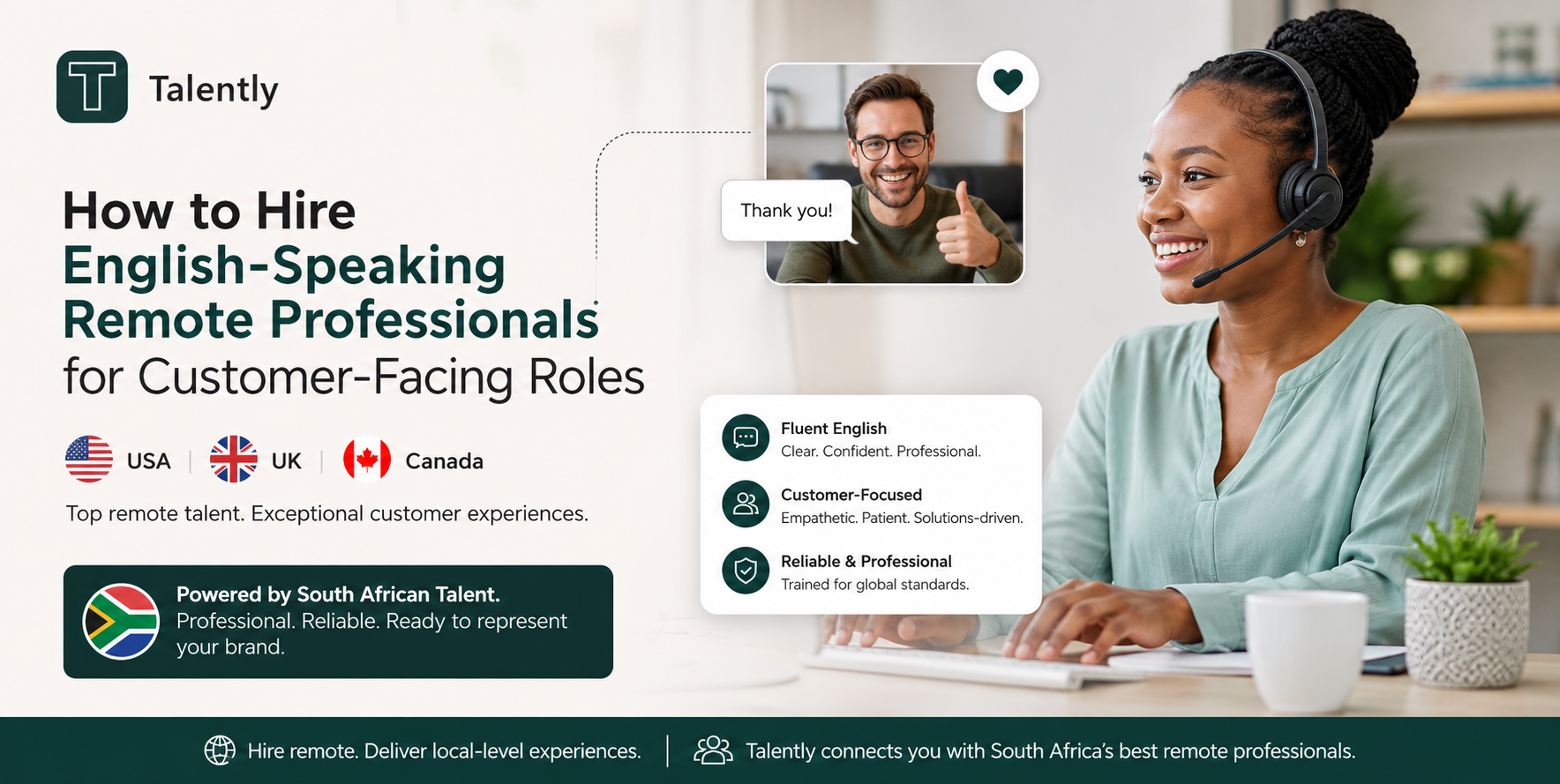
Hiring customer-facing employees has become more challenging than ever. Companies across the US, UK, and Canada are competing for skilled talent while facing rising recruitment costs, longer hiring cycles, and increasing employee turnover.
At the same time, customers expect fast responses, clear communication, and personalized service. One poor interaction can damage trust, while an exceptional experience creates loyal customers.
That’s why many businesses are turning to English-speaking remote professionals, especially highly educated South African talent, to build customer support, sales, and client success teams without compromising quality.
If you’re looking to scale your business while improving customer experience and reducing hiring costs, this guide explains exactly how to do it.
Why English-Speaking Remote Professionals Are in High Demand
English-speaking remote professionals are skilled employees who work remotely while communicating fluently with customers through phone, email, chat, and video calls.
Their value goes beyond language proficiency. Successful customer-facing professionals combine excellent communication, cultural awareness, empathy, and problem-solving skills.
Businesses increasingly hire remote professionals because they provide:
- Lower recruitment and operating costs
- Faster hiring timelines
- Access to specialized global talent
- Flexible workforce scaling
- Better business continuity
For organizations serving English-speaking customers, communication quality directly impacts revenue, retention, and brand reputation.
Why South African Professionals Stand Out
South Africa has become one of the world’s fastest-growing destinations for remote customer-facing talent.
Several factors make South African professionals particularly attractive for businesses in North America and the UK.
| Advantage | Business Benefit |
| Native or near-native English proficiency | Clear customer communication |
| Neutral English accents | Improved customer satisfaction |
| Strong education system | Highly capable professionals |
| Western business culture | Easier collaboration |
| Time zone overlap | Real-time customer support |
| Cost efficiency | Better hiring ROI |
Many professionals already have experience supporting customers from the US, UK, Australia, and Canada, making onboarding significantly easier.
What Roles Can English-Speaking Remote Professionals Fill?
Businesses can hire remote professionals across numerous customer-facing departments.
Customer Support
Ideal for:
- Live chat support
- Email support
- Phone support
- Technical support
- Help desk services
Strong communication skills help resolve issues faster while improving customer satisfaction.
Remote Sales Teams
Remote sales professionals can assist with:
- Outbound prospecting
- Lead qualification
- Appointment setting
- Sales development
- Account management
Well-trained sales representatives often become valuable revenue generators rather than simply reducing hiring costs.
Customer Success
Customer success professionals focus on:
- Client onboarding
- Relationship management
- Product adoption
- Renewals
- Upselling opportunities
Excellent communication creates long-term customer loyalty.
Executive Support
Businesses also hire remote professionals as:
- Executive assistants
- Operations coordinators
- Virtual administrators
- Client coordinators
These roles improve operational efficiency while reducing overhead.
How to Hire English-Speaking Remote Professionals Successfully
Hiring internationally requires more than reviewing resumes.
1. Define Customer Expectations First
Before hiring, identify:
- Communication channels
- Customer demographics
- Working hours
- Required software
- Performance metrics
The clearer your expectations, the better your hiring outcomes.
2. Prioritize Communication Skills
Communication should always outweigh technical skills for customer-facing positions.
Look for professionals who demonstrate:
- Active listening
- Clear verbal communication
- Professional writing
- Emotional intelligence
- Conflict resolution
- Confidence on customer calls
Technical skills can be trained more easily than communication ability.
3. Evaluate Cultural Compatibility
Successful remote teams understand customer expectations.
Interview candidates using realistic scenarios such as:
- Handling an upset customer
- Explaining complex information simply
- Managing difficult conversations
- Responding under pressure
Behavioral interviews often predict future performance better than theoretical questions.
4. Assess Remote Work Readiness
Great remote employees are self-managed.
Look for evidence of:
- Time management
- Accountability
- Reliable internet
- Organized workspace
- Experience using collaboration tools
- Independent problem-solving
Remote success depends heavily on personal discipline.
5. Partner With a Specialized Hiring Provider
Recruiting internationally involves:
- Candidate sourcing
- Screening
- Interviews
- Payroll
- Compliance
- Employment contracts
Working with an experienced provider like Talently simplifies the entire process by connecting businesses in the US, UK, and Canada with highly qualified remote professionals from South Africa.
Why Businesses Choose Remote South African Talent
Hiring globally isn’t only about saving money.
Companies increasingly prioritize value over cost.
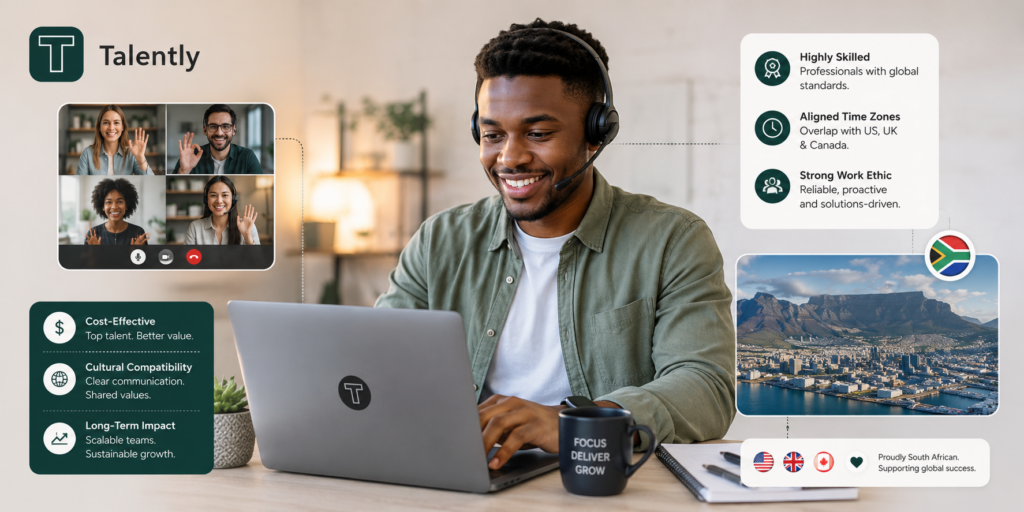
Key advantages include:
- Faster hiring compared to many local markets
- Lower recruitment expenses
- Highly educated professionals
- Excellent customer communication
- High employee retention
- Flexible workforce scaling
For growing businesses, this creates a sustainable hiring strategy without sacrificing service quality.
Expert Insight
“The best customer experience rarely comes from the lowest-cost hire. It comes from hiring professionals who communicate clearly, solve problems confidently, and represent your brand as if it were their own.“
Businesses that combine quality hiring with structured onboarding consistently outperform competitors relying solely on local recruitment.
Common Mistakes When Hiring Remote Customer-Facing Professionals
Avoid these common hiring mistakes:
Hiring based only on cost
The cheapest candidate isn’t always the best long-term investment.
Ignoring communication assessments
A polished resume doesn’t guarantee excellent customer interactions.
Skipping structured onboarding
Even experienced professionals need guidance on your products, systems, and company culture.
Focusing only on technical skills
Customer experience depends more on empathy, professionalism, and communication than technical expertise.
Hiring without compliance support
International employment laws vary. Working with experienced hiring partners reduces legal and payroll risks.
Customer Support Outsourcing vs Building Remote Sales Teams
| Customer Support Outsourcing | Remote Sales Teams |
| Focus on service | Focus on revenue growth |
| Resolves customer issues | Generates qualified leads |
| Improves customer satisfaction | Increases sales pipeline |
| Handles inquiries efficiently | Builds customer relationships |
| Reduces support workload | Expands market reach |
Many organizations successfully combine both strategies using the same global workforce model.
Key Takeaways
- English-speaking remote professionals help businesses improve customer experience while controlling hiring costs.
- South African professionals offer exceptional communication skills, cultural compatibility, and strong business education.
- Hiring success depends on communication ability, not just technical expertise.
- Structured onboarding dramatically improves remote employee performance.
- Partnering with a trusted hiring provider simplifies recruitment, payroll, and compliance.
- Building global teams creates long-term competitive advantages for growing businesses.
Frequently Asked Questions
1. Why are English-speaking remote professionals becoming so popular?
Businesses gain access to skilled global talent, reduce hiring costs, improve scalability, and maintain excellent customer service without geographic limitations.
2. Why do companies hire remote professionals from South Africa?
South African professionals are known for strong English proficiency, excellent communication skills, cultural alignment with Western markets, and cost-effective hiring.
3. Which customer-facing roles work best remotely?
Customer support representatives, sales development representatives, customer success managers, executive assistants, account managers, and virtual administrators all perform effectively in remote environments.
4. How do you evaluate communication skills during hiring?
Use live interviews, role-playing exercises, writing assessments, and customer scenario questions to evaluate real-world communication ability.
5. Is customer support outsourcing better than hiring locally?
For many businesses, outsourcing customer support offers access to specialized talent, lower operating costs, faster hiring, and flexible team growth while maintaining service quality.
6. How long does it typically take to hire remote professionals?
With a specialized recruitment partner, businesses can often hire qualified remote professionals within a few weeks, depending on the role and hiring requirements.
7. What makes Talently different?
Talently helps businesses across the US, UK, and Canada hire carefully vetted South African professionals while managing recruitment, payroll, compliance, and workforce support, allowing companies to build high-performing remote teams with confidence.
Ready to Build Your Customer-Facing Team?
Hiring exceptional English-speaking remote professionals doesn’t have to be slow, expensive, or complicated.
Whether you’re expanding customer support, growing remote sales teams, or improving customer success, Talently connects you with highly qualified South African professionals who communicate confidently, integrate quickly, and deliver measurable business value.
Ready to build your dream team?
Book a free consultation and get your first candidate shortlist within 48 hours.
No upfront fee • Only pay if you hire