
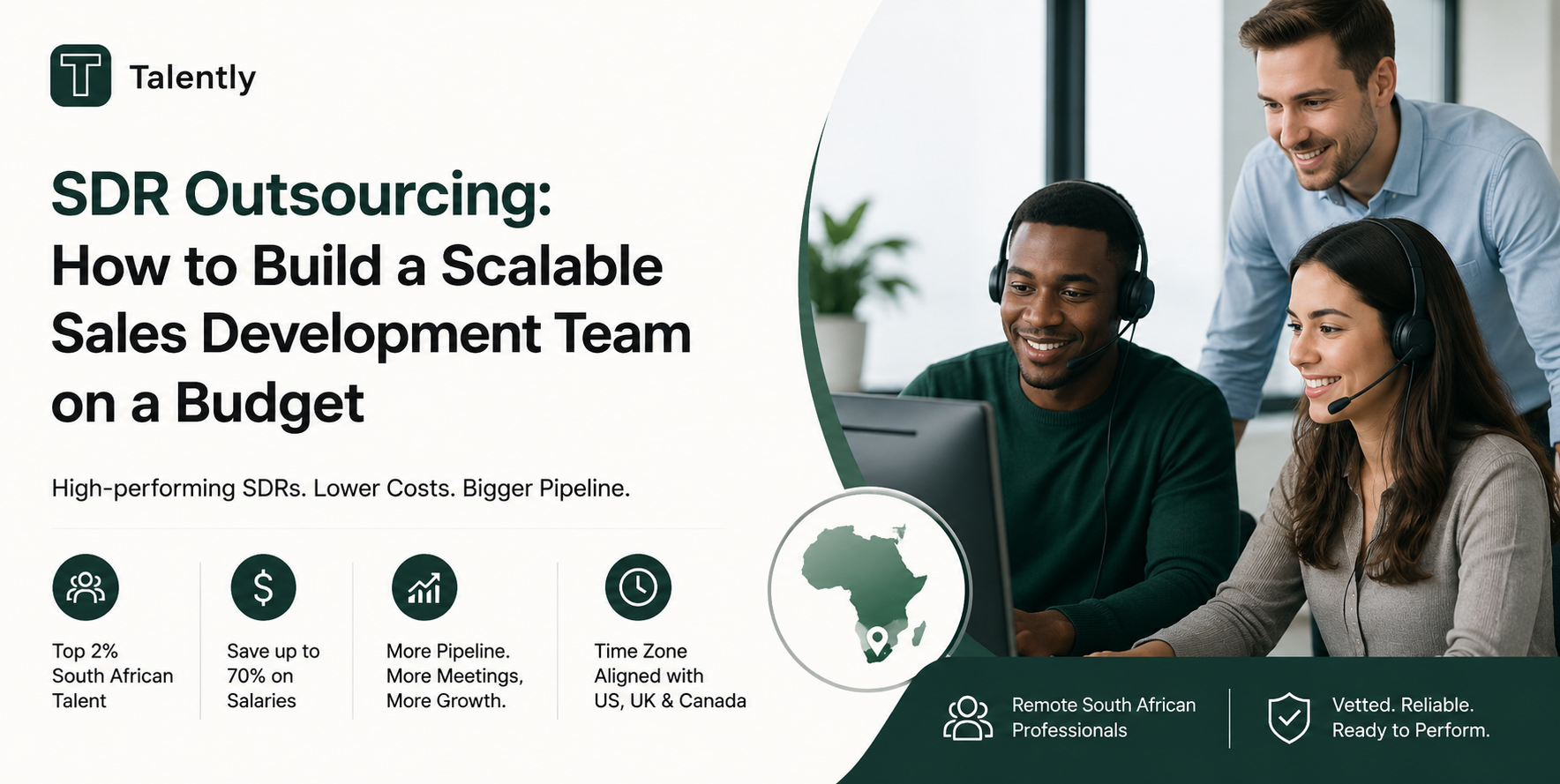
SDR Outsourcing: How to Build a Scalable Sales Development Team on a Budget
 12 min read
If your sales pipeline feels like it’s running on fumes, you’re not alone. Most founders and revenue leaders hit the same wall: they know they need more outbound activity, but hiring a full in-house sales development team locally costs a fortune and takes months.
That’s the exact problem SDR outsourcing was built to solve.
Instead of burning three months and tens of thousands of dollars recruiting a single local sales development rep, growing companies are now building outbound sales teams remotely – faster, leaner, and with far less risk. This guide breaks down exactly how SDR outsourcing works, what it costs, how to do it right, and how to avoid the mistakes that sink most outsourced sales programs before they get off the ground.
Whether you’re a SaaS startup trying to hit your first million in ARR or an established B2B company that needs to reignite sales pipeline growth without ballooning payroll, this is the playbook.
What Is SDR Outsourcing (And Why Is Everyone Talking About It)?
SDR outsourcing means hiring sales development representatives from an external partner – usually in a different country – rather than recruiting, training, and employing them directly in-house.
An outsourced SDR handles the same core responsibilities as an in-house rep: prospecting, cold outreach, lead qualification, and appointment setting. The difference is who employs them, where they’re based, and how much it costs your business to keep them on the team.
Here’s the part most people miss: outsourcing an SDR function isn’t the same as using a call center or a generic lead-gen agency. A well-run SDR outsourcing model gives you a dedicated, trained professional who works inside your CRM, follows your sales process, and reports directly to your sales leadership – just like a full-time hire would.
The only real difference is where they clock in from.
Why Budget-Conscious Companies Are Making the Switch
Sales leaders aren’t outsourcing SDR roles because it’s trendy. They’re doing it because the math simply works better.
Hiring a single US-based SDR now costs companies $55,000–$75,000 a year once you factor in base salary, commission, benefits, payroll tax, software licenses, and management overhead. That’s before you’ve generated a single qualified meeting.
Compare that to remote outsourced talent, and the gap becomes hard to ignore. Companies that build outbound sales teams through offshore or nearshore outsourcing typically report 40–70% lower cost per hire, without sacrificing pipeline output.
How SDR Outsourcing Actually Works
Understanding the mechanics up front will save you from a lot of confusion (and a lot of wasted budget) later.
- You define the role and targets. Ideal customer profile, outreach channels, quota, and CRM access.
- Your outsourcing partner sources and vets candidates. This should include English proficiency testing, sales aptitude assessments, and live interviews – not just a resume scan.
- You interview and select your rep(s). You still get final say on who joins your team.
- Onboarding and integration. The SDR is trained on your product, messaging, and sales stack.
- Ongoing management and reporting. You (or your outsourcing partner) track activity metrics, meetings booked, and pipeline contribution weekly.
This is a fundamentally different model from a lead-gen agency that sells you a batch of “leads” with no visibility into how they were sourced. With outsourced SDRs, you get a team member, not a black box.
SDR Outsourcing vs. Other Sales Growth Models
Not every company should outsource SDRs. Here’s how the model stacks up against the alternatives.
| Model | Typical Cost | Speed to Launch | Control & Visibility | Best For |
| In-house local hire | $55K–$75K/year | 2–4 months | Full | Companies with mature sales ops and big budgets |
| SDR outsourcing (dedicated remote rep) | $18K–$30K/year | 1–3 weeks | High | Startups and SMBs scaling pipeline on a budget |
| Lead-gen agency (pay-per-lead) | Variable, often high per lead | 1–2 weeks | Low | Short-term campaigns, no internal sales infra needed |
| Freelance/contract SDR | $2K–$4K/month | Days | Medium | Very short-term or project-based outreach |
The key takeaway: outsourcing a dedicated SDR gives you agency-level speed with in-house-level control – which is exactly the gap most growing companies need filled.
The Real Advantages of Outsourcing Your SDR Function
1. Dramatically Lower Cost Per Hire
This is the headline benefit, and for good reason. Outsourcing removes the overhead of local payroll taxes, benefits, office space, and recruitment agency fees. Many companies redirect the savings into better tools, more reps, or higher commissions for closers.
2. Faster Time to Pipeline
Traditional SDR hiring – job posting, screening, interviews, offer, notice period – can take two to four months. A vetted outsourcing partner can typically get a qualified SDR working your pipeline within one to three weeks.
3. Access to a Wider, English-Fluent Talent Pool
B2B sales success hinges on communication. Regions like South Africa have become go-to outsourcing hubs precisely because English fluency is high, business culture aligns closely with US, UK, and Canadian norms, and time-zone overlap makes real-time collaboration realistic.
4. Built-In Scalability
Need to go from one SDR to five during a funding round or a big product launch? With an outsourcing model, you can scale up (or down) in weeks rather than restarting an entire local hiring cycle each time.
5. Reduced Management Burden
Reputable outsourcing partners handle sourcing, vetting, compliance, and often ongoing performance support – freeing your sales leadership to focus on strategy and closing, not recruitment logistics.
Why South Africa Has Become a Go-To Hub for Outsourced SDRs
If you’re weighing where to source outsourced sales talent, South Africa deserves serious consideration – and it’s not a coincidence that it keeps coming up in conversations about outbound sales team building.
- Neutral, business-fluent English that reads naturally to US, UK, and Canadian prospects on cold calls and emails.
- Time-zone overlap with both European and North American business hours, enabling live outreach rather than asynchronous, delayed follow-up.
- A mature B2B and SaaS sales culture, with professionals already trained on tools like Salesforce, HubSpot, Outreach, Apollo, and LinkedIn Sales Navigator.
- Strong retention rates, which matters enormously in SDR roles that are notorious for high churn everywhere in the world.
- Significant cost efficiency compared to hiring locally, without the communication or cultural friction that sometimes comes with other offshore regions.
This is exactly the positioning behind Talently’s model: connecting companies in the US, UK, and Canada with vetted, sales-ready professionals who can hire SDRs in South Africa and start contributing to pipeline within days, not months. You can see how the broader case for the region holds up in why South African talent is a competitive advantage for growing teams.
How to Build a Scalable Sales Development Team Without Blowing the Budget
Here’s a practical, step-by-step approach that works whether you’re hiring your first outsourced SDR or your tenth.

Step 1: Nail Your Ideal Customer Profile Before You Hire Anyone
No SDR, in-house or outsourced, can generate quality pipeline against a vague target market. Document your ICP, buying triggers, and disqualifiers before onboarding begins.
Step 2: Choose a Partner That Vets for Sales Skill, Not Just Language
Anyone can screen for English proficiency. Fewer partners actually test for cold-call confidence, objection handling, and coachability. Ask your outsourcing partner exactly how their talent vetting checklist works before signing anything.
Step 3: Start With One Rep, Prove the Model, Then Scale
Resist the urge to hire five SDRs on day one. Bring on one dedicated rep, give them 60–90 days to ramp, measure activity and meeting quality, then expand your outbound sales team based on real data.
Step 4: Give Them Real Sales Enablement, Not Just a Script
The best outsourced SDRs still need messaging frameworks, call recordings to learn from, and a clear escalation path to account executives. Treat onboarding the same way you would for an in-house hire.
Step 5: Track the Metrics That Actually Matter
Activity volume (calls, emails, LinkedIn touches) is a leading indicator. Meetings booked, meeting show-rate, and sales pipeline growth generated from those meetings are the numbers that prove ROI.
Step 6: Build in Feedback Loops From Day One
Weekly check-ins, call reviews, and pipeline reporting keep outsourced reps accountable and improving – the same discipline you’d apply to any internal hire.
Common Mistakes Companies Make With SDR Outsourcing
Even a great outsourcing model can fail if it’s implemented poorly. Watch out for these:
- Treating outsourced SDRs like a lead-gen vendor instead of a team member. This kills accountability and messaging consistency.
- Skipping proper onboarding because “they’re not full-time employees anyway.” Ramp time still matters.
- Hiring on price alone. The cheapest option is rarely the one that protects your brand voice on cold calls.
- No clear handoff process to account executives. Great appointment setting is wasted if meetings die in a broken handoff.
- Ignoring compliance and payroll structure. Work with a partner who understands cross-border employment, not just recruitment.
- Setting unrealistic ramp expectations. Even strong SDRs typically need 4–8 weeks to hit full productivity in a new market or product.
Expert Insight: What Separates High-Performing Outsourced SDR Teams
The companies that get the most out of SDR outsourcing treat their outsourced reps exactly like internal hires – same onboarding rigor, same coaching cadence, same access to product and sales leadership.
The single biggest predictor of success isn’t where the SDR is located – it’s whether the company invests the same structure and coaching it would for a local hire. Skip that step, and even the most talented remote rep will underperform. Invest in it, and geography stops mattering almost entirely.
This is also why the debate often shifts from “should we outsource” to “how do we structure it correctly.” Reviewing an employer of record vs. direct hiring comparison can help clarify which employment structure fits your risk tolerance and growth plans.
SDR Outsourcing Pricing: What Should You Actually Expect to Pay?
Pricing varies based on experience level, industry complexity, and whether the rep is dedicated full-time or shared across accounts. As a general benchmark for a dedicated, full-time outsourced SDR from a region like South Africa:
- Entry-level SDR: roughly $1,500–$2,200/month
- Mid-level SDR with SaaS or B2B experience: roughly $2,200–$3,200/month
- Senior SDR/BDR with team-lead potential: roughly $3,200–$4,500/month
That’s a fraction of the fully loaded cost of a local hire – and it’s why so many companies use outsourcing as their first move when building a remote team without increasing overhead. For an exact, tailored quote based on your industry and volume needs, check current Talently pricing directly.
Real Results: What SDR Outsourcing Looks Like in Practice
Numbers convince skeptics faster than promises do. One SaaS company working with outsourced South African BDRs saw a 40% increase in booked meetings within their first full quarter – a result documented in this case study on SA BDR performance.
That kind of lift isn’t unusual when outsourced reps are properly onboarded and managed. It’s a direct product of consistent outbound activity paired with lower cost per rep – which means more reps, more touches, and more pipeline for the same budget.
Is SDR Outsourcing Right for Your Business?
SDR outsourcing tends to be the right call when:
- You need to grow pipeline but can’t justify a $70K+ local hire yet
- Your sales process is documented enough to train a remote rep on
- You want to test a new market or vertical before committing to permanent local headcount
- You’re scaling fast and need to add reps in weeks, not months
It may be the wrong fit – at least for now – if:
- Your sales process changes weekly and hasn’t stabilized
- You need someone physically on-site for in-person selling
- You don’t yet have basic CRM and outreach tooling in place
If you fall into the first group, the fastest next step is comparing structured options like SDR outsourcing in South Africa against outsourcing to the Philippines or other regions to find the best fit for your target market and time zone.
Key Takeaways
- SDR outsourcing lets companies build outbound sales capacity at 40–70% lower cost than local hiring.
- The best outsourcing partners vet for sales skill and English fluency – not just resumes.
- South Africa has become a leading hub thanks to time-zone overlap, English proficiency, and strong retention.
- Treating outsourced SDRs like real team members – with proper onboarding and coaching – is the biggest driver of success.
- Start with one rep, prove pipeline impact, then scale your outbound sales team based on real data.
Frequently Asked Questions
1. What does SDR outsourcing actually mean?
SDR outsourcing means hiring a sales development representative through an external partner, often based in another country, instead of recruiting and employing one locally. The rep still handles prospecting, qualification, and appointment setting for your business.
2. How much does it cost to outsource an SDR?
Dedicated outsourced SDRs typically cost between $1,500 and $4,500 per month depending on experience level, compared to $55,000–$75,000 per year for a fully loaded local hire.
3. Is outsourced SDR work as effective as an in-house sales team?
Yes, when the outsourced rep receives proper onboarding, sales enablement, and coaching. Performance gaps usually come from poor onboarding, not the outsourcing model itself.
4. Why do companies outsource SDRs to South Africa specifically?
South Africa offers strong English fluency, time-zone overlap with US, UK, and European business hours, and a mature B2B sales culture – making communication and collaboration feel close to local hiring.
5. How long does it take to onboard an outsourced SDR?
Most companies can have a vetted, dedicated SDR working active outreach within one to three weeks, followed by a 4–8 week ramp period to reach full productivity.
6. Can outsourced SDRs work inside my existing CRM and sales tools?
Yes. Most professional outsourced SDRs already have experience with platforms like Salesforce, HubSpot, Outreach, Apollo, and LinkedIn Sales Navigator, so they can integrate into your existing workflow quickly.
7. What’s the difference between SDR outsourcing and a lead-gen agency?
An outsourced SDR functions as a dedicated team member working your process and CRM daily, while a lead-gen agency typically sells you a batch of leads with far less visibility, control, or brand consistency.
Ready to Build Your Outsourced Sales Development Team?
Talently connects US, UK, and Canadian businesses with vetted, sales-ready SDR talent from South Africa – ready to start generating qualified pipeline within days.
Ready to build your dream team?
Book a free consultation and get your first candidate shortlist within 48 hours.
No upfront fee • Only pay if you hire